Explore 10 digital marketing channels every business should know, with beginner-friendly examples, benefits, tools, and tips to choose the right mix.
Digital Marketing Channels: 10 Types Every Business Should Know
Imagine running a business with a useful product, competitive pricing, and a well-designed website. People who need your product are already searching online, watching videos, checking social media, and comparing different brands. Yet, your business may struggle to attract customers because it is not reaching them in the right places.
This is where digital marketing channels become important.
Digital marketing channels are the online platforms, methods, and communication routes businesses use to reach potential customers, promote products or services, build relationships, and generate sales.
These channels include search engines, social media platforms, email, websites, online advertisements, and video-sharing platforms. Each serves a different purpose. Some help people discover a business, while others educate potential customers, generate leads, or encourage repeat purchases.
For example, a small online clothing store might use search engine optimization (SEO) to attract people searching for clothing ideas, Instagram to showcase new collections, email marketing to announce offers, and paid advertising to reach a specific audience.
The objective is not to use every available platform. It is to choose the channels that best match your audience, business goals, resources, and customer journey.
In this guide, you will learn about 10 important digital marketing channels, how they work, their benefits and limitations, and how to choose the right mix for your business.
What Are Digital Marketing Channels?
Digital marketing channels are the online methods businesses use to communicate with audiences and move potential customers toward a desired action.
That action might be visiting a website, subscribing to a newsletter, requesting a quotation, booking an appointment, downloading a resource, or purchasing a product.
A digital marketing channel is different from a marketing tactic.
- Channel: Search engines.
- Tactic: Publishing useful articles and improving website pages to attract organic search traffic.
- Channel: Email.
- Tactic: Sending a welcome email series to new subscribers.
- Channel: Social media.
- Tactic: Publishing short educational videos and responding to comments.
Understanding this distinction helps businesses create a marketing plan instead of posting content or running advertisements without a clear objective.
Why Do Digital Marketing Channels Matter?
Customers rarely follow a single, predictable path before buying something. One person may discover a product through a social media video, research it on Google, read reviews, and purchase it several days later.
Another customer may find a business through a recommendation, visit its website, and subscribe to its email newsletter before making a purchase.
Using suitable digital marketing channels helps businesses:
- Increase visibility: Reach people who may not know the brand exists.
- Attract relevant visitors: Connect with audiences interested in particular products, services, or topics.
- Generate leads: Encourage prospects to request information or share their contact details.
- Build trust: Provide useful information, demonstrations, customer support, and proof of expertise.
- Improve customer retention: Keep existing customers informed and engaged.
- Measure performance: Track traffic, enquiries, purchases, and other meaningful actions.
However, no channel guarantees sales or business growth. Results depend on factors such as audience fit, competition, content quality, budget, product value, and execution.
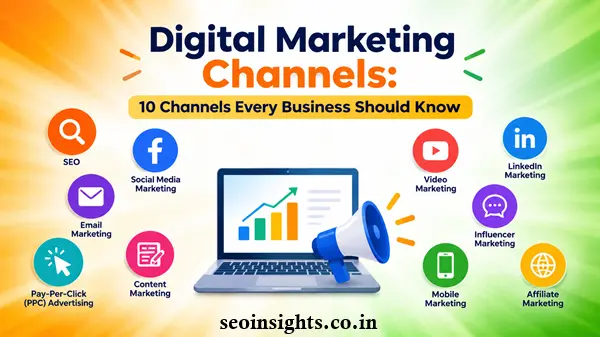
10 Digital Marketing Channels Every Business Should Know
Here are 10 major online marketing channels, including how each works, its main advantages, its limitations, and examples of when to use it.
1. Search Engine Optimization (SEO)
Search engine optimization is the process of improving a website and its content so search engines can understand the pages and users can discover relevant information through unpaid search results.
SEO is especially valuable when potential customers actively search for information, solutions, products, or services.
For example, a digital marketing agency might create useful pages targeting searches such as “SEO services for small businesses” or “how to improve website visibility.”
If the pages satisfy users’ needs and perform well in search, they may attract relevant visitors over time.
How SEO Works
SEO involves several related activities:
- Keyword and audience research: Understand what your potential customers search for.
- On-page SEO: Create descriptive titles, useful headings, relevant content, and clear internal links.
- Technical SEO: Help search engines crawl, render, and index important pages.
- Content development: Answer real questions with accurate, original, helpful information.
- Website experience: Make pages accessible, usable, mobile-friendly, and reasonably fast.
- Authority and reputation: Earn relevant references and links by publishing valuable resources and building genuine relationships.
Google’s official SEO Starter Guide provides guidance on making website content easier for search engines to discover and understand.
Benefits of SEO
- Can attract relevant traffic without paying for every click.
- Helps people discover a business while researching their needs.
- Supports long-term content and brand visibility.
- Can generate visitors well beyond a company’s immediate geographic area.
Limitations of SEO
SEO takes time and ongoing effort. Rankings are not guaranteed, and competitors may target the same searches. Search engines can also change how they display and rank results.
Practical Example
A bakery that offers custom birthday cakes could publish pages explaining cake designs, flavours, ordering deadlines, and delivery areas. Local SEO can help people searching for custom cakes in its service area discover the business.
Best for: Businesses seeking relevant search traffic, long-term visibility, and customers who actively research solutions.
2. Content Marketing
Content marketing involves creating and distributing useful material to attract an audience, answer questions, build trust, and support business goals.
Content can include blog articles, guides, case studies, checklists, newsletters, videos, podcasts, research reports, and downloadable resources.
Unlike direct advertising, which often promotes an offer immediately, content marketing frequently starts by helping people understand a problem or make a better decision.
How Content Marketing Works
A business identifies the questions and challenges its audience faces, then develops content that addresses them.
For example, a company selling accounting software could publish:
- A guide to preparing a business budget.
- A checklist for organising financial records.
- A comparison of manual bookkeeping and accounting software.
- A case study showing how a customer improved its invoicing process.
Each resource serves a different purpose. A beginner’s guide builds awareness, a comparison helps people evaluate options, and a relevant case study can support a purchase decision.
Content marketing also works alongside SEO, email, and social media. A useful article can attract search visitors, provide material for social posts, and offer information to newsletter subscribers.
Benefits of Content Marketing
- Educates potential customers before they buy.
- Demonstrates expertise and helps establish credibility.
- Supports SEO and other marketing channels.
- Gives sales teams helpful resources to share with prospects.
Limitations of Content Marketing
Creating useful content requires research, planning, editing, and distribution. Publishing frequently without meeting audience needs does not guarantee results.
Google recommends creating helpful, reliable, people-first content rather than producing material primarily to manipulate search rankings.
Best for: Businesses that need to explain complex products, answer customer questions, or build trust over time.
3. Social Media Marketing
Social media marketing uses social platforms to publish content, communicate with audiences, increase brand awareness, build communities, and support business objectives.
Depending on the audience, relevant platforms may include Instagram, Facebook, LinkedIn, TikTok, Pinterest, YouTube, or other regional and industry-specific networks.
The best platform depends on where potential customers spend their time and what kind of content helps them make decisions.
How Social Media Marketing Works
Businesses use different formats to reach and engage their audiences:
- Short videos demonstrating products or answering questions.
- Educational posts explaining common problems.
- Customer stories and behind-the-scenes content.
- Polls, discussions, and interactive posts.
- Product announcements and event updates.
- Customer support through comments and direct messages.
For example, a fitness equipment business could post short demonstrations showing how to use its products safely. A B2B software company might use LinkedIn to share industry insights and practical product tutorials.
Benefits of Social Media Marketing
- Helps businesses communicate directly with audiences.
- Supports product discovery and brand recognition.
- Provides opportunities for community building.
- Allows businesses to test content ideas and learn from audience feedback.
Limitations of Social Media Marketing
Organic reach varies by platform, audience, and content. Maintaining an active presence takes time, and a large follower count does not necessarily translate into revenue.
Businesses also depend partly on platforms they do not control, so they should maintain a website and other appropriate customer communication channels.
Best for: Businesses that benefit from visual storytelling, community interaction, customer education, and regular engagement.
4. Pay-Per-Click (PPC) Advertising
Pay-per-click advertising is a digital advertising model in which advertisers generally pay when someone clicks their advertisement. PPC is commonly associated with search advertising, although the term is also used for other click-based advertising campaigns.
Platforms such as Google Ads and Microsoft Advertising allow eligible businesses to advertise to people searching for particular products, services, or information.
PPC can also include campaigns designed to reach audiences across participating websites and other digital placements.
How PPC Advertising Works
A business selects an advertising objective, defines its audience or targeting criteria, creates advertisements, chooses a budget, and directs visitors to a relevant landing page.
For search campaigns, advertisers may bid to show ads for relevant search queries. Actual placement and cost depend on factors such as the auction, competition, relevance, and platform-specific systems.
For example, a plumbing business could advertise for searches related to emergency plumbing services in its service area. Someone who clicks the ad could reach a page with service details, operating hours, and a clear phone number.
Benefits of PPC
- Can generate traffic soon after a campaign becomes eligible to serve.
- Provides control over campaign budgets and targeting settings.
- Helps test offers, landing pages, and customer demand.
- Offers performance data for campaign optimisation.
Limitations of PPC
Traffic usually declines when advertising stops unless other channels continue to attract visitors. Competitive keywords can be expensive, and poorly configured campaigns can spend money without producing valuable leads or sales.
Best for: Businesses that need targeted traffic, have a defined offer, and can measure the value of enquiries or purchases.
5. Email Marketing
Email marketing involves sending relevant messages to people who have provided an appropriate basis for receiving them, such as subscribers or existing customers.
It is useful for maintaining customer relationships, sharing educational content, announcing offers, nurturing leads, and encouraging repeat purchases.
Unlike a social media audience, an email subscriber list is managed by the business, although email delivery still depends on providers, user preferences, and applicable rules.
How Email Marketing Works
A typical email marketing process includes:
- Collect email addresses through a clear, appropriate signup process.
- Explain what subscribers can expect to receive.
- Group subscribers by relevant interests or customer needs.
- Send useful, relevant messages at a reasonable frequency.
- Measure engagement and business outcomes.
- Respect unsubscribes and applicable privacy and marketing requirements.
For example, an online store could send a welcome email to new subscribers, product care advice to recent buyers, and an announcement about a new collection to subscribers interested in that category.
Automation can deliver messages based on events such as signup or purchase, provided the setup complies with relevant consent and privacy requirements.
Benefits of Email Marketing
- Supports ongoing customer relationships.
- Allows messages to be tailored to different audience segments.
- Can encourage repeat purchases and customer retention.
- Makes it possible to test subject lines, content, and calls to action.
Limitations of Email Marketing
Messages may be ignored, filtered into spam, or delivered unsuccessfully. A large subscriber list is not necessarily valuable if subscribers are uninterested or the messages are irrelevant.
Best for: Businesses with an appropriate subscriber base that want to nurture leads, share updates, and retain customers.
6. Video Marketing
Video marketing uses video to explain products, demonstrate services, educate audiences, tell brand stories, and answer customer questions.
Videos can be published on YouTube, social media platforms, company websites, landing pages, and other relevant digital channels.
Video is particularly useful when people need to see how something works before making a decision.
How Video Marketing Works
A business identifies a customer question or marketing objective, chooses a suitable format, produces a clear video, and distributes it where the intended audience is likely to find it.
Useful formats include:
- Product demonstrations.
- Step-by-step tutorials.
- Customer interviews and case studies.
- Short educational videos.
- Webinars and recorded presentations.
- Frequently asked question videos.
For example, a software company could publish a tutorial demonstrating how to create a report using its application. A prospective customer can evaluate the workflow before requesting a demonstration.
Benefits of Video Marketing
- Demonstrates products and processes visually.
- Helps explain ideas that may be difficult to communicate through text alone.
- Can be reused across several marketing channels.
- Creates opportunities for audience engagement.
Limitations of Video Marketing
Production, editing, scripting, and distribution require resources. A polished video is not automatically effective; its usefulness, clarity, relevance, and reach matter more than production complexity alone.
Best for: Businesses with products or services that benefit from demonstrations, visual explanations, or storytelling.
7. Affiliate Marketing
Affiliate marketing is a performance-based arrangement in which a business rewards an affiliate for qualifying actions generated through the affiliate’s promotional efforts.
Depending on the agreement, the action might be a completed sale, a qualified lead, or another defined outcome.
Affiliates may include publishers, bloggers, creators, comparison websites, and other partners whose audiences match the business’s target market.
How Affiliate Marketing Works
A merchant establishes an affiliate programme, defines its commission structure and conditions, and provides approved promotional links or tracking methods.
An affiliate then recommends the product to a relevant audience. If a qualifying action occurs and is properly attributed under the programme’s rules, the affiliate may receive a commission.
For example, a website that publishes software tutorials might recommend a project management application. Readers who visit the merchant through a tracked link may generate commissions if they make an eligible purchase.
Benefits of Affiliate Marketing
- Expands reach through relevant third-party audiences.
- Can align partner compensation with defined outcomes.
- Creates opportunities to work with specialised publishers.
- May complement content marketing and influencer campaigns.
Limitations of Affiliate Marketing
Businesses must recruit and support suitable partners, monitor tracking, establish clear programme rules, and protect against fraudulent or low-quality referrals.
Affiliate relationships also require appropriate disclosures. Applicable advertising and consumer-protection rules vary by market; the US Federal Trade Commission provides guidance on endorsements and material connections.
Best for: Businesses with products that can be recommended through trusted publishers, creators, or industry partners.
8. Influencer Marketing
Influencer marketing involves collaborating with content creators who have an audience and can introduce a brand, product, or service to that audience.
Influencers may operate on Instagram, YouTube, TikTok, blogs, podcasts, or other platforms. Their value depends on factors such as audience relevance, credibility, content quality, and the ability to communicate a product’s benefits.
A creator with a smaller, highly relevant audience may be more suitable for a specialist product than a celebrity whose followers have little interest in the category.
How Influencer Marketing Works
A business defines the campaign objective, identifies suitable creators, agrees on deliverables and compensation, and establishes how results will be measured.
Potential collaborations include:
- Product demonstrations and reviews.
- Sponsored educational videos.
- Tutorials featuring a product.
- Event coverage.
- Campaign-specific discount codes.
- Long-term brand partnerships.
For example, a company selling sustainable home products could work with a home organisation creator who regularly shares practical advice with an audience interested in reducing household waste.
Benefits of Influencer Marketing
- Introduces products to relevant audiences.
- Provides product demonstrations in a creator’s established content style.
- Can support brand awareness and product discovery.
- May generate reusable content when the agreement allows it.
Limitations of Influencer Marketing
Follower counts can be misleading. Fake engagement, audience mismatch, unclear deliverables, and weak measurement can reduce campaign value.
Businesses should agree on disclosure requirements, usage rights, payment terms, and performance measures before publication. Paid partnerships should be disclosed clearly where required by applicable law and platform rules.
Best for: Brands whose customers discover products through trusted creators, recommendations, demonstrations, and specialist communities.
9. Mobile Marketing
Mobile marketing reaches customers through mobile devices and experiences designed for them. It includes mobile-friendly websites, app-based marketing, SMS messages, and push notifications.
Mobile marketing is not limited to sending text messages. It also includes making sure that the website, forms, checkout, advertisements, and other digital experiences work well on smaller screens.
How Mobile Marketing Works
A business selects methods that match its audience and customer journey.
Examples include:
- Sending an appointment reminder by SMS where permitted.
- Using push notifications to inform app users about relevant updates.
- Providing a simple mobile checkout experience.
- Displaying location-specific information when users have provided the necessary permissions.
- Offering a mobile-friendly booking form.
For example, a dental clinic could provide a mobile-friendly appointment page and send appropriate booking reminders to patients who have agreed to receive them.
Benefits of Mobile Marketing
- Supports communication while customers use mobile devices.
- Can make booking, purchasing, and customer service more convenient.
- Helps businesses reach app users through relevant notifications.
- Supports location-related services where appropriate permissions and accurate data are available.
Limitations of Mobile Marketing
Excessive messages can frustrate users and encourage them to unsubscribe or disable notifications. Businesses must also consider privacy, permissions, local regulations, and the risk of collecting more personal data than necessary.
Best for: Businesses with mobile-oriented audiences, appointment-based services, apps, local offers, or repeat customer interactions.
10. Online Public Relations (Digital PR)
Digital public relations, or digital PR, focuses on building a business’s online reputation and visibility through media coverage, expert commentary, relevant publications, industry communities, and other credible online sources.
It differs from paid advertising because the primary aim is often to earn attention and recognition through newsworthy information or genuine relationships rather than purchasing ad placements.
How Digital PR Works
A business identifies something worth sharing, develops a useful story or resource, and connects with relevant journalists, editors, publishers, or industry organisations.
Possible activities include:
- Sharing original research or survey findings.
- Providing expert commentary on industry developments.
- Publishing a useful report or resource.
- Announcing a meaningful business development.
- Participating in relevant podcasts or industry interviews.
For example, a cybersecurity company could publish a practical report on common security mistakes made by small businesses and offer expert commentary to relevant technology publications.
A strong resource may attract coverage, referral traffic, brand recognition, and editorial links. However, coverage is not guaranteed, and links should be earned through legitimate activity rather than manipulated.
Benefits of Digital PR
- Builds awareness beyond a business’s existing audience.
- Can strengthen reputation through credible third-party coverage.
- May generate referral traffic and relevant editorial links.
- Creates opportunities to demonstrate expertise.
Limitations of Digital PR
Media outreach can take time, and journalists decide independently whether a story deserves coverage. Businesses cannot control every mention, link, or publication outcome.
Best for: Businesses with useful expertise, original insights, newsworthy developments, or resources that relevant publications may want to discuss.
How to Choose the Best Digital Marketing Channels for Your Business
Knowing the available channels is only the beginning. The next step is deciding which ones deserve your time and budget.
The best digital marketing channels depend on your audience, objectives, buying process, resources, and the kind of product or service you offer.
1. Define Your Business Goal
Start by identifying what you want marketing to achieve.
| Business goal | Channels worth considering |
| Increase organic website traffic | SEO and content marketing |
| Generate enquiries quickly | PPC and relevant landing pages |
| Build brand awareness | Social media, video, and digital PR |
| Nurture potential customers | Email marketing and content |
| Encourage repeat purchases | Email and mobile marketing |
| Reach a specialised audience | Affiliate and influencer marketing |
| Build online reputation | Digital PR, useful content, and social media |
These are starting points, not fixed rules. A channel can serve multiple goals, and results depend on how the campaign is executed.
2. Understand Your Target Audience
Ask yourself:
- Who is most likely to buy from the business?
- What problems are they trying to solve?
- Where do they search for information?
- Which social platforms or online communities do they use?
- What concerns prevent them from purchasing?
- How much research do they typically need before making a decision?
For instance, a business selling enterprise software may need educational content, professional networking, search visibility, and product demonstrations. A local restaurant may benefit more from local search visibility, social media, and a straightforward reservation or ordering process.
3. Consider Your Budget and Resources
Different channels require different investments.
SEO and content marketing need research, production, and maintenance. PPC requires an advertising budget and campaign management. Video marketing requires suitable production resources, while influencer marketing involves partner selection and campaign agreements.
A small business does not need to launch all 10 channels at once.
Start with a manageable combination, establish a consistent process, and expand when there is evidence that additional channels can support your goals.
4. Match Channels to the Customer Journey
Customers often move through three broad stages:
Awareness
People discover a problem, brand, or possible solution.
Relevant channels: SEO, social media, video marketing, digital PR, and targeted advertising.
Consideration
People compare options, investigate benefits, and assess trustworthiness.
Relevant channels: educational content, email, product demonstrations, reviews, and retargeting where appropriate.
Conversion and retention
People purchase, book, subscribe, or return for another transaction.
Relevant channels: PPC, email, mobile messaging, affiliate referrals, and effective checkout or booking pages.
Not every customer follows these stages in order. Some buy immediately, while others interact with several channels before deciding.
5. Test Before Scaling
Choose a small set of channels and give each a clear purpose.
For example, a new online store could begin with SEO-focused product pages, a regular schedule of useful social content, and a small paid search campaign targeting relevant purchase-intent queries.
Measure the results against the same business objective. If the store needs profitable sales, website visits alone are not enough to determine success.
Organic vs. Paid Digital Marketing Channels
Digital marketing channels can also be classified by how businesses acquire visibility and reach audiences.
| Aspect | Organic channels | Paid channels |
| Meaning | Earn visibility without paying for each visit or placement | Pay for advertising or promotional placement |
| Examples | SEO, organic social media, content marketing | Search ads, paid social ads, sponsored placements |
| Main investment | Time, skills, tools, and content production | Advertising spend plus campaign management |
| Speed | Often takes time to build momentum | Can generate visibility once campaigns are eligible to serve |
| Sustainability | Useful content and audiences can provide ongoing value | Paid reach generally depends on continued spending |
| Main limitation | Growth and visibility are not guaranteed | Poor targeting or weak offers can waste money |
These categories are not completely separate. A business might create an article organically, promote it with paid advertising, and send it to subscribers by email.
Which is better: organic or paid marketing?
Neither is universally better. Organic channels can support long-term discovery, while paid campaigns can help businesses test offers or reach relevant audiences more quickly. The right balance depends on your objectives, budget, and how customers make purchasing decisions.
How to Measure Digital Marketing Channel Performance
A marketing campaign should have a measurable purpose. Otherwise, it is difficult to determine whether the channel is contributing to business results.
Important Digital Marketing Metrics
| Metric | What it tells you |
| Impressions | How often content or an advertisement was displayed |
| Click-through rate (CTR) | The percentage of impressions that resulted in clicks, subject to the metric’s definition |
| Website traffic | How many visits or users arrived at your website |
| Engagement rate | How audiences interacted with content, according to the platform’s definition |
| Conversion rate | The proportion of eligible visitors or interactions that completed a defined action |
| Cost per lead (CPL) | Advertising or campaign cost divided by the number of leads generated |
| Customer acquisition cost (CAC) | The cost of acquiring customers under your chosen cost-accounting method |
| Return on ad spend (ROAS) | Attributed advertising revenue divided by advertising spend |
| Customer lifetime value (CLV) | An estimate of the value a customer generates over the relationship |
Metrics should match the channel and business objective. For example, a digital PR campaign may aim to increase relevant media coverage, while an email campaign might focus on qualified website visits and purchases.
Useful Tools for Measuring Performance
Google Analytics
Measures website and app activity, traffic acquisition, user behaviour, and configured key events. Use it to understand what visitors do after reaching your website.
Website: Google Analytics
Google Search Console
Helps website owners analyse Google Search impressions, clicks, queries, indexing information, and other search performance data.
Website: Google Search Console
Google Ads
Provides campaign reporting for advertising impressions, clicks, costs, and configured conversions.
Website: Google Ads
Google Analytics distinguishes between key events, which measure important user actions, and advertising conversions, which are used to measure important campaign outcomes. Configure tracking carefully before using these reports to make budget decisions.
A Simple Performance Measurement Example
Suppose a business spends $500 on a paid advertising campaign and generates 25 qualified leads.
Its cost per lead is:
\[ \text{CPL}=\frac{\$500}{25}=\$20 \]
If five of those leads become customers, the campaign generated five customers from 25 leads. Whether the campaign is profitable depends on customer revenue, margins, fulfilment costs, and other relevant expenses.
This is why businesses should track meaningful outcomes rather than judging a channel solely by clicks, views, or followers.
Common Digital Marketing Mistakes to Avoid
Even a well-funded marketing campaign can underperform when the underlying strategy is weak.
1. Using Too Many Channels at Once
Managing every platform can stretch a small team too thin. Start with channels that best fit your audience and objectives, then expand when you can manage them effectively.
2. Focusing on Traffic Instead of Business Results
A website may receive many visits without generating enquiries or sales. Review traffic quality, landing-page relevance, and conversion performance.
3. Ignoring the Customer Journey
An advertisement may attract interest, but a confusing website or weak product page can prevent a purchase. Ensure that the experience after the click matches the promise made in the marketing message.
4. Publishing Without a Clear Purpose
Every article, video, email, or campaign should serve an audience need or business objective. Avoid publishing simply to maintain a schedule.
5. Expecting Immediate Results From Every Channel
Paid campaigns can generate visibility quickly, but performance still needs testing. SEO and audience-building activities often require sustained effort. Set realistic expectations for each channel.
6. Neglecting Measurement and Tracking
Without reliable tracking, it becomes difficult to compare channels or identify what is working. Define your key metrics and test tracking before committing significant resources.
7. Ignoring Privacy and Advertising Requirements
Email campaigns, mobile messages, tracking technologies, and sponsored endorsements may be subject to legal requirements that differ by location. Follow relevant laws, platform policies, consent requirements, and disclosure rules.
8. Copying Competitors Without Understanding Your Audience
A strategy that works for one business may not work for another. Use competitor research to identify opportunities, but build your approach around your own customers, products, and capabilities.
Recommended Authoritative Resources
For readers who want to explore the underlying practices further, these resources provide useful guidance:
- Google Search Central SEO Starter Guide — SEO fundamentals and search visibility.
- Creating Helpful, Reliable, People-First Content — Google’s guidance on useful, trustworthy content.
- Google Analytics Help — Analytics setup, measurement, and reporting.
- FTC Endorsements, Influencers, and Reviews — US guidance on endorsements, reviews, and influencer marketing.
The FTC resource focuses on the United States. Businesses marketing internationally should also check the applicable advertising and privacy rules in the countries where they operate.
Key Takeaways
- Choose channels based on your audience: Do not assume every platform is suitable for every business.
- Understand the 10 major channels: SEO, content marketing, social media, PPC, email, video, affiliate marketing, influencer marketing, mobile marketing, and digital PR serve different but sometimes overlapping purposes.
- Combine complementary channels: Useful content can support search visibility, social media distribution, email campaigns, and paid promotion.
- Set clear goals: Decide whether you want awareness, qualified leads, sales, or customer retention before selecting channels.
- Measure meaningful results: Track conversions, lead quality, costs, and revenue where appropriate, not just impressions and clicks.
- Start small and improve: Test a manageable mix of channels, learn from the results, and expand strategically.
- Prioritise trust and usefulness: Deliver relevant information, respect customer preferences, and follow applicable advertising and privacy requirements.
FAQ
1. What are the main digital marketing channels?
The main digital marketing channels include SEO, content marketing, social media marketing, PPC advertising, email marketing, video marketing, affiliate marketing, influencer marketing, mobile marketing, and digital PR. Businesses can combine several channels to attract customers, build trust, and generate sales.
2. Which digital marketing channel is best for beginners?
There is no single best channel for every beginner. SEO and content marketing can be useful for businesses that can create helpful information consistently. Social media may suit visually oriented products, while email marketing can help businesses nurture an existing subscriber audience. The right starting point depends on your audience, resources, and goals.
3. Which digital marketing channels are best for small businesses?
Small businesses can consider local SEO, a useful website, relevant social media activity, email marketing, and carefully targeted paid advertising. A local service provider might prioritise local search visibility and enquiries, while an online store may focus on product pages, social content, and email campaigns.
4. What is the difference between organic and paid digital marketing?
Organic digital marketing aims to earn visibility without paying for each click or placement. Examples include SEO, organic social posts, and unpaid content distribution. Paid digital marketing involves purchasing advertising or promotional placements, such as search ads and sponsored social posts. Both can complement each other.
5. How many digital marketing channels should a business use?
There is no fixed number. A new business may begin with two or three well-managed channels, while a larger organisation may operate across many. Choose enough channels to reach your audience and support your objectives without spreading your budget and team too thinly.
6. How do you measure the effectiveness of digital marketing channels?
Start by defining the intended outcome. Track relevant measures such as qualified traffic, enquiries, conversion rate, customer acquisition cost, revenue, and return on ad spend. Use analytics and advertising reports to evaluate results, while accounting for the fact that different channels may contribute at different stages of the customer journey.
7. Can digital marketing channels work together?
Yes. For example, a business can publish an SEO-focused article, share it on social media, promote it through a newsletter, and use paid advertising to reach a relevant audience. Consistent messaging and appropriate measurement help these activities support a common goal.
8. Which digital marketing channel produces the fastest results?
Paid advertising can generate visibility soon after a campaign becomes eligible to run, but it does not guarantee leads or sales. Social media campaigns and influencer collaborations may also create awareness quickly. SEO and content marketing often take longer to build momentum. The actual timeline depends on the audience, offer, competition, budget, and execution.
Conclusion
Digital marketing channels give businesses different ways to connect with potential customers, demonstrate value, and build lasting relationships. SEO and content marketing support discovery and education, social media and video encourage engagement, paid advertising can reach targeted audiences, and email helps nurture relationships. Affiliate marketing, influencer marketing, mobile marketing, and digital PR provide additional opportunities when they match the business model.
The most effective approach is not to use every channel simply because it is available. Start by identifying your ideal customer, choosing one clear business goal, and selecting a manageable combination of channels that can support it.
Your next step: Choose two or three relevant digital marketing channels, define a measurable objective for each, and review their performance regularly. Build on what works, improve what does not, and let evidence guide your next investment.
For more articles on Digital Marketing:
- What Is Digital Marketing? Complete Beginner’s Guide for 2026
- How Does Digital Marketing Work? A Step-by-Step Guide 2026
- Digital Marketing vs Traditional Marketing: What’s the Difference?
- What Are the 7 Types of Digital Marketing? A Beginner’s Guide (2026)
- Why Is Digital Marketing Important for Businesses in 2026? A Complete Guide
- How to Start Digital Marketing: A Beginner’s Step-by-Step Guide
- Digital Marketing Strategy: How to Build a Plan That Works