
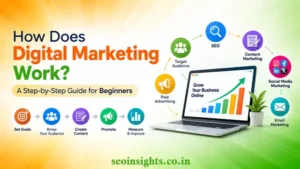
Learn how digital marketing works step by step, from setting goals and finding your audience to SEO, social media, paid ads, and measuring results.
Introduction: How Does Digital Marketing Work?
Imagine you own a small online store selling handmade products. You have attractive products, reasonable prices, and a website where customers can place orders. However, only a few people visit your website, and even fewer make a purchase.
The problem may not be your products. Potential customers might simply not know your business exists.
This is where digital marketing comes in.
Digital marketing helps businesses reach people through internet-based channels, understand their needs, build relationships, and encourage meaningful actions. These actions might include visiting a website, subscribing to a newsletter, requesting a quotation, downloading a guide, or purchasing a product.
Unlike traditional marketing methods that often rely on television, newspapers, or printed advertisements, digital marketing uses online platforms to communicate with audiences. Businesses can also measure many aspects of their campaigns and use the results to improve their decisions.
But how does digital marketing work in practice?
It follows a connected process: identify a goal, understand the audience, choose suitable channels, create useful content, attract visitors, encourage conversions, and measure the results.
Let’s explore each step using practical examples that beginners can understand and apply.
What Is Digital Marketing?
Digital marketing is the promotion of products, services, or brands through digital channels and technologies. It includes activities such as search engine optimization (SEO), social media marketing, email marketing, content marketing, online advertising, and affiliate marketing.
For example, when someone searches Google for a product, discovers a helpful article, watches a product demonstration, or receives a promotional email from a business, they may be interacting with digital marketing.
Digital marketing is not limited to large companies. Freelancers, local shops, startups, bloggers, educational institutions, and international brands can all use it.
How digital marketing differs from traditional marketing
Traditional marketing often uses offline channels, while digital marketing uses online platforms. However, the two approaches can complement each other.
A local restaurant might distribute printed flyers to people nearby while also maintaining a website, publishing social media posts, and appearing in relevant local search results.
The right approach depends on the audience, business objectives, budget, and product or service being promoted.
How Does Digital Marketing Work Step by Step?
Digital marketing works best when individual activities support a common business goal. Consider a company that sells eco-friendly water bottles online. Its objective is to attract interested visitors and turn some of them into customers.
Here is how the process might work.
Step 1: Set clear marketing goals
Every digital marketing campaign should begin with a specific objective.
Without a clear goal, a business may spend time publishing content, running advertisements, and collecting website traffic without knowing whether those activities are helping.
Common digital marketing goals include:
- Increasing relevant website traffic.
- Generating enquiries and qualified leads.
- Increasing online sales.
- Building brand awareness.
- Growing an email subscriber list.
- Encouraging repeat purchases.
- Improving customer retention.
For the water bottle business, the goal might be to increase online sales by improving product-page visibility and attracting shoppers who are interested in reusable bottles.
The company can then select measurable indicators, such as completed purchases, qualified website visits, conversion rate, and advertising cost per acquisition.
Actionable tip: Write down one primary goal before choosing marketing channels. Make the goal specific, measurable, achievable, relevant, and time-bound where appropriate.
Step 2: Understand your target audience
Digital marketing becomes more effective when businesses understand who they want to reach.
A target audience may be defined by interests, location, needs, purchasing behaviour, professional role, or other relevant characteristics.
For example, the water bottle company might serve:
- People looking for reusable alternatives to disposable bottles.
- Students who need durable bottles for everyday use.
- Office workers who carry water during the day.
- Travellers who want portable drinkware.
These groups may care about different product features. A student might prioritise affordability, while a traveller may look for durability and leak resistance.
Understanding these differences helps the business create more relevant content and choose appropriate marketing channels.
Businesses can research their audiences through customer interviews, surveys, website analytics, customer support questions, search queries, and feedback on social media.
Actionable tip: Start by answering three questions: Who is the ideal customer? What problem are they trying to solve? What information would help them make a decision?
Step 3: Research keywords and customer needs
Once the target audience is clear, the next step is to understand what people search for online.
Keyword research helps identify the words and phrases people use when looking for information, products, or services.
Suppose someone sells reusable water bottles. Potential search phrases might include:
- Reusable water bottles.
- Best water bottle for daily use.
- Stainless steel water bottle.
- How to clean a reusable water bottle.
- Leakproof water bottle for travel.
These phrases reflect different search intentions.
A person searching for cleaning instructions wants information. Someone searching for a specific product feature may be comparing options. A person searching for a particular product model may be closer to making a purchase.
Businesses can use this information to plan blog articles, product pages, landing pages, and advertising campaigns.
Keyword research tools and Google Search Console can help identify relevant search terms and queries that already bring visitors to a website.
Actionable tip: Choose keywords based on relevance and search intent, not just popularity. A highly relevant, specific search may be more valuable than a broad phrase that attracts the wrong audience.
Step 4: Build a useful, trustworthy website
A website often acts as the central destination for digital marketing activities.
Social media profiles, search listings, email campaigns, and advertisements can introduce people to a business. The website then provides more detailed information and a clear way to take action.
A useful business website should generally include:
- Clear information about products or services.
- Easy-to-understand navigation.
- Relevant, original content.
- Mobile-friendly page layouts.
- Secure browsing through HTTPS.
- Fast-loading pages.
- Clear contact details and calls to action.
- Appropriate privacy and other required legal disclosures.
For an online store, product pages should explain important features, pricing, shipping information, and return policies. For a service business, pages might describe the services offered, areas served, previous work, and how to request a quotation.
A website does not need elaborate design to be effective. Visitors should be able to understand the offer and find the next step without unnecessary effort.
Actionable tip: Visit your website on a mobile phone and ask whether a first-time visitor can understand what you offer and how to contact you or buy from you.
Step 5: Choose the right digital marketing channels
Digital marketing includes several channels, and each serves a different purpose.
Businesses do not need to use every channel immediately. They should prioritise those that fit their audience, resources, and goals.
Search engine optimization (SEO)
SEO helps websites improve their visibility in unpaid search results.
It includes activities such as creating helpful content, improving page titles, organising website navigation, using descriptive URLs, and making pages accessible to search engines.
For example, the water bottle company might publish a detailed guide about choosing a reusable bottle. Someone researching the topic could discover the guide through a search engine and later visit the company’s product pages.
SEO generally requires consistent work, and results can take time. Search engines decide how pages appear, so rankings cannot be guaranteed.
Content marketing
Content marketing involves creating and distributing useful material to attract and engage a relevant audience.
Content may include blog posts, videos, tutorials, infographics, newsletters, case studies, and downloadable guides.
A software company, for example, might publish a tutorial explaining how to solve a common problem before introducing its product as one possible solution.
Useful content builds familiarity and helps potential customers make informed decisions.
Social media marketing
Social media marketing uses platforms such as Instagram, Facebook, LinkedIn, YouTube, and other relevant networks to communicate with audiences.
A business might share product demonstrations, answer customer questions, publish educational posts, or participate in relevant discussions.
The best platform depends on where the intended audience spends time and what kind of content the business can produce consistently.
Having accounts on every platform is not necessary. Maintaining a few relevant, active profiles may be more practical than spreading resources too thinly.
Email marketing
Email marketing allows businesses to communicate with people who have chosen to receive their messages.
A company might send a welcome email to new subscribers, share useful tips, announce a new product, or provide post-purchase guidance.
For example, a digital marketing blog could offer a downloadable SEO checklist in exchange for an email subscription, provided the sign-up clearly explains what subscribers can expect.
Businesses should obtain appropriate permission, respect unsubscribe requests, and follow applicable privacy and anti-spam laws.
Pay-per-click (PPC) and paid advertising
Paid digital advertising allows businesses to promote products or services through advertising platforms.
Examples include search ads, social media ads, display ads, and certain video advertising formats.
A business selling office furniture might advertise for relevant searches from people looking to purchase desks. It can direct those visitors to a page specifically designed for that product.
In pay-per-click advertising, advertisers commonly pay when someone clicks an ad, although other pricing models are also used.
Paid advertising can generate visibility quickly, but results depend on factors such as targeting, competition, landing-page quality, and budget. Advertising expenditure does not automatically produce sales.
Affiliate and influencer marketing
Affiliate marketing involves partners promoting products or services in exchange for an agreed commission or other compensation when specified conditions are met.
Influencer marketing involves collaborating with creators whose audiences may be relevant to a business.
For example, a company that sells photography equipment could work with a photography educator who demonstrates the product to an interested audience.
Partnerships should be relevant, transparent, and consistent with applicable advertising disclosure requirements.
Step 6: Create content that answers real questions
Choosing a channel is only part of the process. Businesses also need content that gives people a reason to pay attention.
Content should match what the audience needs at a particular stage of its decision-making process.
Consider someone who wants to learn about email marketing software.
At first, the person might read an article explaining what email marketing is. Later, they might compare different tools. Finally, they may visit a pricing page or request a demonstration.
Each stage requires different information.
A practical content plan could include:
- Awareness: Beginner guides, educational videos, and explanatory blog posts.
- Consideration: Comparisons, tutorials, product demonstrations, and case studies.
- Decision: Pricing details, product specifications, testimonials, and demonstrations.
- Retention: Helpful newsletters, product instructions, and customer support resources.
Content should be accurate, easy to understand, and genuinely useful. It should answer the reader’s question rather than merely repeat keywords.
Actionable tip: Before creating a page or post, write down the question it will answer and the next useful action a reader could take.
Step 7: Attract visitors to your content
After publishing content, businesses need to help the right people discover it.
Different channels can work together to bring relevant visitors to a website.
For example, a blog post may attract organic search traffic. The business could also share the article through its newsletter and relevant social media profiles. If paid promotion fits the budget, it might advertise a related offer.
This is where digital marketing becomes an interconnected system rather than a collection of unrelated tasks.
However, the number of visitors is not the only important consideration. A large volume of irrelevant traffic may contribute little to business goals.
A smaller number of visitors who genuinely need the product or service may be more valuable.
Businesses should evaluate both traffic quantity and quality.
Actionable tip: Track which channels bring visitors who read relevant pages, enquire, subscribe, or purchase. Use those findings to refine your marketing activities.
Step 8: Turn visitors into leads or customers
Attracting visitors is not the same as achieving a business result.
A conversion occurs when someone completes a desired action. Depending on the campaign, that action might be making a purchase, submitting a form, registering for an event, or subscribing to a newsletter.
A conversion does not always mean a sale.
Businesses can improve conversion opportunities by making the next step clear and reducing unnecessary obstacles.
Examples include:
- Adding a visible contact button to a service page.
- Making product information easy to find.
- Providing a straightforward checkout process.
- Offering a useful newsletter subscription.
- Creating a landing page that directly matches an advertisement.
- Explaining what happens after someone submits a form.
Imagine a visitor clicks an advertisement for a specific backpack but lands on a general homepage. The visitor must search again to find the product.
A dedicated landing page showing the advertised backpack, its features, price, and purchase button may provide a more relevant experience.
The improvement should be tested rather than assumed.
Actionable tip: Give each important landing page one clear primary action and make sure that action works on desktop and mobile devices.
Step 9: Measure performance using analytics
Digital marketing allows businesses to measure many campaign activities and outcomes.
Analytics helps answer practical questions: Are people finding the website? Which content attracts attention? Are visitors taking the desired actions? Are campaigns generating worthwhile business results?
Common metrics include:
| Metric | What it tells you |
| Impressions | How often content or an advertisement was displayed, according to the platform’s definition. |
| Click-through rate (CTR) | The percentage of impressions that resulted in clicks. |
| Website traffic | The visits or users recorded by an analytics system. |
| Conversion rate | The proportion of a defined group that completed a desired action. |
| Cost per lead | The marketing cost associated with generating a lead. |
| Customer acquisition cost (CAC) | The cost of acquiring a customer, based on the costs and attribution method included. |
| Return on ad spend (ROAS) | Attributed advertising revenue divided by advertising spend. |
For example, suppose a campaign costs $200 and generates $800 in attributed sales revenue.
Its ROAS is:
$800 ÷ $200 = 4
That is a 4:1 return on ad spend, or $4 in attributed revenue for each $1 spent on advertising.
However, ROAS is not the same as profit. It does not automatically account for product costs, fulfilment, salaries, taxes, or other business expenses.
Businesses can use tools such as Google Analytics and Google Search Console to understand website activity and search performance. Advertising platforms also provide campaign reporting, although their attribution methods may differ.
Actionable tip: Select a small set of metrics that directly relate to your goal. Avoid judging a campaign by likes, impressions, or traffic alone when the actual objective is sales or qualified leads.
Step 10: Improve the strategy and repeat the process
Digital marketing is an ongoing cycle.
After reviewing results, businesses can identify what deserves further investment, what needs improvement, and what should be stopped.
Suppose a blog receives visits from an article about website speed, but few readers explore the related services page.
The business might review whether the article naturally introduces the service, whether the link is visible, and whether the destination answers the reader’s needs.
Alternatively, an online store may discover that many shoppers add products to their carts but do not complete purchases. It could investigate unexpected shipping costs, confusing checkout steps, payment errors, or other obstacles.
The important point is to investigate evidence rather than make random changes.
A simple improvement cycle looks like this:
- Define the goal.
- Launch the campaign.
- Collect relevant data.
- Identify an opportunity or problem.
- Make a focused change.
- Measure the result.
- Repeat what works and reconsider what does not.
Some changes produce results quickly, while SEO and audience-building activities may need longer observation periods. The appropriate evaluation period depends on the channel and campaign.
A Practical Digital Marketing Example
Let’s bring the steps together using a fictional business called GreenSip, which sells reusable water bottles online.
GreenSip wants to attract new customers and increase online orders.
How GreenSip’s digital marketing works
First, it sets a goal. The business decides to increase relevant website visits and completed purchases over the next three months.
Next, it researches the audience. It identifies shoppers interested in reusable bottles for work, travel, and everyday use.
Then, it researches search intent. The team identifies relevant questions about bottle materials, cleaning, capacity, and leak resistance.
It improves the website. Product pages clearly explain specifications, prices, delivery details, and returns.
It creates helpful content. The company publishes a guide to choosing a reusable bottle and a separate article about cleaning and maintenance.
It promotes the content. GreenSip shares useful product demonstrations on relevant social media channels and builds organic search visibility. It may also test a small paid search campaign.
It encourages conversions. Articles link naturally to relevant product pages, where customers can review the details and place orders.
Finally, it measures results. The business evaluates relevant traffic, product-page visits, completed orders, conversion rates, and campaign costs.
If one channel brings interested visitors but few purchases, GreenSip investigates the problem. If another channel produces profitable orders, the business considers whether it can scale that activity sustainably.
This example shows how digital marketing connects audience research, content, promotion, customer experience, and measurement.
How Do the Main Digital Marketing Channels Work Together?
Individual marketing channels can be useful on their own, but a coordinated approach can make the customer journey more consistent.
For example:
- SEO helps potential customers discover useful information through search engines.
- Content marketing answers their questions and explains available solutions.
- Social media helps distribute content and encourages discussion.
- Paid advertising can reach relevant audiences or promote specific offers.
- Email marketing supports ongoing communication with subscribers.
- Analytics helps businesses understand the results across these activities.
Consider a person who discovers a company through a search result, reads its educational article, subscribes to its newsletter, and purchases a product after receiving a relevant email.
Several channels have contributed to the journey.
Not every customer follows the same path, and businesses should not assume that one channel deserves all the credit for a conversion. Tracking limitations, privacy settings, and differences between reporting systems can also affect measurement.
The goal is to build a coherent customer experience, not simply to increase the number of marketing channels used.
How to Start Digital Marketing as a Beginner
You do not need a large budget or an advanced technical background to begin learning digital marketing. Start with a manageable plan.
-
Choose one business goal
Decide whether you want to increase website visits, generate enquiries, sell products, or grow an audience.
-
Define your target audience
Identify the people you want to reach, their needs, and the problems your product or service solves.
-
Create a reliable online presence
Set up a useful website or appropriate landing page with clear information and a working contact or purchase process.
-
Select one or two relevant channels
A beginner with a content-focused website might start with SEO and content marketing. A local service provider may also benefit from a well-maintained business profile and relevant local search visibility.
-
Publish useful content consistently
Answer real customer questions, explain your services, and provide practical information.
-
Set up basic measurement
Use suitable analytics tools to monitor traffic, enquiries, purchases, or other meaningful actions. Respect consent requirements and applicable privacy rules when collecting data.
-
Review and improve
Examine the results regularly. Make focused changes based on what you learn rather than trying every new marketing tactic at once.
A beginner can build a foundation through practice, free educational resources, and small experiments. Paid tools and advertising can be introduced when there is a clear reason to use them.
Common Digital Marketing Mistakes to Avoid
Even a well-planned strategy can underperform when basic principles are overlooked.
Expecting instant SEO results
Organic search visibility often requires sustained work. Publishing an article does not guarantee that it will rank or attract visitors.
Targeting everyone
Trying to appeal to every possible customer can make messages vague. A defined audience helps businesses communicate more clearly.
Choosing channels without a strategy
A platform may be popular without being the best fit for your audience. Choose channels based on business needs rather than trends alone.
Publishing content without a purpose
Content should address a genuine need and support the customer journey. Publishing frequently is not a substitute for relevance and quality.
Ignoring mobile users
Visitors may leave when pages are difficult to read, buttons are hard to use, or forms do not work properly on smaller screens.
Measuring vanity metrics alone
Likes and impressions can provide useful context, but they do not necessarily demonstrate revenue, lead quality, or customer satisfaction.
Spending on advertising without tracking conversions
Before increasing an advertising budget, ensure that important actions can be measured reliably and that campaign performance is assessed against business objectives.
Neglecting existing customers
Digital marketing should not focus exclusively on acquiring new customers. Helpful follow-up communication, good service, and relevant customer education can support retention and repeat purchases.
Is Digital Marketing Effective for Small Businesses?
Digital marketing can be useful for small businesses because it provides several ways to reach specific audiences, communicate value, and measure activity.
A small consultancy could publish specialist articles to demonstrate expertise. A neighbourhood bakery could share product updates and improve its local online presence. A freelance designer could use a portfolio website and professional social media to attract enquiries.
The most appropriate strategy depends on the business model, audience, competition, available time, and budget.
Small businesses can begin with a few well-managed activities rather than trying to compete on every platform. They should also remember that online marketing involves ongoing work, and its results are not guaranteed.
What Tools Help Digital Marketing Work?
The tools you choose should match the tasks you need to perform.
| Marketing task | Example tools | Main purpose |
| Search performance | Google Search Console | Monitor search visibility, clicks, impressions, and indexing information. |
| Website analytics | Google Analytics | Understand website activity and configured conversion events. |
| Keyword research | Google Keyword Planner and other keyword tools | Discover and evaluate relevant search terms. |
| Website content management | WordPress and other CMS platforms | Publish and manage web pages and articles. |
| Email campaigns | Email marketing platforms | Manage subscribers and send permission-based campaigns. |
| Paid advertising | Google Ads and social advertising platforms | Create and evaluate paid campaigns. |
| Social media management | Native platform tools and scheduling services | Publish content and monitor engagement. |
Tool availability, pricing, and features can change. Beginners should first identify what they need to accomplish before paying for a collection of subscriptions.
Key Takeaways
- Digital marketing uses online channels to connect businesses with relevant audiences and support measurable business goals.
- The process begins with clear objectives, audience research, and an understanding of customer needs.
- SEO, content marketing, social media, email, and paid advertising can support different stages of the customer journey.
- A useful website and clear calls to action help turn visitors into leads, subscribers, or customers.
- Analytics provides evidence for evaluating performance, but individual metrics must be interpreted in context.
- Successful digital marketing requires testing, learning, and improving over time.
- Beginners can start with a small, focused strategy and expand when their results and resources justify it.
Frequently Asked Questions (FAQ)
-
How does digital marketing work in simple words?
Digital marketing helps businesses reach potential customers through online channels. Businesses create useful content or advertisements, attract relevant visitors, encourage actions such as enquiries or purchases, and measure the results to improve their strategy.
-
What are the main types of digital marketing?
The main types include search engine optimization (SEO), content marketing, social media marketing, email marketing, paid online advertising, affiliate marketing, and influencer marketing. Businesses can combine the methods that best match their audience and goals.
-
How long does digital marketing take to show results?
The time varies by channel, competition, budget, and the results being measured. Paid advertising may generate traffic soon after a campaign launches, while SEO and organic audience development often take longer. Neither approach guarantees a particular result.
-
Can I learn digital marketing without experience?
Yes. Beginners can start by learning audience research, keyword research, content creation, website basics, and analytics. Practising on a personal website or small project is a useful way to develop practical skills before managing larger campaigns.
-
How can I measure whether digital marketing is working?
Start with the goal of the campaign. For awareness, you might track relevant reach and impressions. For SEO, monitor search impressions, clicks, and relevant organic traffic. For lead generation, track qualified enquiries and cost per lead. For sales, evaluate completed purchases, conversion rates, acquisition costs, and profitability.
Conclusion
Digital marketing works by connecting the right audience with the right information, product, or service through relevant online channels. The process begins with clear goals and audience research, continues through website development, content creation and promotion, and improves through measurement and experimentation.
You do not need to master every channel on your first day. Start with a clear objective, understand your audience, build a useful online presence, and choose the marketing methods that best support your goal.
As you collect meaningful data, use it to improve your content, customer experience, and campaigns. Over time, this disciplined approach can help you build a more effective digital marketing strategy for your website or business.
For more articles on Digital Marketing: