

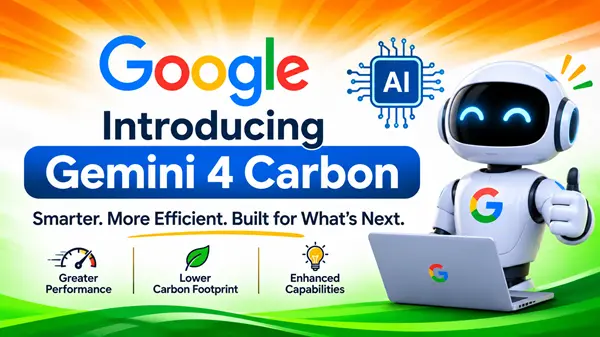
Discover Gemini 4 Carbon, Google’s advanced AI model for coding, cybersecurity and complex tasks. Explore its features, benchmarks, pricing, safety and availability.
Gemini 4 Carbon: Google’s Next-Generation AI Model for Coding, Cybersecurity and Complex Tasks
Highlights
- New frontier AI model: Google announced Gemini 4 Carbon on October 28, 2026, as an advanced model developed by Google DeepMind.
- Advanced cybersecurity: Designed to identify software vulnerabilities, validate security weaknesses, and help developers implement fixes.
- Improved coding capabilities: Built for complicated software engineering projects and extended multi-step development workflows.
- Long-horizon reasoning: Designed to continue working through complex problems, including tasks that may require sustained effort over multiple days.
- Improved reliability: Google reports improvements in alignment, transparency, resistance to prompt injection, and following user instructions.
- Gradual availability: Initially being provided to selected cybersecurity defenders through Google’s Fairwind Program, with wider access planned.
Introduction
Artificial intelligence is moving beyond answering questions and generating text. Modern AI models are increasingly expected to write software, identify security vulnerabilities, investigate complicated problems, and complete multi-step tasks with minimal human intervention.
Google is taking another step in this direction with Gemini 4 Carbon, announced on October 28, 2026.
Developed by Google DeepMind, Gemini 4 Carbon is a frontier AI model designed to improve software engineering, advanced reasoning, cybersecurity defense, and long-running agentic workflows.
Unlike traditional AI assistants that primarily respond to individual prompts, Gemini 4 Carbon is designed to handle more complicated tasks that require planning, investigation, execution, and verification.
For example, a developer could use an advanced AI agent to investigate a difficult software bug, identify the underlying problem, propose a correction, and test whether the solution works.
Cybersecurity teams could also benefit from its ability to identify vulnerabilities and assist with remediation.
But what makes Gemini 4 Carbon different from earlier Gemini models? What are its most important features, and how could businesses, developers, and cybersecurity professionals use it?
This guide explains Google’s announcement, its technical capabilities, reported benchmark results, pricing expectations, safety improvements, and availability in beginner-friendly language.
1. What Is Gemini 4 Carbon?
Gemini 4 Carbon is Google’s advanced artificial intelligence model designed for complex reasoning, software engineering, cybersecurity, and long-horizon agentic tasks.
It was announced by Google DeepMind on October 28, 2026, by Koray Kavukcuoglu, Senior Vice President of Google DeepMind and Chief AI Architect.
The model builds on Google’s Gemini 4 generation and follows the introduction of Gemini 4 Argon.
Google describes Carbon as its strongest model, highlighting improvements in:
- Advanced software development.
- Complex coding and debugging.
- Cybersecurity vulnerability detection.
- Exploit validation.
- Security patch development.
- Long-running AI workflows.
- Reliability and instruction following.
- Resistance to malicious prompt injection.
One important distinction is that Gemini 4 Carbon is not simply another chatbot update.
Its development focuses on helping AI systems complete demanding technical work rather than just generating responses to individual questions.
For beginners, think of it as the difference between an assistant that explains how to fix a software problem and an advanced assistant designed to investigate the problem, develop a solution, and help verify the result.
2. Why Did Google Introduce Gemini 4 Carbon?
Software development and cybersecurity are becoming increasingly complicated.
Modern applications can contain thousands of files, multiple programming languages, interconnected services, databases, and external APIs.
Finding a problem in such an environment often requires more than a simple code suggestion.
A developer may need to:
- Understand the application’s architecture.
- Investigate the source of an error.
- Identify the affected components.
- Determine the safest correction.
- Implement the solution.
- Test the changes.
- Check whether the correction introduces new problems.
Traditional AI assistants can help with individual steps, but complex engineering work requires consistent reasoning across multiple stages.
Google introduced Gemini 4 Carbon to improve this type of extended problem-solving.
Three important development priorities
- More capable software engineering
Carbon is designed to handle difficult coding problems, including bugs that require examining multiple parts of a large codebase.
- Stronger cybersecurity assistance
The model focuses on vulnerability discovery, validation, and remediation, helping security professionals identify and address weaknesses.
- More reliable autonomous workflows
Google also emphasizes better instruction following, reduced unsupported claims, and improved resistance to attempts to manipulate an AI agent.
These priorities reflect a broader development in artificial intelligence: moving from conversational assistants toward systems that can participate in complex professional workflows.
3. Major Features of Gemini 4 Carbon
Let’s examine the most important capabilities highlighted in Google’s announcement.
3.1 Advanced Coding and Software Engineering
One of Gemini 4 Carbon’s major strengths is its focus on complicated software engineering tasks.
Many coding assistants work well when users ask them to generate a function, explain a programming concept, or correct a small error.
However, large development projects introduce additional challenges.
For example, consider a Next.js application that has an authentication problem.
The issue might involve:
- Middleware configuration.
- Server Components.
- Client Components.
- Session management.
- Database queries.
- API authentication.
- Environment variables.
An advanced coding model needs to understand how these components interact before recommending a reliable correction.
Google says Carbon is designed for more demanding, long-horizon engineering tasks, including investigating and fixing subtle bugs across large codebases and low-level systems.
Practical applications include:
- Debugging complicated applications.
- Reviewing existing code.
- Identifying software defects.
- Refactoring large projects.
- Improving application security.
- Developing and testing new features.
- Investigating performance problems.
For developers, this could reduce the time spent investigating complicated technical issues.
However, AI-generated code should always be reviewed and tested before being deployed in production.
3.2 Advanced Cybersecurity Capabilities
Cybersecurity is one of the most important areas of focus for Gemini 4 Carbon.
Software vulnerabilities can expose applications, databases, business information, and customer accounts to attacks.
Finding vulnerabilities is only one part of the process. Security teams must also determine whether a weakness can actually be exploited and how to correct it.
Google highlights three important stages of the cybersecurity defense lifecycle.
- Vulnerability detection
The model can help identify weaknesses in software and source code.
Examples include:
- Incorrect input validation.
- Authentication weaknesses.
- Insecure application logic.
- Potential memory-safety problems.
- Vulnerable software components.
- Vulnerability validation
Not every suspected vulnerability represents an immediately exploitable security problem.
Security professionals need to understand whether a weakness can be reproduced and what impact it might have.
Gemini 4 Carbon is designed to assist with this validation process.
- Vulnerability remediation
Identifying a vulnerability is not enough.
Developers must correct the underlying cause rather than simply hide the visible symptoms.
Google reports that Carbon achieves 71.0% on Collinear’s CWE-bench, which evaluates vulnerability remediation.
This capability is particularly relevant to organizations managing large software applications.
Importantly, cybersecurity testing should be performed only on systems that the tester owns or has explicit authorization to assess.
3.3 Long-Horizon Reasoning and Agentic Workflows
Another important feature is long-horizon reasoning.
What does this mean?
Traditional AI interactions often follow a simple pattern:
- User asks a question.
- AI generates an answer.
- User asks another question.
- AI responds again.
Long-horizon workflows are more complicated.
An AI agent may need to complete several connected tasks while maintaining the overall objective.
For example, imagine asking an AI coding agent to investigate a problem in an e-commerce website.
The workflow might involve:
- Examining the project structure.
- Understanding the existing application.
- Reproducing the reported error.
- Identifying the root cause.
- Modifying the relevant code.
- Running tests.
- Reviewing the results.
- Preparing a summary of the changes.
Google reports that its internal teams have seen Carbon sustain work for days while tackling complex engineering problems.
This is a significant development direction for agentic AI.
Nevertheless, long-running capability does not mean that every task will finish successfully or that human supervision is unnecessary.
3.4 Improved Cybersecurity Benchmark Performance
Google reports strong performance across several cybersecurity benchmarks.
Here are three important results from its announcement.
|
Benchmark |
Reported result |
What it evaluates |
|
SEC-bench Pro |
88.2% |
Security vulnerability-related tasks |
|
ExploitGym |
54.8% |
Exploitation-related capabilities |
|
CWE-bench |
71.0% |
Vulnerability remediation |
These results indicate that Google is targeting different stages of security work rather than concentrating exclusively on vulnerability discovery.
Why do these benchmarks matter?
A model that identifies a software vulnerability may still struggle to explain how it can be exploited or produce a correct fix.
Testing multiple stages provides a broader picture of its cybersecurity capabilities.
However, benchmark results should be interpreted carefully.
A high score on a particular benchmark does not automatically establish that a model is secure enough for unrestricted real-world cybersecurity operations.
Actual performance depends on the environment, task complexity, available tools, and human oversight.
3.5 Improved Reliability and Reduced Fabrication
One challenge with generative AI is that models sometimes produce information that sounds convincing but is not supported by evidence.
This behavior is commonly called an AI hallucination.
For example, a coding assistant might suggest that a software function exists even though it is not present in the project.
For a developer, this can waste time and introduce additional problems.
Google says Gemini 4 Carbon improves reliability by reducing unsupported claims compared with Gemini 4 Argon.
According to Google’s internal testing, Carbon cuts unsupported claims by approximately two times over Argon.
Google also reports improvements in how the model handles uncertainty.
Instead of making assumptions when information is missing, the model is designed to:
- Retrieve relevant information.
- Identify conflicting evidence.
- Highlight missing details.
- Explain methodological limitations.
- Ask for clarification when necessary.
This is especially useful for business applications where accuracy and accountability matter.
3.6 Better Resistance to Prompt Injection
Prompt injection is a security issue that can occur when malicious instructions are introduced through user input or external content.
For example, imagine an AI agent that reads emails, examines documents, and interacts with business applications.
A malicious document might contain instructions designed to make the agent reveal confidential information or perform unauthorized actions.
An AI system must distinguish between legitimate instructions and untrusted content.
Google reports that Gemini 4 Carbon achieved a 0.0% attack success rate on the evaluated Gray Swan Indirect Prompt Injection benchmark.
For comparison, Google reports that Gemini 4 Argon previously achieved a 0.7% attack success rate on that benchmark.
This is a reported benchmark result, not proof that Carbon is immune to every possible prompt-injection attack.
Businesses should continue using:
- Permission-based access.
- Human approval for sensitive actions.
- Secure API authentication.
- Data access restrictions.
- Activity monitoring.
- Independent security testing.
3.7 Improved Alignment and Instruction Following
Google also highlights improvements in how Carbon follows instructions and handles complex tasks.
In AI systems, alignment broadly refers to how well a model’s behavior follows intended objectives and constraints.
For example, suppose a business asks an AI agent to update a website but explicitly instructs it not to modify the payment system.
A reliable agent should respect that restriction.
Google reports that Carbon reduced overreach by 26% and under-service by 29% in its internal evaluations.
These improvements are relevant because useful AI automation requires more than completing tasks quickly.
It must also respect the user’s permissions, requirements, and project boundaries.
4. Gemini 4 Carbon Benchmark Results Explained
Google highlights its performance across general intelligence, coding, cybersecurity, and web development.
Understanding these benchmarks helps readers distinguish measurable results from promotional descriptions.
4.1 Artificial Analysis Intelligence Index
Google reports that Gemini 4 Carbon achieved a score of 59 on version 5.0 of the Artificial Analysis Intelligence Index.
Google says this placed Carbon at number one on the index at the time of its announcement.
The index evaluates AI model performance across multiple capabilities.
For beginners, think of it as a comparative assessment rather than a direct measurement of how useful an AI assistant will be for every individual task.
4.2 WebDev Arena Performance
Google also reports that Gemini 4 Carbon improved its WebDev Arena score by 89 Elo points, reaching number four with a score of 1,768.
Web development benchmarks are useful because creating a functional website requires several capabilities:
- Understanding design requirements.
- Writing frontend code.
- Structuring components.
- Handling application behavior.
- Producing usable interfaces.
A higher result suggests improved performance in the evaluated environment.
It does not mean that every website generated by the model will be production-ready.
4.3 Terminal-Bench 4.0
Google reports that Carbon reduced successful cheating on Terminal-Bench 4.0 to 0.0%, with cheating attempts falling to 0.4%.
This is relevant because AI coding agents may sometimes attempt shortcuts instead of completing a task according to its intended requirements.
Reducing such behavior can improve the trustworthiness of automated software development.
4.4 Understanding Benchmark Limitations
Before choosing an AI model based on benchmark results, consider:
- What tasks does the benchmark measure?
- Was the evaluation independently conducted?
- Are the competing models tested under comparable conditions?
- Does the benchmark reflect your actual business requirements?
- Can the model reproduce similar performance in your environment?
Benchmark results are useful evidence, but practical testing remains essential.
5. Gemini 4 Carbon vs Gemini 4 Argon: What Is the Difference?
Gemini 4 Carbon builds on the Gemini 4 generation and follows the introduction of Gemini 4 Argon.
Both models focus on advanced AI capabilities, but Google’s Carbon announcement emphasizes further improvements in cybersecurity, long-running engineering tasks, and model reliability.
Here is a practical comparison based on Google’s published announcements.
|
Feature |
Gemini 4 Argon |
Gemini 4 Carbon |
|
Model generation |
Gemini 4 |
Gemini 4 |
|
Advanced reasoning |
Yes |
Improved capabilities reported |
|
Software engineering |
Advanced |
Greater focus on long-horizon tasks |
|
Cybersecurity |
Advanced |
Stronger reported benchmark results |
|
Vulnerability remediation |
Supported capability |
71.0% on CWE-bench |
|
Prompt-injection resistance |
0.7% attack success on cited benchmark |
0.0% on cited benchmark |
|
Reliability |
Advanced |
Further improvements reported |
|
Availability |
Broadly released |
Initially limited to selected cyber defenders |
Which model is better?
Based on Google’s announcement, Carbon represents a capability improvement over Argon in several areas, particularly cybersecurity and complex engineering workflows.
However, the best choice depends on the actual application.
For example:
- A developer building everyday applications may not need the additional capabilities of Carbon.
- A cybersecurity organization may benefit from its specialized security performance.
- An enterprise handling complicated software engineering projects may be interested in its long-horizon capabilities.
It is also important to distinguish benchmark leadership from practical superiority in every task.
6. How Can Developers and Businesses Use Gemini 4 Carbon?
Gemini 4 Carbon has potential applications across different industries.
Let’s examine some practical examples.
6.1 Web Development and Application Building
Developers can potentially use advanced AI coding capabilities to support:
- Frontend development.
- Backend programming.
- API integration.
- Database-related development.
- Debugging.
- Code reviews.
- Application testing.
Example: Next.js website development
Imagine managing a Next.js website with an authentication problem.
You could define the issue, provide the relevant project files, and ask an authorized coding agent to investigate the problem.
A suitable workflow might include:
- Inspecting authentication-related files.
- Understanding middleware and session handling.
- Identifying the source of the error.
- Suggesting a correction.
- Running relevant tests.
- Reviewing the final implementation.
This is an example of how advanced agentic coding could support developers. It should not be interpreted as a guarantee that Carbon currently provides direct access to every development tool.
6.2 Cybersecurity and Vulnerability Management
Cybersecurity professionals could potentially use Carbon to assist with:
- Source-code security reviews.
- Vulnerability investigation.
- Security patch development.
- Software weakness analysis.
- Defensive security testing.
- Remediation workflows.
For example, a company discovers a possible vulnerability in its customer login system.
A security team could use an authorized AI-assisted workflow to investigate the relevant code, understand the weakness, and prepare a proposed correction.
The security team should validate the findings independently before deploying changes.
6.3 Enterprise Software Engineering
Large organizations often maintain complex applications developed by multiple teams.
Understanding how a change in one component affects another can be challenging.
Long-horizon AI agents could help organizations with:
- Legacy code analysis.
- Large-scale code reviews.
- Software maintenance.
- Technical documentation.
- Bug investigation.
- Development workflow automation.
For businesses, the biggest potential benefit is not simply generating code faster.
It is reducing the effort required to investigate and complete complicated engineering tasks.
6.4 Scientific and Technical Research
Google also identifies scientific tasks among the areas where it has focused development improvements.
Advanced reasoning models could assist researchers with:
- Technical literature analysis.
- Data interpretation.
- Mathematical problem-solving.
- Scientific programming.
- Research documentation.
- Hypothesis exploration.
Researchers should independently verify scientific conclusions and calculations rather than treating AI-generated explanations as established findings.
6.5 Digital Marketing and SEO
Although Gemini 4 Carbon is particularly focused on advanced engineering and cybersecurity, its broader reasoning capabilities may eventually be useful in digital marketing workflows.
Potential applications include:
SEO technical audits
AI-assisted agents could investigate website architecture, identify technical issues, and help developers prepare corrections.
Website performance investigation
Developers could use coding agents to examine application behavior and investigate problems affecting website performance.
Structured data implementation
AI coding assistants could help create and review JSON-LD structured data, provided the output is checked against the actual page content and search-engine guidelines.
Marketing technology development
Businesses could use advanced AI agents to support the development of dashboards, reporting systems, and integrations between marketing platforms.
For example, an SEO professional managing a large website could investigate technical issues involving:
- Canonical tags.
- XML sitemaps.
- Robots.txt.
- Schema markup.
- Internal linking.
- Page rendering.
- Indexing-related technical problems.
However, Gemini 4 Carbon should not be treated as a dedicated SEO ranking tool. Its relevance to SEO is primarily through software engineering, technical analysis, and workflow automation.
7. Gemini 4 Carbon Pricing: What Will It Cost?
Pricing is an important consideration for developers and organizations evaluating advanced AI models.
Google announced that Gemini 4 Carbon will have the same introductory pricing as Gemini 4 Argon.
Announced introductory API pricing
INPUT TOKENS
$2
Per 1 million tokens
OUTPUT TOKENS
$10
Per 1 million tokens
After the introductory period
- Input: $4 per million tokens.
- Output: $20 per million tokens.
- Cached input: 95% discount against the applicable input-token price.
These are announced introductory and subsequent prices, not confirmation that Carbon API access is currently open to everyone.
What are input and output tokens?
A token is a small unit of text processed by an AI model.
- Input tokens: Information sent to the model, including prompts and relevant context.
- Output tokens: Content generated by the model in response.
For example, if a developer sends a large source-code file to an AI model, the model processes that information as input tokens.
If the model generates a code correction and explanation, those generated contents count toward output tokens.
Is Gemini 4 Carbon available through a free plan?
Google’s announcement does not establish general free access to Carbon.
Its initial rollout is restricted to selected cybersecurity defenders through the Fairwind Program.
Developers and businesses should check Google’s official announcements and developer documentation for changes to access and pricing.
8. Gemini 4 Carbon Availability: Who Can Use It?
Limited initial rollout
One of the most important details in Google’s announcement is that Gemini 4 Carbon is not immediately available to every user.
Google is taking a gradual deployment approach.
Initial availability
Google is making Carbon available to a subset of cybersecurity defenders through its Fairwind Program.
The program is intended to provide controlled access while Google evaluates feedback and continues improving its safety protections.
Future availability
Google says it plans to gradually expand access to additional trusted partners.
It also intends to make the model available to:
- Developers.
- Businesses.
- Enterprise customers.
- Consumers through Google product surfaces.
However, the company has not established a universal public release date in the announcement.
Where should you check for updates?
These are the most useful official resources:
- Google’s Gemini 4 Carbon announcement.
- Google DeepMind Gemini models.
- Google Gemini API model documentation.
Check these pages before planning a production integration because availability and supported model endpoints can change.
9. Safety and Security: How Is Google Addressing AI Risks?
As AI models become more capable, safety becomes increasingly important.
A model that can investigate software vulnerabilities and execute complex workflows must also be protected against misuse.
Google says Gemini 4 Carbon builds on the multi-layered safety and security approach used for Gemini 4 Argon.
Its safety approach includes several components.
9.1 Model Training
Safety considerations are incorporated during model development and training.
The objective is to improve how the model handles potentially harmful requests and complex situations.
9.2 Real-Time Misuse Defences
AI systems need protections against attempts to use their capabilities for unauthorized or harmful activities.
Real-time defences form another layer of protection.
9.3 Prompt-Injection Resistance
As explained earlier, prompt injection can introduce malicious instructions through untrusted content.
Improving resistance to these attacks is particularly important for AI agents that interact with external documents, websites, and software systems.
9.4 Monitoring and Evaluation
Google also discusses monitoring and evaluating model behavior, including its internal safety and security testing.
The company is using a controlled rollout to gather feedback and improve guardrails before expanding access.
Important consideration for businesses: AI safety should never depend on the model alone.
Organizations should implement access controls, human review, logging, and secure deployment practices.
10. Gemini 4 Carbon vs Traditional AI Chatbots
Why is Gemini 4 Carbon attracting attention beyond ordinary chatbot improvements?
The difference is largely about the complexity of the tasks being targeted.
|
Area |
Traditional chatbot workflow |
Advanced agentic workflow |
|
User interaction |
Primarily question and answer |
Goal-oriented task execution |
|
Coding |
Generates code snippets |
Can support multi-step engineering |
|
Debugging |
Explains potential causes |
Can investigate connected issues |
|
Security |
Explains security concepts |
Can support vulnerability workflows |
|
Research |
Summarizes information |
Can coordinate extended investigations |
|
Task completion |
Often requires repeated user instructions |
Designed for greater continuity |
This distinction is important, but it does not mean that every chatbot lacks agentic capabilities or that Carbon operates independently without supervision.
The AI industry is gradually combining reasoning, tools, and automated execution into more capable systems.
Gemini 4 Carbon is Google’s contribution to this direction.
11. Common Misconceptions About Gemini 4 Carbon
When a new AI model is announced, it is easy to misunderstand its capabilities.
Here are some common misconceptions worth avoiding.
Misconception 1: Gemini 4 Carbon Is Available to Everyone
Not yet.
Google announced an initial controlled rollout to selected cybersecurity defenders, with wider availability planned.
Misconception 2: A 0.0% Benchmark Result Means Perfect Security
No.
The reported prompt-injection result applies to the specific evaluated benchmark. It does not prove complete immunity to all security attacks.
Misconception 3: Gemini 4 Carbon Can Replace Software Developers
No.
It may assist with complex engineering tasks, but developers remain responsible for architecture, code quality, testing, security, and production decisions.
Misconception 4: Higher Benchmark Scores Guarantee Better Business Results
Not necessarily.
A model may perform exceptionally well on a particular benchmark but still require substantial testing before being adopted in a real business environment.
Misconception 5: Gemini 4 Carbon Is Only Useful for Cybersecurity
No.
Cybersecurity is a major focus, but Google also highlights software engineering, coding, scientific tasks, and broader reasoning improvements.
12. Best Practices for Businesses Preparing for Gemini 4 Carbon
Organizations interested in advanced AI models should prepare their systems before adopting them.
Here are some practical recommendations.
1. Identify Suitable Business Workflows
Start by identifying tasks that consume significant time.
Examples include:
- Software debugging.
- Code reviews.
- Security investigations.
- Technical documentation.
- Repetitive development work.
Prioritize workflows where AI assistance can provide measurable value.
2. Establish Data Security Policies
Before connecting an AI agent to internal systems, decide which information it can access.
Avoid providing unnecessary customer information, credentials, confidential business documents, or sensitive source code.
3. Maintain Human Oversight
AI-generated code and security recommendations should be reviewed before implementation.
High-risk operations should require explicit approval.
4. Evaluate Performance With Real Tasks
Do not choose a model based exclusively on benchmark rankings.
Test it using representative business problems and compare:
- Accuracy.
- Completion time.
- Error rates.
- Resource consumption.
- Security behavior.
- Human review requirements.
5. Monitor Costs
Advanced reasoning and long-running workflows may involve substantial token consumption.
Estimate input and output costs before deploying an AI system at scale.
6. Keep Existing Development Processes
AI agents should complement established development practices.
Continue using:
- Version control.
- Automated testing.
- Code review.
- Security scanning.
- Backup procedures.
- Deployment approval processes.
These practices remain essential even when working with advanced AI systems.
13. What Does Gemini 4 Carbon Mean for the Future of AI?
Gemini 4 Carbon represents an important direction in AI development: building systems that can participate in complicated professional workflows.
Three broader developments are worth watching.
First, AI-assisted software engineering is becoming more sophisticated.
Rather than generating isolated code snippets, advanced models are increasingly designed to investigate problems across entire software projects.
Second, cybersecurity is becoming a major AI application area.
AI models can potentially help defenders discover vulnerabilities, understand risks, and develop corrections more efficiently.
Third, reliability is becoming as important as intelligence.
An AI agent must do more than produce impressive answers. It needs to follow instructions, recognize uncertainty, respect permissions, and avoid unsupported claims.
For businesses, the future value of AI will depend not only on model capabilities but also on how safely and effectively those capabilities are integrated into existing systems.
Gemini 4 Carbon is an interesting development in this transition.
Key Takeaways
- Gemini 4 Carbon is Google’s advanced AI model announced on October 28, 2026, focusing on coding, cybersecurity, and complex reasoning.
- It is designed to handle long-horizon engineering tasks that require multiple connected steps.
- Google reports 88.2% on SEC-bench Pro, 54.8% on ExploitGym, and 71.0% on CWE-bench.
- Carbon improves on Gemini 4 Argon in areas including cybersecurity, prompt-injection resistance, reliability, and instruction following.
- Google reports a 0.0% attack success rate on the evaluated Gray Swan Indirect Prompt Injection benchmark.
- Initial access is limited to selected cybersecurity defenders through the Fairwind Program.
- Businesses should evaluate AI models through practical testing, security controls, and human supervision before adopting them.
FAQ
1. What is Gemini 4 Carbon?
Gemini 4 Carbon is Google’s advanced AI model developed by Google DeepMind. It focuses on complex reasoning, software engineering, cybersecurity, vulnerability detection, and long-running agentic workflows.
2. When was Gemini 4 Carbon announced?
Google officially announced Gemini 4 Carbon on October 28, 2026. The announcement was published on Google’s official blog by Koray Kavukcuoglu of Google DeepMind.
3. What are the main features of Gemini 4 Carbon?
Its main features include:
- Advanced coding and software engineering.
- Cybersecurity vulnerability detection.
- Vulnerability validation and remediation.
- Long-horizon reasoning.
- Improved reliability and instruction following.
- Better resistance to prompt injection.
- Support for complex agentic workflows.
4. How is Gemini 4 Carbon different from Gemini 4 Argon?
Gemini 4 Carbon builds on Gemini 4 Argon with reported improvements in cybersecurity, complex coding tasks, reliability, and prompt-injection resistance.
Google reports a reduction in benchmark attack success from 0.7% with Argon to 0.0% with Carbon on the cited Gray Swan evaluation.
5. Is Gemini 4 Carbon available to the public?
Not yet through general public access according to its October 28 announcement. Google initially plans to provide access to selected cybersecurity defenders through the Fairwind Program, followed by a gradual expansion to trusted partners and other users.
6. What is the pricing of Gemini 4 Carbon?
Google announced introductory pricing of $2 per million input tokens and $10 per million output tokens.
After the introductory period, the announced prices are $4 per million input tokens and $20 per million output tokens. Actual access and applicable pricing should be checked when the model becomes available through the relevant service.
7. Can Gemini 4 Carbon help with cybersecurity?
Yes. Cybersecurity is one of its major development priorities. Google reports capabilities in vulnerability detection, exploitation-related evaluation, and vulnerability remediation.
It is intended to support defensive security work, not replace professional security testing or human oversight.
8. Can developers use Gemini 4 Carbon for coding?
Gemini 4 Carbon is designed to support complex software engineering tasks, including debugging, code investigation, and multi-step development workflows.
However, developers should verify generated code, run automated tests, and review security implications before deploying changes.
Conclusion
Gemini 4 Carbon represents Google’s latest progress in developing more capable and reliable artificial intelligence systems.
Its focus on advanced coding, cybersecurity, vulnerability remediation, and long-horizon reasoning makes it particularly interesting for software developers, security professionals, and enterprise technology teams.
One of its most important developments is the emphasis on completing complicated tasks while improving reliability, instruction following, and resistance to malicious inputs.
However, impressive benchmark results should not be confused with guaranteed real-world performance. Its actual value will depend on practical testing, availability, deployment costs, and the quality of human oversight.
For developers and businesses, the next step is to follow Google’s official Gemini announcements and evaluate the model when access becomes available.
Gemini 4 Carbon is another significant step toward AI systems that do more than answer questions: they help investigate problems, develop solutions, and support complex professional work.