Why is digital marketing important for businesses in 2026? Discover its benefits, key channels, practical strategies, and ways to reach more customers.
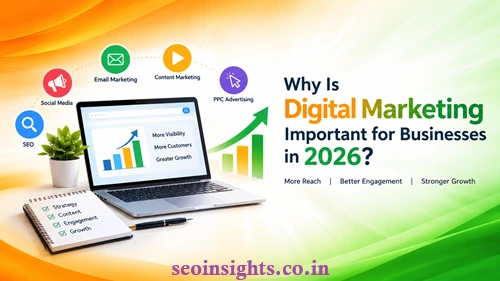
Why Is Digital Marketing Important for Businesses in 2026?
Imagine opening a small business that sells quality products or provides an excellent service. You invest time, money, and effort into building it. Your products are ready, your prices are competitive, and you believe customers will appreciate what you offer.
But there is one problem: very few people know your business exists.
A potential customer searches online for the product you sell, watches a video about a similar service, or asks friends for recommendations. If your business is absent from these discovery channels, that customer may choose a competitor instead.
This is where digital marketing becomes important.
Digital marketing helps businesses become discoverable, communicate their value, attract potential customers, and build lasting relationships. It connects the products and services a business offers with the people who are most likely to need them.
In 2026, digital marketing is more than publishing social media posts or running advertisements. It involves understanding customer needs, creating useful content, choosing appropriate online channels, and measuring whether marketing activities contribute to business goals.
Whether you operate a small shop, manage an online store, provide professional services, or run a growing company, understanding the importance of digital marketing can help you make better decisions about your business growth.
What Is Digital Marketing?
Digital marketing is the promotion of products, services, or brands through digital channels such as search engines, websites, social media platforms, email, mobile applications, and online advertising.
Traditional marketing often uses channels such as newspapers, television, radio, and printed brochures. Digital marketing provides additional ways to reach audiences, communicate with them, and measure their responses.
For example, imagine a local bakery that wants to attract more customers.
The owner could:
- Create a website showing products, prices, and opening hours.
- Improve its Google Business Profile so people can discover the bakery in local searches.
- Publish photographs and videos on social media.
- Send promotional emails to customers who have opted in.
- Run a limited advertising campaign to promote a new product.
- Review website traffic, enquiries, and sales to understand what works.
These activities are examples of digital marketing.
The key is not to use every available channel. It is to select the channels that help the business reach its intended audience and achieve its objectives.
Why Is Digital Marketing Important for Businesses in 2026?
Customer discovery and purchasing decisions increasingly involve digital touchpoints. People may discover a brand through search, compare its products on a website, read reviews, watch a demonstration, and complete a purchase days later.
Digital marketing helps businesses participate in these different stages of the customer journey.
Here are the main reasons it matters.
-
It Helps Businesses Reach More Potential Customers
A physical business generally serves customers within a particular geographical area. An online presence can expand that reach.
A local consultant can attract clients from other cities through useful articles. An online store can sell products to customers in different countries, subject to shipping and legal requirements. A software company can demonstrate its product to potential customers around the world.
Search engines, social media, email, and other digital channels provide different opportunities to introduce a business to relevant audiences.
Practical example: A handmade jewellery business initially sells only at local exhibitions. After creating an online store and publishing product demonstrations, it can attract customers who would never have visited a local exhibition.
Actionable tip: Define your target audience before selecting channels. Consider the problems your customers want to solve, the locations you serve, and how they prefer to discover products.
-
It Makes Marketing More Accessible to Small Businesses
Small businesses do not always have the resources to run expensive television or newspaper campaigns. Digital marketing offers several ways to start with limited resources.
A business can publish helpful content, optimise its website for search engines, participate in relevant online communities, and build an email list without paying for every individual interaction.
Paid advertising is also available, although its cost and results vary by industry, competition, audience, and campaign quality.
Digital marketing does not automatically make a small business successful. However, it gives smaller organisations additional ways to compete for customer attention.
Practical example: A freelance graphic designer publishes articles explaining logo design, brand colours, and common design mistakes. These articles demonstrate expertise and may attract people looking for professional design services.
Actionable tip: Begin with one or two channels you can maintain consistently. A useful website and a well-planned content strategy may be a better starting point than spreading your time across six social networks.
-
It Improves Brand Awareness and Recognition
Customers are more likely to recognise a business when they encounter consistent, useful information about it across relevant channels.
Brand awareness is not simply about making a company name visible. It also involves helping customers understand what the business offers, who it serves, and why its products or services may be suitable.
Digital marketing supports brand recognition through:
- Search-optimised articles and guides.
- Educational videos and social media content.
- Consistent branding across websites and social profiles.
- Online reviews and customer testimonials.
- Email newsletters and useful updates.
- Partnerships with relevant creators or industry websites.
Practical example: A company selling environmentally conscious household products publishes practical guides about product materials, maintenance, and responsible purchasing. Over time, these resources can help customers associate the company with its area of expertise.
Actionable tip: Use consistent brand messaging, accurate business information, and a recognisable visual identity across your website and social channels.
-
It Helps Businesses Reach the Right Audience
Getting thousands of website visitors is not necessarily useful if those visitors have no interest in the product or service.
Digital marketing can help businesses focus on people whose needs match what they offer.
Search engine optimisation attracts people looking for relevant information. Paid campaigns can target selected audiences and locations. Email marketing can communicate with subscribers based on their interests and preferences.
The goal is to improve the relevance of your marketing, rather than simply increasing the number of people who see it.
Example: A company selling accounting software to small businesses should create content around business accounting, invoicing, and financial recordkeeping rather than focusing entirely on broad topics that attract unrelated visitors.
Actionable tip: Create a simple customer profile that describes your ideal customer’s needs, challenges, location, budget, and decision-making process. Use it to guide your content and campaign choices.
-
It Makes Marketing Results Easier to Measure
One of the most useful benefits of digital marketing is the ability to monitor performance.
Traditional advertising can sometimes make it difficult to determine precisely how many customers responded to a campaign. Digital tools provide more direct measurements of online behaviour, although attribution is not always straightforward.
Depending on the channel and tracking setup, businesses can measure:
- Website visits and traffic sources.
- Search impressions, clicks, and click-through rate.
- Social media engagement.
- Email delivery, clicks, and conversions.
- Advertising spend and cost per lead.
- Online purchases and revenue.
- Form submissions and telephone enquiries.
For example, a business may discover that an educational article attracts many visitors but generates few enquiries. That information can prompt a review of the article’s audience, the service being promoted, or the clarity of the next step.
Actionable tip: Choose a small set of metrics linked to business objectives. Use tools such as Google Analytics and Google Search Console to understand website activity and organic search performance. Configure conversion tracking carefully and respect applicable privacy requirements.
-
It Can Improve Marketing Efficiency and Return on Investment
Marketing budgets are limited, so businesses need to understand whether their spending is producing worthwhile results.
Digital marketing helps organisations compare campaigns, audiences, offers, and channels. These comparisons can guide decisions about where to invest more and where to reduce spending.
For example, if a paid campaign generates enquiries but few qualified leads, a business can review the targeting, advertisement, landing page, and follow-up process before increasing its budget.
Similarly, a well-maintained article may continue attracting relevant visitors after publication, although rankings and traffic can change over time.
It is important to distinguish between measurable activity and actual business value. Clicks, impressions, and likes do not necessarily translate into sales or profit.
Actionable tip: Calculate return on investment using a clearly defined method.
A basic marketing ROI formula is:
\[ \text{Marketing ROI}= \frac{\text{Attributed Return}-\text{Marketing Cost}} {\text{Marketing Cost}}\times100\% \]
Use a consistent definition of return and include relevant costs. For campaigns that generate leads rather than immediate sales, track lead quality and eventual revenue as well.
-
It Builds Customer Trust and Credibility
People often want reassurance before spending money, particularly when buying from an unfamiliar company.
They may look for product details, customer reviews, case studies, clear contact information, refund policies, and evidence that the business understands their needs.
Digital marketing provides opportunities to answer these questions before a customer contacts the business.
Useful approaches include publishing original educational content, explaining services transparently, displaying genuine testimonials with permission, and responding professionally to customer feedback.
Practical example: A web development agency publishes case studies explaining the client’s original challenge, the solution implemented, and the results that can be substantiated. Potential customers can use these examples to evaluate the agency’s expertise.
Actionable tip: Make it easy for visitors to understand who you are, what you offer, how to contact you, and what they can reasonably expect from your service.
-
It Supports Direct Communication and Customer Relationships
Digital marketing can continue after the first purchase.
Email newsletters, helpful follow-up messages, customer support resources, and relevant product updates allow businesses to maintain communication with existing customers.
This matters because customer relationships are not built solely through advertising. They depend on whether a business continues delivering value.
For instance, a company selling gardening equipment could send seasonal maintenance tips to customers who have subscribed to its newsletter. A software provider could share onboarding guides and product tutorials to help customers use its service more effectively.
Actionable tip: Build an email list through voluntary subscriptions, explain what subscribers will receive, and make unsubscribing straightforward. Avoid buying email lists or sending unsolicited promotional messages.
-
It Helps Businesses Adapt to Changing Search Behaviour
Search is changing as people use conversational queries, AI-assisted search experiences, video, and other discovery tools to research their options.
A potential customer might ask a detailed question instead of searching for a short keyword. Another may watch a product demonstration before visiting a website.
Businesses therefore need content that answers genuine questions clearly and accurately.
This does not mean abandoning traditional SEO. Technical accessibility, useful content, clear page titles, descriptive headings, internal links, and trustworthy information remain important foundations.
Google’s guidance recommends creating helpful, reliable, people-first content rather than content primarily designed to manipulate rankings.
Actionable tip: Build content around customer problems and questions. Explain concepts in plain language, include practical examples, and keep important information accurate and up to date.
For more beginner-friendly guidance, visit SEO Insights.
-
It Creates Opportunities for Personalisation
Different customers may have different needs, even when they are interested in the same product.
Digital channels can help businesses tailor messages based on relevant, lawfully collected information and customer preferences.
For example, an online learning company might send beginner tutorials to new learners and advanced resources to subscribers who have expressed interest in specialised subjects.
Personalisation should be useful rather than intrusive. Businesses must handle personal information responsibly, follow applicable privacy laws, and avoid making assumptions based on unreliable data.
Actionable tip: Start with simple, transparent segmentation, such as customer interests, preferred language, or purchase history where appropriate. Do not collect more personal information than you need.
What Are the Main Types of Digital Marketing?
Understanding the different channels helps businesses choose a practical strategy.
SEO improves a website’s ability to be discovered through relevant organic search results. It includes useful content, technical accessibility, internal linking, and clear page structure.
Best suited to: businesses seeking relevant search visibility over time.
PPC advertising allows businesses to pay for eligible ad interactions, such as clicks, depending on the advertising model. Search ads can help reach people actively looking for a product or service.
Best suited to: targeted campaigns, time-sensitive offers, and testing demand.
Businesses use social platforms to share content, build communities, answer questions, and introduce products to relevant audiences.
Best suited to: brand awareness, audience engagement, and visual storytelling.
Email supports newsletters, product updates, educational sequences, and customer retention. Results depend on relevance, permission, deliverability, and message quality.
Best suited to: nurturing leads and maintaining customer relationships.
Articles, videos, tutorials, guides, and case studies help answer customer questions and demonstrate expertise.
Best suited to: education, trust-building, and supporting SEO.
- Analytics and Conversion Optimisation
Analytics help businesses understand customer behaviour. Conversion optimisation focuses on making useful actions, such as enquiries or purchases, easier to complete.
Best suited to: measuring performance and improving existing campaigns.
These channels work best when they support a common goal. For example, a blog article may attract organic traffic, social media may distribute it, email may bring readers back, and analytics may show whether visitors eventually become customers.
How Is Digital Marketing Changing in 2026?
Digital marketing continues to evolve as technology and customer expectations change. Several developments deserve attention in 2026.
AI-assisted marketing and content creation
AI tools can help marketers brainstorm topics, organise research, summarise information, analyse campaign data, and develop initial content drafts.
However, automation does not remove the need for fact-checking, original insights, human judgement, or an understanding of the audience.
Businesses should use AI to improve their workflows rather than publish large amounts of repetitive, unverified material.
AI-assisted search and discovery
People may discover businesses through a combination of conventional search results, AI-generated answers, videos, maps, and other online experiences.
Businesses should make their websites accessible to search engines, explain products and services clearly, and provide useful information that answers real questions. There is no guaranteed method for appearing in every AI-generated answer.
More attention to first-party customer relationships
Businesses benefit from developing direct relationships with customers through their own websites, consent-based email lists, and customer service channels.
These relationships can reduce reliance on any single social platform or advertising channel. They do not eliminate the need to comply with privacy and data-protection requirements.
Better measurement and responsible personalisation
Marketers increasingly need to connect campaign activity with meaningful outcomes, such as qualified enquiries, purchases, retention, and customer value.
At the same time, they should respect consent, protect customer information, and be transparent about how data is used.
For an example of how Google has been developing AI-related marketing capabilities, see its Google Marketing Live 2026 overview.
The practical lesson is simple: use new technology where it solves a real business problem, but keep customer needs and measurable outcomes at the centre of your strategy.
How to Start Digital Marketing With a Small Budget
You do not need to implement every digital marketing technique at once. A focused plan is often easier to manage and evaluate.
Step 1: Set one clear business goal
Decide whether you want more qualified enquiries, online sales, local visits, newsletter subscribers, or brand awareness. Define how you will measure progress.
Step 2: Understand your audience
Identify your potential customers, their needs, the questions they ask, and the channels they use to research solutions.
Step 3: Establish a useful online presence
Create a clear website or landing page with accurate contact details, product or service information, and an obvious next step. Local businesses can also maintain their Google Business Profile.
Step 4: Publish useful content
Answer customer questions through articles, demonstrations, FAQs, or short videos. Focus on quality and relevance instead of publishing simply to meet a quota.
Step 5: Measure and improve
Review relevant metrics regularly. Identify what attracts suitable visitors, where people leave the buying process, and what changes might improve results.
A simple 30-day digital marketing action plan
| Period | Main activity | Intended outcome |
| Days 1–7 | Define your audience, goal, and baseline metrics | A clear direction |
| Days 8–14 | Improve website pages and contact information | A stronger online presence |
| Days 15–21 | Publish useful content and distribute it through a relevant channel | Better discovery and engagement |
| Days 22–30 | Review available data and identify improvements | A practical next-month plan |
This is a starting framework, not a guarantee of results. SEO visibility and customer acquisition may take longer than 30 days, while the speed of paid campaign feedback depends on the campaign and its budget.
Common Digital Marketing Mistakes Businesses Should Avoid
Digital marketing can waste time and money when businesses focus on activity instead of customer needs.
Avoid these common mistakes:
- Using every platform at once: Choose channels that match your audience and available resources.
- Publishing content without a purpose: Each page or campaign should help the reader or support a defined business objective.
- Ignoring mobile users: Check that pages, forms, images, and navigation work properly on smaller screens.
- Buying fake followers or reviews: These tactics can undermine trust and may violate platform policies.
- Expecting immediate SEO results: Search visibility depends on many factors, and outcomes are not guaranteed.
- Measuring only likes and page views: Track enquiries, purchases, qualified leads, and other outcomes relevant to your goals.
- Neglecting existing customers: Follow-up communication and customer support can be just as important as attracting new audiences.
- Using AI without review: Verify claims, remove generic filler, and ensure that published content provides real value.
For further guidance on creating useful website content, consult Google’s SEO Starter Guide.
Key Takeaways
- Digital marketing helps businesses connect with relevant audiences through websites, search engines, social media, email, and advertising.
- Small businesses can use digital channels to compete for attention without necessarily committing to a large advertising budget.
- SEO and content marketing can support long-term discovery, while paid campaigns can help businesses reach targeted audiences.
- Analytics make it easier to evaluate campaign performance, but meaningful business outcomes matter more than vanity metrics.
- Helpful content, accurate information, good customer service, and transparent communication contribute to trust.
- AI-assisted tools can improve marketing workflows, but human review, factual accuracy, and customer relevance remain important.
- The best digital marketing strategy is one that aligns with your audience, resources, business objectives, and ability to measure progress.
Frequently Asked Questions (FAQs)
-
Why is digital marketing important for businesses in 2026?
Digital marketing helps businesses improve online visibility, reach relevant customers, communicate their value, measure campaign performance, and build customer relationships. It also helps them adapt to changing online discovery and purchasing behaviour.
-
What are the main benefits of digital marketing?
The main benefits include broader audience reach, targeted promotion, measurable performance, brand awareness, customer engagement, and opportunities to improve marketing efficiency. The actual results depend on the business, its strategy, and execution.
-
Is digital marketing necessary for small businesses?
Digital marketing is valuable for many small businesses because customers often use online channels to research products and services. The right approach depends on the business model, customer preferences, and budget. A simple website and a relevant online presence can be a sensible starting point.
-
Which type of digital marketing is best for beginners?
There is no single best channel for every business. SEO and content marketing can be useful when customers search for answers, local search can help location-based businesses, and social media may suit businesses whose audiences actively use those platforms. Start with the channel most closely connected to your customers’ needs.
-
How can businesses measure digital marketing success?
Businesses can measure success through metrics such as qualified leads, conversions, revenue, cost per acquisition, customer retention, and marketing ROI. Website traffic, impressions, and engagement can also provide context, but should be interpreted alongside business outcomes.
Conclusion
The importance of digital marketing in 2026 comes down to a fundamental business challenge: helping the right people discover, understand, and trust what you offer.
A business can have excellent products and services, but it still needs an effective way to communicate their value. Digital marketing provides that opportunity through search, content, social media, email, online advertising, and data-informed decision-making.
Success does not require using every platform or following every new trend. It requires understanding your audience, choosing suitable channels, providing genuinely useful information, and improving your approach based on evidence.
For beginners, the best next step is to set one clear goal, establish a useful online presence, and start with a manageable marketing plan. As you learn what your customers respond to, you can expand your strategy.
Explore more practical SEO and digital marketing guides at SEO Insights to continue developing your knowledge and applying it to your business.
For more articles on Digital Marketing: