
Learn how to start digital marketing step by step. Explore SEO, social media, email, PPC, free tools, practical projects, and career tips for beginners.
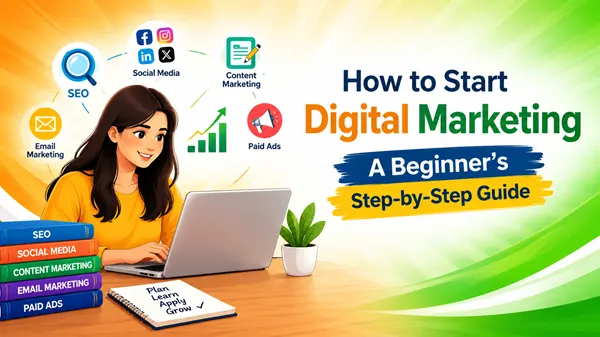
How to Start Digital Marketing: A Beginner’s Step-by-Step Guide
Digital marketing can seem overwhelming when you are just starting. You may hear about SEO, social media, paid advertising, email campaigns, analytics, and artificial intelligence, all while trying to decide which skill to learn first.
The good news is that you do not need to master every marketing channel at once. You can begin with a few essential concepts, practise them on a real or sample project, and gradually develop the skills needed to promote a business online.
Learning how to start digital marketing is useful whether you want to grow your own business, promote a website, become a freelancer, or build a career in digital marketing.
This guide explains the fundamentals, introduces beginner-friendly tools, and provides a practical roadmap you can follow without making a large initial investment.
What Is Digital Marketing?
Digital marketing is the promotion of products, services, brands, or ideas through digital channels such as search engines, websites, social media platforms, email, and online advertising networks.
For example, imagine that you own a small bakery. You could use digital marketing to:
- Publish a website showing your products and prices.
- Improve your website so customers can discover it through Google Search.
- Share cake designs and customer stories on Instagram.
- Send email offers to customers who have agreed to receive them.
- Run paid advertisements to promote a seasonal offer.
- Measure website visits, enquiries, and orders to understand which activities work.
These activities help connect the business with people who may be interested in its products.
Unlike traditional marketing methods such as printed flyers or newspaper advertisements, digital marketing can often provide detailed information about audience interactions and campaign performance. However, results depend on the channel, tracking setup, audience, and quality of the campaign.
Why Is Digital Marketing Important?
People use the internet to research products, compare services, learn new skills, and find businesses. A well-planned digital marketing strategy helps organisations reach relevant audiences where they spend time online.
The main benefits include:
1. Reach a relevant audience
Businesses can target their marketing around interests, search behaviour, location, and other appropriate audience characteristics, depending on the channel and its available settings.
2. Start with a manageable budget
A beginner can learn SEO, publish useful content, and build an organic social media presence without buying advertisements. Paid campaigns can be introduced later when there is a clear objective and suitable budget.
3. Measure marketing performance
Analytics can help you understand how people discover your website, which pages they visit, and whether they complete actions such as submitting a form or making a purchase.
4. Build trust over time
Helpful articles, educational videos, useful social media posts, and relevant email communication can demonstrate expertise and strengthen relationships with potential customers.
5. Develop valuable professional skills
Digital marketing includes several career paths, from SEO and content writing to paid advertising, email marketing, social media management, and analytics.
Important: Digital marketing does not guarantee immediate sales or rapid growth. Success depends on the value of the offer, audience demand, competition, execution, and continuous improvement.
What Are the Main Types of Digital Marketing?
Before choosing a learning path, understand the major digital marketing channels and what each one does.
- Search Engine Optimization (SEO)
SEO helps search engines discover, understand, and present relevant website content to users. Beginners can start with keyword research, useful content, internal links, technical basics, and Search Console.
- Social Media Marketing
This involves creating content, interacting with communities, and building brand awareness on platforms such as Instagram, Facebook, LinkedIn, TikTok, or other networks relevant to your audience.
- Pay-Per-Click Advertising (PPC)
PPC and other paid advertising models help businesses reach potential customers through sponsored placements. Advertisers can pay per click, impression, conversion, or another pricing model, depending on the campaign.
- Content Marketing
Content marketing uses useful articles, videos, guides, case studies, and other resources to answer audience questions and support business goals.
- Email Marketing
Email marketing allows businesses to communicate with people who have subscribed or otherwise provided a valid basis for receiving messages. Common uses include newsletters, onboarding emails, and customer updates.
- Web Analytics and Conversion Optimization
Analytics helps marketers understand behaviour and results. Conversion optimization focuses on improving the likelihood that visitors complete useful actions, such as requesting a quote or purchasing a product.
You do not need to specialise in all six areas immediately. Start with one primary skill, understand how it supports a business goal, and expand as your experience grows.
How to Start Digital Marketing: 10 Practical Steps
The most effective way to learn digital marketing is to combine structured learning with practical work. Follow these ten steps in order, adjusting the pace to your available time.
Step 1: Define Your Goal
First, decide why you want to learn digital marketing. Your goal determines which skills you should prioritise.
Common starting goals include:
- Growing a business: Attract customers, generate enquiries, or increase online sales.
- Building a career: Develop skills that employers need and prepare a portfolio.
- Starting freelancing: Learn a specific service you can offer to clients.
- Promoting a blog or website: Increase relevant visitors, engagement, and advertising or affiliate revenue.
- Marketing a product: Help the right audience discover and purchase it.
For example, someone who wants to grow a blog should probably prioritise SEO, content strategy, website performance, and analytics. Someone who wants to manage paid campaigns should learn advertising fundamentals, audience targeting, budgeting, and measurement.
Your first task: Write down one goal you want to achieve within the next three months. Make it specific enough to measure.
Instead of saying, “I want to learn marketing,” try, “I want to publish eight useful blog posts and learn how to measure their search performance.”
Step 2: Understand Your Target Audience
Digital marketing works best when you understand the people you want to reach.
Before creating content or advertisements, answer these questions:
- Who is your ideal customer or reader?
- What problem are they trying to solve?
- What questions do they ask before making a decision?
- Which websites, search engines, or social platforms do they use?
- What would persuade them to trust your business?
Suppose you want to promote an online course for beginners learning Excel.
Your audience might be students, job seekers, and professionals who want to improve their spreadsheet skills. Their questions may include how to use formulas, create charts, or prepare for spreadsheet-related interviews.
You can use those questions to plan articles, tutorials, short videos, and email content.
Create a simple customer profile
| Element | Example |
| Audience | Job seekers and office beginners |
| Main problem | Limited spreadsheet knowledge |
| Goal | Learn practical Excel skills |
| Content preference | Step-by-step tutorials |
| Possible offer | Beginner Excel course |
| Desired action | Visit the course page or enrol |
This is a starting hypothesis, not a substitute for research. Refine it using conversations with customers, search queries, website data, and campaign results.
Step 3: Learn the Fundamentals of Marketing
Before learning individual tools, understand the basic principles behind a successful campaign.
Customer journey: People may discover a business, research its offer, compare alternatives, and eventually purchase or enquire. Different people enter this journey at different points.
Value proposition: Explain clearly why someone should choose your product or service. Focus on the problem you solve and the value you provide.
Marketing funnel: A simplified model that groups activities into awareness, consideration, and conversion. It helps organise marketing efforts around different stages of decision-making.
Call to action (CTA): A clear instruction that encourages the next step, such as “Read the guide,” “Request a quote,” or “Start your free trial.”
Key performance indicators (KPIs): Measurable indicators used to assess progress towards a business goal.
For instance, if a local plumbing company wants more enquiries, website traffic alone is not enough to evaluate success. Relevant measures may include qualified enquiries, enquiry conversion rate, and the cost of acquiring a customer.
These concepts will help you make better decisions regardless of which digital marketing channel you choose.
Step 4: Choose One Digital Marketing Skill to Learn First
A common beginner mistake is trying to learn SEO, paid advertising, video editing, social media, email automation, and analytics simultaneously.
Instead, choose a primary skill based on your goal.
Choose SEO if you enjoy research and writing.
Learn search intent, keyword research, on-page SEO, internal linking, technical SEO basics, and performance monitoring.
Choose social media marketing if you enjoy communication and creative work.
Learn content planning, copywriting, short-form video concepts, community engagement, and platform analytics.
Choose PPC if you enjoy testing and numerical analysis.
Learn campaign objectives, keyword targeting, bidding, ad copy, landing pages, and conversion tracking. Practise with training environments before spending real money.
Choose email marketing if you enjoy communication and customer relationships.
Learn audience segmentation, newsletter writing, consent, deliverability, and campaign reporting.
Choose analytics if you enjoy interpreting data.
Learn traffic sources, event tracking, conversion measurement, reporting, and how to turn observations into practical recommendations.
You can develop a broad understanding of all these areas later. Initially, depth in one useful skill is often more valuable than a superficial understanding of everything.
Step 5: Learn Keyword Research and Content Planning
Keyword research helps you understand the language people use when searching for information, products, and services.
Start with the topic your audience cares about, then investigate related questions and the kind of results search engines display.
For a beginner photography website, a topic might be “photography for beginners.” Related queries could include:
- How to use a camera for beginners
- Best camera settings for portraits
- Photography composition tips
- How to take better photos in low light
These queries represent different needs. A person learning camera basics may want a tutorial, while someone comparing camera equipment may be closer to making a purchase.
A simple keyword research process
- Start with a topic. Identify a problem your audience wants to solve.
- Explore related queries. Use Google Search suggestions, related searches, and the People Also Ask section when available.
- Check search intent. Determine whether searchers want an explanation, comparison, product, or specific website.
- Review competing results. Understand what useful information the existing pages provide and identify gaps you can address.
- Group related keywords. Organise queries that can be answered well by the same page.
- Prioritise realistically. Consider relevance, competition, your expertise, and the value the topic offers your audience.
Tools such as Google Trends can help explore interest over time, while Google Search Console can show queries for which your website already receives impressions.
Avoid selecting keywords solely because a tool reports a high search-volume estimate. A smaller, highly relevant audience can be more valuable than a large audience with little interest in your offer.
Step 6: Build a Website or Practical Marketing Project
You do not need a large website to begin practising digital marketing. You need a project where you can apply your learning and observe the results.
Possible projects include:
- A personal blog about a subject you understand.
- A sample marketing plan for a fictional business.
- A website for a local shop or service provider.
- A portfolio showcasing your writing and marketing work.
- A small educational website with useful guides and tutorials.
If you create a website, include the basics:
- A clear homepage explaining what the site offers.
- Relevant pages with useful, original content.
- Simple navigation and a mobile-friendly layout.
- A contact page or another appropriate conversion path.
- Secure HTTPS access.
- Accurate page titles and descriptive headings.
- A way to measure important actions.
For a website intended to appear in search engines, learn how crawling, indexing, and search visibility work. Google’s official SEO Starter Guide is a useful reference for understanding these fundamentals.
Example: A beginner’s marketing project
Imagine you create a blog that teaches people how to use spreadsheets.
You could publish a series of beginner tutorials, optimise the pages for relevant queries, share short tips on LinkedIn, and add a newsletter signup for readers who want more lessons.
You would then monitor which pages attract search impressions, which posts generate engagement, and whether visitors subscribe.
This project teaches several skills at once without requiring a paid advertising campaign.
Step 7: Learn to Use Essential Digital Marketing Tools
Digital marketing tools help you research topics, publish content, analyse visitors, manage campaigns, and measure outcomes.
You do not need to buy an expensive software subscription immediately. Start with a small set of tools that support your current learning goal.
| Tool | Main purpose | Beginner task |
| Google Search Console | Search visibility and indexing information | Review impressions, clicks, and search queries |
| Google Analytics 4 | Website and app behaviour measurement | Explore traffic sources and important events |
| Google Trends | Explore search interest over time | Compare interest in related topics |
| Google Keyword Planner | Keyword research and advertising planning | Explore keyword ideas and estimates |
| Google Ads Skillshop | Learn Google Ads concepts | Complete a relevant learning path |
| Meta Blueprint | Learn marketing on Meta platforms | Study social media and advertising fundamentals |
| Canva | Create visual content | Design a simple social media graphic |
| WordPress | Publish and manage website content | Build a small blog or portfolio |
Tool availability, free features, pricing, and certification requirements can change. Check the official provider’s website before relying on a particular feature.
For example, Google provides official documentation on setting up a Google Analytics 4 property and data stream.
Google Skillshop offers self-paced training and Google Ads learning paths, while Meta Blueprint provides courses covering its marketing platforms.
The key is to learn what a tool helps you accomplish, not simply how to navigate its interface.
Step 8: Practise with a Realistic Campaign
Reading about digital marketing is useful, but practical experience helps you understand how different activities fit together.
Create a small campaign with one clear objective.
For example, imagine a neighbourhood fitness studio that wants more enquiries about beginner classes.
Your campaign might include:
- Goal: Increase qualified enquiries for introductory classes.
- Audience: People within the studio’s service area who are interested in fitness.
- Website content: A page explaining the classes, schedule, location, pricing, and how to enquire.
- SEO: Answer relevant questions about beginner fitness classes and optimise the page naturally.
- Social media: Publish useful exercise tips and information about the classes.
- Conversion path: Provide a clear enquiry form or contact method.
- Measurement: Track relevant visits, enquiries, and the proportion of visitors who enquire.
- Improvement: Identify where visitors lose interest and test reasonable changes.
You could begin with organic activities and add paid promotion later if the business has an appropriate budget.
How to measure the campaign
Use a small set of metrics connected to your objective.
| Metric | What it helps you understand |
| Impressions | How often content or an advertisement was displayed, according to the platform’s definition |
| Clicks | How often users clicked a result, link, or advertisement |
| Click-through rate (CTR) | The proportion of impressions that resulted in clicks |
| Conversion rate | The proportion of relevant visitors or interactions that completed a defined action |
| Cost per lead | Advertising or campaign cost divided by the number of leads, when applicable |
| Qualified leads | How many enquiries match the business’s intended customer profile |
For example, if 200 visitors reach a class enquiry page and 10 submit the form, the page’s visitor-to-enquiry conversion rate is 5%, assuming all 200 visitors are included in the measurement.
That figure describes the example; it is not a universal benchmark. You need context and reliable tracking before judging whether a real campaign is performing well.
Step 9: Learn Analytics and Improve Your Results
Once your project starts receiving visitors or engagement, use the available data to decide what to improve.
Start with three questions:
- Where are people discovering my content?
- Which pages or campaigns help achieve the goal?
- What prevents interested visitors from taking the next step?
Suppose an article receives impressions in search results but few clicks. Review whether the title and description accurately communicate the page’s value, whether the search intent matches the content, and how the page compares with other results.
If the article attracts visitors but generates few newsletter subscriptions, examine whether the newsletter offer is relevant, the signup process is clear, and the content provides a good reason to subscribe.
Avoid changing everything simultaneously. Make a focused improvement, observe the results over an appropriate period, and consider other explanations before concluding that the change caused an improvement.
Also remember that analytics data has limitations. Consent choices, browser restrictions, tracking configuration, and differences between platforms can affect reported measurements. Not every visit or conversion will necessarily be recorded.
Step 10: Build a Portfolio and Expand Your Skills
A portfolio demonstrates that you can apply what you have learned.
You do not need to wait for a paid client before creating one. Use your own website, a volunteer project, or a clearly labelled sample project.
A beginner’s digital marketing portfolio might include:
- A keyword research document with search-intent analysis.
- Two or three useful, optimised articles.
- A sample social media content calendar.
- An example email newsletter.
- A mock advertising campaign plan.
- A simple analytics report with recommendations.
For each project, explain the objective, the work you completed, the tools you used, and what you learned.
If you have actual performance data, report it honestly and provide enough context to explain the results. If the project is a demonstration, label it as a sample rather than presenting hypothetical results as real achievements.
Once you have a strong foundation, expand into complementary skills. An SEO specialist may benefit from learning analytics and content strategy, while a paid media specialist may benefit from conversion optimization and landing-page testing.
A 30-Day Digital Marketing Learning Roadmap
A short, structured learning plan makes it easier to turn knowledge into practice. The following schedule is a starting recommendation, not a guarantee of professional proficiency within 30 days.
Week 1
Days 1–7
Learn the fundamentals
- Understand the major digital marketing channels.
- Choose a goal and target audience.
- Learn customer journeys, marketing funnels, and KPIs.
- Select one primary skill to develop.
Output: A one-page marketing plan.
Week 2
Days 8–14
Learn and create
- Study your chosen skill.
- Practise keyword research or campaign planning.
- Build a basic website or sample project.
- Create your first useful piece of content.
Output: A working page, campaign plan, or content sample.
Week 3
Days 15–21
Implement and measure
- Publish or prepare your project.
- Set up appropriate measurement tools.
- Create supporting social media or email content.
- Review the quality of the user experience.
Output: An implemented project with a measurement plan.
Week 4
Days 22–30
Analyse and document
- Review the data available.
- Identify problems and potential improvements.
- Create a simple performance report.
- Prepare a portfolio case study and next month’s learning plan.
Output: A portfolio-ready project with honest findings.
If you have only 30 minutes per day, use that time consistently. If you have more time, spend it practising rather than collecting courses you never apply.
How to Start Digital Marketing with No Experience
You can begin without previous professional experience or a marketing degree. However, you still need to develop practical skills and demonstrate that you can use them responsibly.
Here is a straightforward approach.
Start with free learning resources
Use official documentation and platform training to learn the basics before purchasing courses.
- Google Search Central for SEO and Google Search documentation.
- Google Skillshop for Google Ads and other Google marketing tools.
- Meta Blueprint for learning Meta marketing platforms.
- Google Analytics Help for analytics setup and reporting guidance.
These resources can help you build a foundation, although completing a course does not automatically make you an experienced marketer.
Practise before offering services
For example, choose a small business and create a sample audit of its public website. Identify opportunities involving page titles, useful content, mobile usability, internal links, and conversion paths.
Clearly distinguish recommendations from verified problems. Do not claim access to the business’s analytics or advertising accounts unless the owner has provided it.
Look for opportunities to gain experience
You might:
- Help a local organisation with an agreed, limited project.
- Build and promote your own website.
- Apply for internships or entry-level positions.
- Create sample campaigns using mock data.
- Offer a narrowly defined service to a suitable first client.
If you work with a real client, agree on the scope, deliverables, access permissions, budget, reporting, and ownership of accounts before starting.
Focus on proof of skill
A portfolio showing thoughtful research, clear execution, and honest reporting can make your abilities easier to evaluate.
Certifications may support your learning and demonstrate familiarity with particular platforms, but they should complement practical work rather than replace it.
How to Start a Digital Marketing Career
Digital marketing offers several specialisation paths. Your best choice depends on your interests, current skills, and the type of work you enjoy.
| Career path | Core skills to develop |
| SEO specialist | Keyword research, content optimization, technical SEO, search performance analysis |
| Content marketer | Research, writing, editorial planning, content distribution |
| Social media manager | Content calendars, creative production, community management, reporting |
| PPC specialist | Campaign setup, targeting, budgets, bidding, conversion tracking |
| Email marketer | Segmentation, copywriting, consent management, automation, deliverability |
| Digital marketing analyst | Measurement plans, analytics, data interpretation, reporting |
| Digital marketing generalist | Working knowledge across channels, planning, execution, and reporting |
Create a career-focused portfolio
Choose two or three projects that demonstrate skills relevant to the position you want.
For an SEO role, for example, you might provide a keyword research sample, a content optimization exercise, and a report explaining how you would diagnose an indexing problem.
For a social media role, you could present a content calendar, example creative concepts, audience research, and a measurement plan.
Describe your own contribution accurately, especially when a project involves other people.
Prepare for interviews
Be ready to explain:
- How you would approach a marketing problem.
- Which metrics you would use and why.
- How you would investigate weak campaign performance.
- How you would prioritise tasks with limited resources.
- What you learned from a project that did not go as expected.
Employers may value practical reasoning and communication alongside platform knowledge. Requirements vary by role and organisation.
How to Start Digital Marketing as a Freelancer
Freelancing is another option, but it involves more than understanding marketing tools. You must also communicate with clients, define deliverables, manage expectations, and demonstrate the value of your work.
1. Select one service
Start with a service you can deliver competently, such as:
- On-page SEO audits.
- Blog content planning.
- Social media content calendars.
- Email newsletter setup.
- Basic website analytics reporting.
- Paid advertising support under an agreed scope.
Avoid promising guaranteed rankings, sales, or lead volumes.
2. Define the deliverables
Instead of offering vague “complete digital marketing,” specify exactly what the client receives.
For example, a starter SEO service might include a review of a defined number of pages, a list of prioritized recommendations, and a final report.
3. Find suitable prospects
You can use professional networks, freelance marketplaces, referrals, or direct outreach. Focus on businesses that genuinely need your service and can reasonably benefit from it.
Personalise outreach, respect platform rules, and follow applicable privacy and marketing laws.
4. Report progress honestly
Explain what you completed, what the data shows, which limitations apply, and what you recommend next.
A professional freelancer builds trust by setting realistic expectations and communicating clearly—not by guaranteeing outcomes that depend on factors outside their control.
Common Digital Marketing Mistakes Beginners Should Avoid
Learning what not to do can save time and money.
Trying to use every channel at once: Start with one main goal and a manageable set of activities. Expand when you have a clear reason.
Publishing content without understanding search intent: A page may include relevant keywords yet fail to answer the question readers actually have. Research the audience’s needs before writing.
Expecting immediate organic traffic: SEO results can take time, and some pages may never attract substantial traffic. Evaluate content quality, indexing, relevance, competition, and user needs rather than assuming rankings will improve automatically.
Spending on ads before understanding conversion tracking: If you cannot measure meaningful outcomes, it becomes harder to evaluate the value of advertising. Test the conversion path and tracking setup before committing significant budget.
Chasing vanity metrics: Likes and impressions can be useful indicators, but they do not always reflect leads, sales, or business value. Select metrics that match your objective.
Copying competitors: Study competing pages to understand audience expectations, not to duplicate their wording. Develop original content based on your knowledge, research, and practical experience.
Ignoring mobile users: Test your pages on mobile devices. Slow pages, difficult forms, and confusing navigation can make it harder for visitors to complete their goals.
Buying unnecessary tools: Begin with tools that solve an actual problem. Add paid subscriptions when their value justifies the expense.
Using AI without checking its output: AI tools can assist with brainstorming, outlines, analysis, and editing, but inaccurate claims, repetitive content, privacy risks, and weak recommendations still require human review.
Ignoring privacy and consent: Follow relevant data protection, cookie, email marketing, and advertising requirements for your target markets. Rules vary across jurisdictions, so consult appropriate official guidance when collecting or using personal data.
Best Practices for Learning Digital Marketing Faster
To make steady progress, build habits that reinforce both knowledge and practical ability.
- Learn with a project: Apply each new concept to a website, business scenario, or portfolio task.
- Use official documentation: Product interfaces and advertising policies change, so confirm important details with the platform provider.
- Write down your decisions: Record why you selected a keyword, audience, content format, or KPI.
- Measure the right outcomes: Connect marketing metrics to the original business objective.
- Test changes carefully: Make focused improvements and evaluate them using suitable evidence.
- Protect user privacy: Collect only the data you need and handle it responsibly.
- Review your work: Check factual accuracy, readability, accessibility, links, and mobile usability before publishing.
- Keep learning: Digital marketing platforms and user behaviour evolve. Regularly review new documentation and reassess established practices.
One more principle matters: treat early projects as opportunities to learn, not as proof that every tactic will work everywhere. A method that performs well for one audience or business may not deliver the same result for another.
Recommended Free Resources to Continue Learning
After completing your first project, use these official resources to strengthen your knowledge.
Google Search Central
Learn how Google Search works, how to improve crawlability and indexing, and how to create search-friendly content.
Google Skillshop
Explore self-paced learning paths for advertising, measurement, and Google marketing products.
Meta Blueprint
Study social media marketing, campaign planning, and advertising on Meta platforms.
Choose a resource that matches your current learning objective. You will benefit more from completing one relevant course and applying it to a project than from collecting certificates without practical experience.
Key Takeaways
- Start with a clear goal. Decide whether you want to promote a business, grow a website, freelance, or pursue a marketing career.
- Learn the fundamentals first. Understand your audience, customer journey, value proposition, and marketing KPIs.
- Choose one primary skill. Begin with SEO, content marketing, social media, PPC, email marketing, or analytics.
- Practise with a real project. Build a website, create a sample campaign, or help a suitable organisation with an agreed project.
- Use beginner-friendly tools. Explore official learning resources and free tools before investing in expensive subscriptions.
- Measure meaningful results. Connect traffic and engagement metrics to outcomes such as enquiries, subscriptions, and sales.
- Build a portfolio and keep improving. Document your work, explain your decisions, and expand your skills as you gain experience.
FAQ
1. How do I start digital marketing as a complete beginner?
Start by learning digital marketing fundamentals and identifying your goal. Choose one main skill, such as SEO or social media marketing, practise it on a website or sample project, and use appropriate tools to measure your progress. Build a portfolio as you gain experience.
2. Can I learn digital marketing for free?
Yes. You can begin with free official documentation, educational resources, and tools such as Google Search Console, Google Trends, and Google Analytics. You can also create a basic portfolio project without purchasing advertising. Some advanced tools, courses, certifications, and services may require payment.
3. Can I start digital marketing without a degree or experience?
Yes. Many digital marketing skills can be learned independently, and some entry-level roles and freelance opportunities do not require a specific degree. However, employers and clients may expect relevant knowledge, communication skills, practical experience, and evidence that you can complete the work.
4. Which digital marketing skill should I learn first?
Choose based on your goal and interests. SEO and content marketing are useful starting points for people who enjoy research and writing. Social media marketing suits those interested in communication and creative work. PPC may suit people who enjoy campaign testing and data analysis. Analytics is useful across nearly every specialisation.
5. How long does it take to learn digital marketing?
You can learn the fundamentals over several weeks with consistent study and practice. Developing job-ready skills usually requires additional projects, feedback, and experience. The time required depends on your starting knowledge, available study time, chosen specialisation, and the level of proficiency you want to achieve.
6. Can I start digital marketing from home?
Yes. You can study online, practise using your own website or sample projects, build a portfolio, and apply for remote jobs or freelance work. Some roles may require collaboration with clients or teams across different time zones, and remote opportunities vary by employer and market.
7. Do I need a website to start digital marketing?
Not necessarily. You can begin by studying marketing fundamentals, planning social media content, or creating sample campaigns. However, a website or blog is particularly useful for practising SEO, content publishing, conversion optimization, and website analytics. It can also serve as a portfolio.
8. How can beginners get their first digital marketing client?
Choose one service, create sample work that demonstrates your skills, and identify businesses that may benefit from that service. Reach out professionally, explain the specific value you can provide, and offer clearly defined deliverables. Be transparent about your experience and avoid promising guaranteed rankings or sales.
Conclusion
Starting digital marketing becomes easier when you stop treating it as a collection of unrelated tools and begin seeing it as a process: understand an audience, identify a need, create something useful, reach the right people, measure the results, and improve your approach.
You do not need to master every marketing channel before taking your first step. Begin with one goal, choose one skill, and build a small project that lets you practise what you learn.
Your next step: Set aside 30 minutes today to choose your first digital marketing project. Write down its target audience, primary objective, and one measurable outcome. Then start learning the skill that will help you achieve it.
Consistent practice, honest measurement, and a willingness to learn from mistakes will give you a stronger foundation than simply collecting courses or following every new marketing trend.
For more articles on Digital Marketing:
- What Is Digital Marketing? Complete Beginner’s Guide for 2026
- How Does Digital Marketing Work? A Step-by-Step Guide 2026
- Digital Marketing vs Traditional Marketing: What’s the Difference?
- What Are the 7 Types of Digital Marketing? A Beginner’s Guide (2026)
- Why Is Digital Marketing Important for Businesses in 2026? A Complete Guide