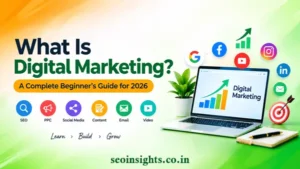
Learn what digital marketing is, how SEO, PPC, social media, content and email work together, and how beginners can build a practical strategy in 2026.
What Is Digital Marketing?
Imagine you own a small bakery.
A potential customer searches Google for “birthday cake near me.” Someone else watches a short video showing your cakes on social media. Another person receives your email about a weekend offer. A fourth customer discovers your website after reading a helpful article about choosing the right cake for a wedding.
These activities may look different, but they have something important in common: they use digital channels to connect your business with potential customers.
Digital marketing is the practice of promoting products, services, brands or ideas through digital channels such as search engines, websites, social media, email, video platforms, mobile apps and online advertising.
The goal is not simply to “be online.” Good digital marketing connects the right audience with a useful message at the right stage of their buying journey.
Modern digital marketing also involves measuring results, learning from customer behaviour and improving campaigns based on evidence. Major digital marketing disciplines include SEO, paid advertising, content marketing, social media marketing, email marketing, affiliate marketing and more.
For a beginner, the easiest way to understand it is:
Digital marketing = reaching people through digital channels and helping them move from awareness to interest, action and eventually loyalty.
Why Is Digital Marketing Important in 2026?
The way people discover, compare and buy products has changed dramatically.
A customer might:
- See a brand on Instagram.
- Search for it on Google.
- Read reviews.
- Watch a YouTube demonstration.
- Visit the website.
- Compare competitors.
- Subscribe to an email list.
- Purchase several days later.
The journey is rarely a straight line.
That is why digital marketing is better understood as an ecosystem of connected channels, rather than a collection of unrelated tactics.
Businesses can use digital marketing to:
- Increase brand visibility
- Attract website visitors
- Generate leads
- Sell products or services
- Build customer relationships
- Encourage repeat purchases
- Understand audience behaviour
- Test marketing messages
- Measure campaign performance
Another major advantage is feedback. Digital campaigns can provide measurable signals such as impressions, clicks, conversions, engagement and revenue, allowing marketers to evaluate and improve their approach.
However, measurement does not mean every result can be perfectly attributed to one channel. Customers often interact with several channels before converting.
How Does Digital Marketing Work?
At its simplest, digital marketing follows a customer journey.
-
Attract
First, you need to get someone’s attention.
This might happen through:
- Google Search
- Social media
- YouTube
- Blog content
- Online advertising
- Email referrals
- Influencers or creators
For example, a person searches:
“How to choose running shoes.”
A sporting goods company publishes a useful guide explaining different shoe types. The searcher discovers the article and becomes aware of the brand.
-
Engage
Getting attention is only the beginning.
The visitor needs a reason to stay.
Useful content, videos, product demonstrations, newsletters, reviews and helpful website experiences can turn initial attention into genuine interest.
-
Convert
Eventually, you want the visitor to take a valuable action.
Depending on the business, that action could be:
- Buying a product
- Requesting a quote
- Booking an appointment
- Signing up for a course
- Downloading a resource
- Joining an email list
- Starting a free trial
-
Retain
Digital marketing does not end after the first sale.
Email campaigns, useful content, customer support, loyalty programs and personalised communication can help businesses maintain relationships with existing customers.
-
Measure and Improve
Finally, marketers examine what happened.
Which campaign generated leads?
Which landing page converted?
Which content attracted qualified visitors?
Which advertising campaign wasted money?
The answers help marketers make better decisions during the next cycle.
Main Types of Digital Marketing
There is no single universal list of digital marketing channels. Different marketers group activities differently. The following categories cover the major disciplines beginners should understand.
-
Search Engine Optimization (SEO)
SEO is the practice of improving websites and content so they can be discovered through unpaid search results.
Suppose you operate an online gardening store.
Someone searches:
“best indoor plants for low light.”
You publish a genuinely useful guide explaining suitable plants, their care requirements and common mistakes.
If the page earns visibility in search results, it can introduce your business to people who are already interested in the topic.
SEO generally involves:
- Search intent research
- Useful content
- On-page optimization
- Technical SEO
- Internal linking
- Website structure
- Image optimization
- Digital authority and reputation
SEO is particularly valuable for businesses that want to build sustainable organic visibility over time.
But SEO is not a shortcut to guaranteed rankings. Following search-engine best practices can improve a site’s eligibility and quality, but no legitimate SEO method can guarantee a particular position in search results.
-
Pay-Per-Click and Paid Advertising
Paid advertising allows businesses to pay for visibility across digital platforms.
Common examples include:
- Search advertising
- Display advertising
- Social media advertising
- Video advertising
- Shopping advertisements
- Remarketing campaigns
For example, a travel company could advertise when someone searches for:
“family holiday packages.”
Unlike SEO, paid advertising can provide visibility without waiting for a page to earn organic search visibility.
But paid traffic has a cost. Successful campaigns require careful targeting, compelling advertisements, appropriate landing pages and measurement.
-
Social Media Marketing
Social media marketing uses platforms such as Instagram, Facebook, LinkedIn, TikTok, YouTube and other networks to reach and engage audiences.
Businesses may use social media for:
- Brand awareness
- Community building
- Product discovery
- Customer support
- Lead generation
- Traffic
- Direct sales
- Creator collaborations
Imagine a fitness coach.
Instead of simply posting:
“Buy my training program.”
the coach could publish useful workout tips, answer common questions, share client-approved success stories and demonstrate exercises.
The audience receives value before being asked to buy.
That is a fundamental principle of effective social media marketing.
-
Content Marketing
Content marketing focuses on creating and distributing useful content for a defined audience.
Content can include:
- Blog posts
- Guides
- Case studies
- Videos
- Podcasts
- Newsletters
- Infographics
- Tutorials
- Webinars
- Checklists
For example, an accounting software company might publish:
“Small Business Cash Flow: A Beginner’s Guide.”
The article may help someone solve a problem while introducing the company to a potential customer.
Content marketing and SEO often work closely together. Content provides something useful for people to discover, while SEO helps relevant audiences find it.
-
Email Marketing
Email marketing allows businesses to communicate directly with people who have opted to receive their messages.
Common email campaigns include:
- Welcome emails
- Newsletters
- Product announcements
- Educational sequences
- Special offers
- Abandoned-cart messages
- Customer retention campaigns
For example, an online bookstore could send a new subscriber a sequence such as:
Email 1: Welcome and recommended books
Email 2: How to choose your next book
Email 3: Popular books in your favourite category
Email 4: New arrivals
Email is especially useful because the business is building a direct communication channel rather than relying entirely on algorithmic distribution.
-
Video Marketing
Video has become an important part of digital marketing across websites, social platforms and video services.
Businesses can create:
- Tutorials
- Product demonstrations
- Explainer videos
- Interviews
- Short-form videos
- Webinars
- Customer stories
Consider someone shopping for a camera.
A written product description tells them specifications. A demonstration video can show how the camera actually operates.
That difference can make video particularly powerful for products that benefit from visual explanation.
-
Affiliate Marketing
Affiliate marketing involves partnerships in which another person or organization promotes a product or service and receives compensation according to an agreed arrangement, often based on sales or other measurable actions.
For example:
A technology website reviews a laptop.
A reader clicks an affiliate link and purchases the laptop.
The publisher may receive a commission according to the affiliate program’s terms.
Affiliate marketing can help businesses extend their reach while giving publishers another way to monetize relevant audiences.
-
Influencer and Creator Marketing
Influencer marketing involves collaborating with creators who have an established audience.
A skincare company, for example, might work with a creator whose audience is interested in skincare.
The important question is not simply:
“How many followers does this creator have?”
Instead, marketers should consider:
- Audience relevance
- Engagement quality
- Content quality
- Brand fit
- Audience trust
- Campaign objectives
- Disclosure requirements
A smaller but highly relevant audience can sometimes be more valuable than a much larger audience with little connection to the product.
-
Mobile and Messaging Marketing
Digital marketing can also include mobile-focused experiences and permission-based messaging.
Examples include:
- Mobile applications
- SMS marketing
- Push notifications
- Mobile-friendly websites
- Messaging-based customer communication
The key is relevance and permission. Sending excessive or unwanted messages can damage the relationship a business is trying to build.
Digital Marketing vs Traditional Marketing
The biggest difference is the environment in which the marketing activity takes place.
| Digital Marketing | Traditional Marketing |
| Search engines | Newspapers |
| Websites | Magazines |
| Social media | Billboards |
| Direct mail | |
| Online advertising | Television |
| Video platforms | Radio |
| Mobile apps | Print advertising |
Digital marketing often offers more granular measurement and targeting possibilities. Traditional marketing can still be valuable, particularly for local awareness, mass-market exposure and situations where offline experiences matter.
The two approaches do not have to compete.
A business can use both.
For example, a restaurant could distribute printed menus locally while using SEO, social media, email and online advertising to attract customers digitally.
What Are the Benefits of Digital Marketing?
Global Reach
A website can potentially reach customers beyond the business’s physical location.
A small company in one country can create content for customers in other markets, provided it understands language, culture, regulations, logistics and customer expectations.
Better Audience Targeting
Many digital advertising platforms allow marketers to define audiences using available targeting options.
This can make it easier to present relevant messages to specific groups.
Measurable Results
Digital marketing can provide data about activities such as:
- Impressions
- Clicks
- Website visits
- Leads
- Purchases
- Conversion rates
- Engagement
Measurement helps marketers make informed decisions.
Flexible Testing
Digital campaigns can often be tested and adjusted more easily than traditional campaigns.
A marketer might test two headlines, landing pages or advertisements and compare their performance.
Relationship Building
Digital channels provide many opportunities for businesses to communicate with customers before, during and after a purchase.
What Is a Digital Marketing Strategy?
A digital marketing strategy is a structured plan for using digital channels to achieve specific business objectives.
It should answer five basic questions:
- Who are we trying to reach?
- What problem are we solving?
- Where does this audience look for information?
- What action do we want them to take?
- How will we measure success?
Without these questions, businesses often fall into the trap of posting content everywhere without knowing why.
How to Create a Digital Marketing Strategy as a Beginner
You do not need ten platforms and a huge budget to begin.
Start small.
Step 1: Define Your Goal
Avoid vague goals such as:
“I want more online visibility.”
Make the objective clearer.
For example:
“Generate qualified enquiries for my consulting service.”
Now you have something measurable.
Step 2: Understand Your Audience
Create a simple customer profile.
Ask:
- What does this person need?
- What problem are they experiencing?
- What questions do they ask?
- What objections might stop them buying?
- Where do they look for information?
- What alternatives are they considering?
Customer research is more useful than guessing what people want.
Step 3: Choose the Right Channels
You do not need to use every channel.
If people actively search for your service, SEO and search advertising may deserve priority.
If your product is highly visual, video and social media may be more important.
If you already have a customer database, email marketing may be valuable.
Choose channels based on audience behaviour and business goals, not popularity alone.
Step 4: Create Useful Content
Build content around real customer questions.
For example, a web-design company could create:
- How much does a business website cost?
- What should a business website include?
- WordPress vs website builders
- How to improve website speed
- How to make a website mobile-friendly
Each topic can address a different stage of the customer’s decision-making process.
Step 5: Create a Conversion Path
Do not send every visitor to a generic homepage.
Give visitors a logical next step.
For example:
Search result → Helpful article → Service page → Enquiry form → Follow-up
The path should make sense from the customer’s perspective.
Step 6: Measure Meaningful Results
Do not judge a campaign solely by likes or impressions.
Depending on your objective, useful metrics may include:
- Organic traffic
- Qualified leads
- Conversion rate
- Cost per lead
- Revenue
- Customer acquisition cost
- Email engagement
- Return on advertising spend
The right metric depends on the goal.
Digital Marketing in the Age of AI
One of the biggest changes marketers need to understand in 2026 is the growing role of artificial intelligence.
AI can help marketers with activities such as:
- Brainstorming ideas
- Research organization
- Content outlines
- Data analysis
- Audience segmentation
- Campaign experimentation
- Creative production
- Workflow automation
- Customer-service assistance
AI is also changing how people discover information. Search experiences increasingly include AI-generated or AI-assisted responses, while consumers can use AI tools alongside traditional search, social platforms and websites.
But AI does not eliminate the fundamentals of marketing.
A business still needs:
A real audience + a real problem + a useful solution + a credible message + a good customer experience.
Using AI to produce large quantities of generic content does not automatically create effective marketing.
The competitive advantage increasingly comes from combining technology with original expertise, customer understanding, useful information and strong execution.
Common Digital Marketing Mistakes Beginners Make
Trying Every Platform
Being active everywhere is not the same as having a strategy.
Start with one or two channels where your audience is most likely to be found.
Focusing Only on Traffic
Thousands of visitors are not necessarily valuable if none become customers.
Connect traffic metrics with meaningful business outcomes.
Publishing Without Understanding Search Intent
A page can target the right keyword and still fail to satisfy the person searching.
Always ask:
“What does this person actually want to accomplish?”
Expecting Instant SEO Results
SEO is generally a long-term activity. Publishing one article does not guarantee immediate visibility.
Focus on creating useful resources and improving the overall quality of your site.
Copying Competitors
Competitor research can help identify topics and gaps, but copying their structure or wording rarely creates a strong brand.
Develop your own examples, expertise and perspective.
Ignoring Existing Customers
Acquiring a customer is only part of marketing.
Retention, support, education and repeat purchases can be equally important depending on the business model.
Digital Marketing Tools Beginners Should Understand
You do not need dozens of tools.
Start by understanding what each category does.
Analytics
Used to understand website and campaign activity.
Search Performance Tools
Used to monitor how your website appears in search and identify technical or search-related issues.
SEO Tools
Used for keyword research, competitor analysis, technical audits and content research.
Advertising Platforms
Used to create, manage and measure paid campaigns.
Email Platforms
Used to collect subscribers and send automated or scheduled communications.
Content Management Systems
Used to create and manage websites and content.
AI Tools
Used to support research, ideation, analysis, automation and creative workflows.
The important skill is not knowing the largest number of tools.
It is knowing why and when to use a tool.
Is Digital Marketing a Good Skill for Beginners?
Yes, but it should not be treated as one single skill.
Digital marketing combines several disciplines.
A beginner might start with:
- SEO
- Content writing
- Social media
- Email marketing
- Paid advertising
- Analytics
- Conversion optimization
You do not need to master everything immediately.
A practical learning path is:
Learn marketing fundamentals → choose one channel → practice → measure results → build projects → expand into related channels.
For example, someone interested in SEO could learn keyword research, search intent, on-page SEO, technical fundamentals, content strategy and analytics before moving into paid search or social advertising.
A Simple Digital Marketing Example
Let’s return to the bakery from the beginning.
The bakery wants more birthday-cake orders.
Instead of randomly posting on social media, the owner creates a simple strategy.
Goal
Generate more birthday-cake enquiries.
Audience
People planning birthdays and family celebrations.
SEO
Create pages targeting relevant searches such as birthday cakes, custom cakes and local cake-related searches where appropriate.
Social Media
Publish cake designs, behind-the-scenes content and useful celebration ideas.
Video
Create short videos showing cake decoration and finished designs.
Offer subscribers seasonal cake ideas and promotions.
Paid Advertising
Test advertisements for people actively searching for relevant products or services.
Measurement
Track enquiries, orders and revenue rather than simply counting followers.
Now the channels are working toward one business objective.
That is digital marketing strategy in action.
What Should Beginners Learn First?
If you are completely new, do not start by memorizing hundreds of marketing terms.
Start with these fundamentals:
- Understand the Customer
Marketing starts with people, not platforms.
- Learn Search Intent
Understand why someone is searching and what answer they expect.
- Learn Content Basics
Learn how to create useful, clear and original information.
- Learn SEO Fundamentals
Understand how search engines discover, interpret and rank web pages.
- Learn Analytics
Know how to interpret traffic, conversions and campaign performance.
- Practice
Create a small website, social account, newsletter or mock campaign and learn by doing.
- Review Results
Ask what worked, what failed and what should change.
This cycle is more valuable than simply completing courses.
Key Takeaways
- Digital marketing is the promotion of products, services, brands or ideas through digital channels such as search engines, websites, social media, email and online advertising.
- The major disciplines include SEO, PPC, social media, content, email, video, affiliate and influencer marketing.
- Effective digital marketing is not just about getting traffic; it is about moving people toward meaningful actions and business outcomes.
- A strong strategy begins with clear goals and customer understanding, not with choosing the most popular platform.
- SEO can build long-term organic visibility, while paid advertising can provide faster visibility when campaigns are properly managed.
- AI is changing how marketers create, analyse and distribute content, but fundamental marketing principles remain important.
- Beginners should start with one or two relevant channels, practice consistently and use measurement to improve.
Frequently Asked Questions About Digital Marketing
-
What is digital marketing in simple words?
Digital marketing means promoting a product, service, brand or idea through digital channels such as search engines, websites, social media, email, video platforms and online advertising. Its purpose is to reach relevant people, provide value and encourage useful actions such as enquiries, purchases or sign-ups.
-
What are the main types of digital marketing?
The major types include SEO, PPC advertising, social media marketing, content marketing, email marketing, video marketing, affiliate marketing and influencer marketing. Some marketers also classify mobile marketing, display advertising, marketing automation and other activities separately.
-
How does digital marketing work?
Digital marketing typically works by attracting an audience, engaging them with useful information or experiences, encouraging a conversion, retaining customers and measuring the results. Different channels can support different stages of this journey.
-
Is digital marketing difficult for beginners?
The fundamentals are accessible, but becoming highly skilled takes practice. Digital marketing includes several disciplines, so beginners should focus on learning one area at a time rather than trying to master every channel simultaneously.
-
How can I start learning digital marketing in 2026?
Start by learning marketing fundamentals, customer research, search intent, content, SEO and analytics. Then choose a channel that matches your interests and goals. Create a small practical project, measure its results and gradually add related skills.
Conclusion
Digital marketing can sound complicated because it includes so many platforms, tools and specialized terms.
At its heart, however, the idea is simple.
Find the right audience. Understand what they need. Give them something genuinely useful. Make it easy to take the next step. Measure what happens. Then improve.
SEO can help people discover you. Social media can help you build attention and community. Content can demonstrate expertise. Email can maintain relationships. Paid advertising can accelerate reach. Analytics can show what is actually happening.
The best digital marketers do not simply chase clicks, followers or the latest platform.
They connect customer needs with business goals.
That principle will remain important regardless of how search engines, social networks, advertising platforms and AI tools evolve throughout 2026 and beyond.