

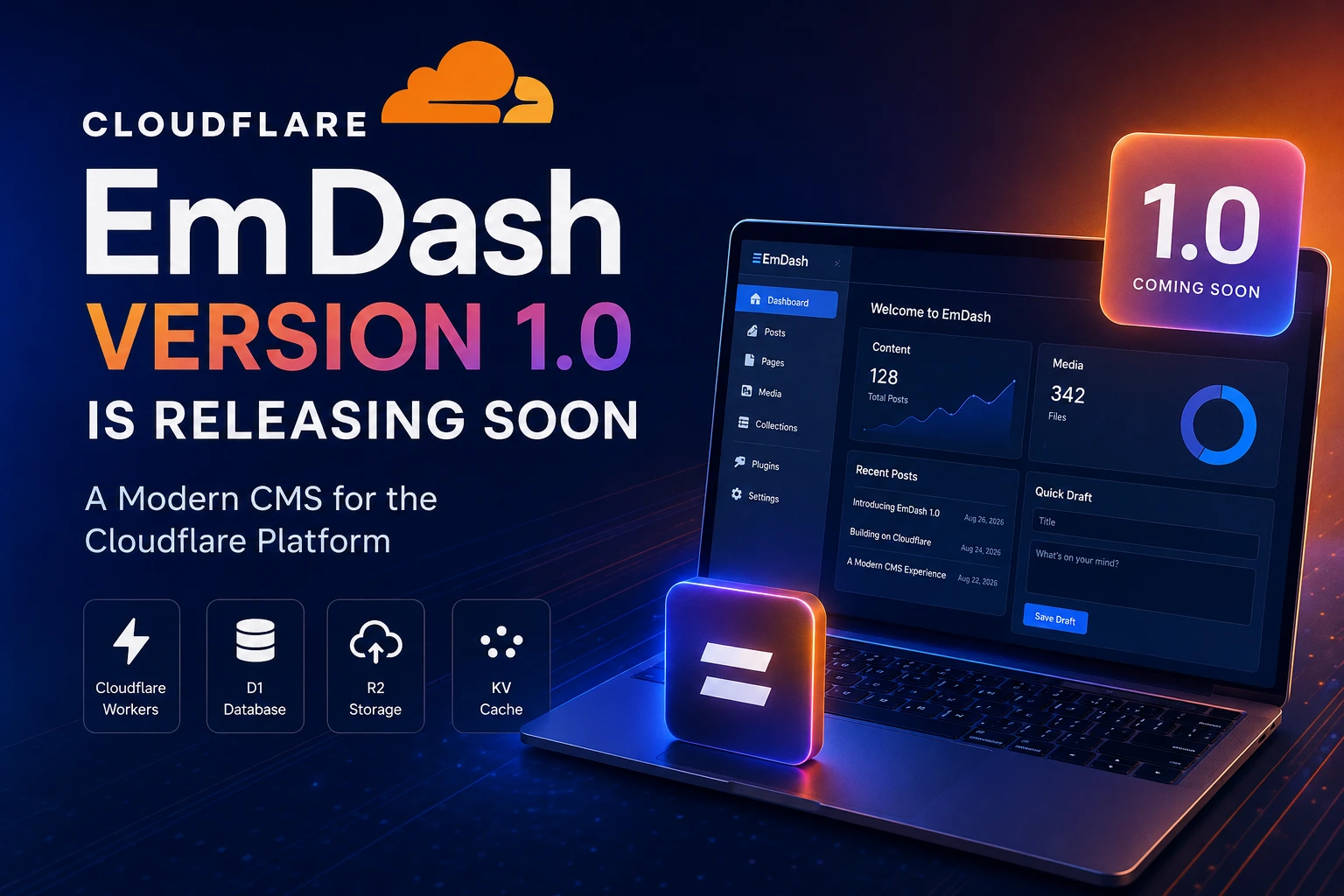
Cloudflare EmDash Version 1.0 Is Coming Soon: What to Know
Cloudflare’s EmDash CMS is moving closer to its first stable 1.0 release.
EmDash first appeared in April 2026 as a beta, with Cloudflare describing it as a “spiritual successor” to WordPress. Rather than building another traditional PHP-based CMS, Cloudflare designed EmDash around modern JavaScript, Astro and its own serverless platform.
Now, after moving the Cloudflare Blog itself to EmDash in August, the project has a much larger real-world test behind it. Cloudflare’s own blog migration provides an important signal about where EmDash is heading before version 1.0.
Highlights
- EmDash is a modern CMS designed for Astro and Cloudflare.
- Cloudflare originally launched EmDash as a beta in April 2026.
- The Cloudflare Blog was migrated to EmDash in August 2026.
- EmDash is designed to address some security and maintenance challenges associated with traditional CMS platforms.
- Its architecture uses technologies such as Cloudflare Workers, D1 and R2.
- The public EmDash 1.0 roadmap was already more than 80% complete as of August 26, 2026.
What Is Cloudflare EmDash?
EmDash is a full-stack content management system designed to run on modern web infrastructure.
Cloudflare introduced it as an open-source CMS built around Astro and serverless JavaScript. One of its major goals is to provide the publishing capabilities people expect from a CMS without depending on the traditional architecture used by platforms such as WordPress.
For a beginner, think of EmDash as software that helps you:
- Create and edit website content
- Manage media
- Organize content
- Add functionality through plugins
- Publish content to the web
- Manage a website through an administrative interface
The important difference is where and how that software runs.
Instead of relying primarily on a conventional web server and database, EmDash can use Cloudflare Workers for application execution, D1 for database storage and R2 for media storage.
Why Is EmDash 1.0 Important?
Software often goes through significant development before reaching version 1.0.
EmDash is currently following a pre-1.0 release model in which minor releases can introduce new features and breaking changes. The project’s documentation explains that its emdash and @emdash-cms/cloudflare packages share the same version number.
A 1.0 release therefore matters because users can expect the project to move beyond its initial development phase toward a more stable foundation.
However, version 1.0 should not automatically be interpreted as “better than WordPress.” The two systems have different architectures, ecosystems and target users.
Cloudflare Is Testing EmDash on Its Own Blog
One of the most significant developments happened in August 2026.
Cloudflare moved its own blog to EmDash on August 12. The company explained that the migration was part of a broader redesign that included changes such as dark mode and a modernized interface.
This is particularly interesting because Cloudflare can use its own infrastructure as a real-world test environment.
Instead of asking developers to trust a CMS only because it works in a demonstration environment, Cloudflare is using EmDash on one of its own important websites.
For potential users, that provides useful evidence that the platform is being tested against real publishing and traffic requirements.
How Does EmDash Work?
At a high level, an EmDash website can combine several Cloudflare services.
Cloudflare Workers
Workers provide the application runtime. They allow web applications to execute across Cloudflare’s distributed network rather than depending on a traditional centralized server.
Cloudflare D1
D1 is Cloudflare’s serverless SQL database. EmDash documentation identifies D1 as an option for Cloudflare Workers deployments.
Cloudflare R2
R2 can be used for media storage, making it suitable for images and other website assets.
Cloudflare KV
EmDash can also use Cloudflare KV as an object cache. The documentation says this cache can store frequently requested database results and reduce database read load.
For a beginner, the simplified picture is:
Visitor → Cloudflare → Workers → EmDash → D1/R2/KV
The exact architecture can become more sophisticated depending on the website.
EmDash vs WordPress: What Is Different?
EmDash is often discussed as a potential modern alternative to WordPress, but it is important not to think of it as simply “WordPress rebuilt.”
Cloudflare’s original announcement described EmDash as a spiritual successor rather than a continuation of WordPress itself.
The biggest differences are architectural.
| Feature | WordPress | EmDash |
| Core approach | Traditional CMS | Modern serverless CMS |
| Primary technology | PHP | JavaScript/TypeScript ecosystem |
| Hosting model | Many hosting options | Strong Cloudflare integration |
| Database | Commonly MySQL/MariaDB | D1 and other supported databases |
| Media | Server/object storage | R2 and other storage options |
| Plugins | Large established ecosystem | Newer plugin ecosystem |
| Edge deployment | Requires additional infrastructure | Designed for Cloudflare Workers |
The table should not be interpreted as saying that one platform is universally better. WordPress has a mature ecosystem developed over many years, while EmDash is a much newer project.
What About EmDash Plugin Security?
Plugin security is one of the ideas behind EmDash.
Traditional CMS plugins can run with significant access to the main application. A vulnerable or poorly designed plugin can therefore become a security concern.
EmDash takes a different approach for sandboxed plugins. On Cloudflare Workers, sandboxed plugins can run in isolated Workers created through the Worker Loader system.
This separation is intended to reduce the risk associated with allowing third-party extensions to operate directly inside the main application.
There is an important practical consideration, though: the EmDash documentation says the sandboxed plugin system on Cloudflare Workers requires a Workers Paid plan and appropriate Worker Loader configuration.
What Does EmDash Mean for Website Owners?
If you are starting a new website, EmDash is an interesting technology to watch.
It could be particularly relevant to developers and publishers who want:
- A modern CMS architecture
- Cloudflare-native deployment
- Serverless infrastructure
- Edge-based delivery
- Programmatic content management
- A newer alternative to traditional CMS platforms
But beginners should avoid migrating an established website simply because EmDash is approaching version 1.0.
A migration involves more than moving articles.
You need to consider:
- URL structures
- Redirects
- Metadata
- Images
- Internal links
- Structured data
- Search engine indexing
- Analytics
- Forms
- Authentication
- Plugins and integrations
What Should SEO Professionals Watch?
From an SEO perspective, the CMS name itself is not the deciding factor.
A website can perform well in search regardless of whether it uses WordPress, EmDash or another platform if it provides technically sound pages and useful content.
If you are evaluating EmDash for SEO, pay attention to:
- URL control
Make sure the CMS allows meaningful, stable URLs.
- Metadata
You should be able to manage titles, descriptions and other important metadata appropriately.
- Indexability
Check how the system handles robots directives, canonical URLs, XML sitemaps and HTTP responses.
- Performance
A modern architecture can help developers build fast websites, but performance ultimately depends on implementation.
- Content migration
If moving from WordPress or another CMS, preserve important URLs whenever possible and create redirects where URLs must change.
Should You Switch From WordPress to EmDash?
For most existing websites, there is no need to rush.
EmDash is still a young project. Its 1.0 milestone is significant, but a stable release does not instantly create the decades of ecosystem maturity that WordPress has accumulated.
For a new technical project, however, EmDash may be worth experimenting with.
A sensible approach is to create a test website first.
A Simple Evaluation Plan
- Create a small test site.
- Publish several different types of content.
- Test image and media management.
- Test URLs and metadata.
- Examine page performance.
- Test backups and deployment.
- Check available plugins and integrations.
- Test your SEO workflow.
- Compare maintenance requirements with your current CMS.
This gives you practical information before committing a production website to a new platform.
What Happens Next?
The public EmDash GitHub 1.0 milestone shows a “First stable release” milestone and was listed as 82% complete on August 26, 2026, with no due date shown.
That means the project was clearly approaching its 1.0 target, but the available public roadmap did not provide a specific guaranteed release date.
For anyone following EmDash, the most useful signals to watch are:
- The official 1.0 milestone
- Release notes
- Documentation changes
- Breaking-change notices
- Cloudflare’s own production experience
- Plugin ecosystem growth
- Deployment and migration improvements
Key Takeaways
- Cloudflare EmDash is a new CMS built around modern web technologies and Cloudflare infrastructure.
- Cloudflare introduced EmDash as a beta in April 2026.
- The Cloudflare Blog moved to EmDash in August 2026, giving the CMS a significant production test.
- EmDash can use Workers, D1, R2 and other Cloudflare services.
- Its plugin architecture includes sandboxed execution for supported deployments.
- The public 1.0 milestone was already substantially complete by late August 2026.
- Website owners should evaluate EmDash carefully rather than assuming that version 1.0 alone makes it a replacement for an established CMS.
FAQ
What is Cloudflare EmDash?
EmDash is an open-source content management system developed around Astro and modern serverless JavaScript. It is designed to work particularly well with Cloudflare’s infrastructure.
Is EmDash a replacement for WordPress?
Cloudflare presents EmDash as a spiritual successor to WordPress, but it is a separate CMS with a different architecture. It does not have WordPress’s mature ecosystem and history.
Is EmDash free?
The EmDash software is open source, but operating a website can still involve infrastructure costs depending on the hosting architecture and Cloudflare services you use.
When will EmDash 1.0 be released?
The public 1.0 milestone indicates that EmDash is working toward its first stable release, but the available milestone does not provide a specific release date.
Is EmDash good for SEO?
A CMS can support good SEO when it provides control over important technical elements such as URLs, metadata, indexability, redirects and structured content. The CMS alone does not guarantee search rankings.
Can EmDash run on Cloudflare Workers?
Yes. Cloudflare’s documentation provides a deployment path using Workers together with D1 for the database and R2 for media storage.
Can plugins run securely in EmDash?
EmDash supports sandboxed plugins. On Cloudflare Workers, these can run in isolated Workers using the Worker Loader system, subject to the deployment requirements documented by EmDash.
Should beginners migrate their website to EmDash now?
Not necessarily. Beginners should first test EmDash on a non-production website and compare its publishing, SEO, deployment and maintenance workflows with their existing CMS.
Conclusion
Cloudflare EmDash is becoming one of the more interesting new CMS projects to watch in 2026.
Its move from beta development toward version 1.0 is significant, but the bigger story may be how Cloudflare is using its own blog as a production environment for the technology.
For SEO professionals and website owners, the important question is not simply whether EmDash reaches version 1.0. The real question is whether its modern architecture, security model and Cloudflare integration provide enough practical advantages to justify adopting a relatively young CMS.
For now, EmDash is best viewed as a promising platform to evaluate, rather than an automatic replacement for WordPress.