

Google Beam Expands Globally: What It Means for the Future of Remote Meetings
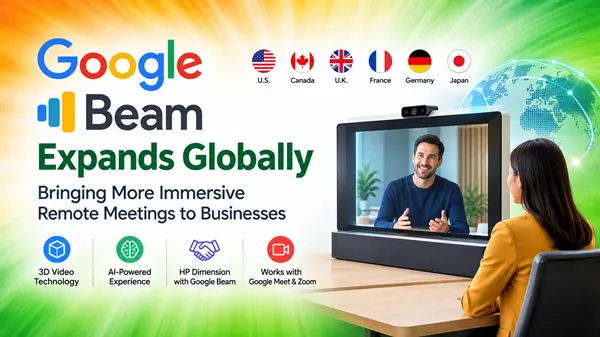
Google Beam expands to six countries with HP, Zoom, and Industrious partnerships, bringing more immersive, face-to-face remote meetings to businesses.
Google Beam Is Moving From Experiment to Wider Business Use
Imagine joining an important business meeting with someone thousands of kilometres away.
You are not looking at a tiny rectangle on a laptop. Instead, the other person appears at a much more natural, life-sized scale, making the interaction feel closer to an in-person conversation.
That is the experience Google has been working toward with Google Beam.
Google originally introduced the technology as Project Starline, a research project designed to make remote conversations feel more like being physically present with another person. In 2025, Google introduced the next stage of that work as Google Beam, describing it as an AI-first 3D video communication platform.
Now the technology is entering a broader commercial phase.
In its September 23, 2026 announcement, Google said Beam units are shipping to customers across six countries and that its ecosystem includes 18 channel partners. The company is also expanding access through a partnership with flexible-workspace operator Industrious.
So what exactly is Google Beam, how does it work, and why could it matter for businesses?
Let’s break it down.
What Is Google Beam?
Google Beam is an AI-powered 3D video communication platform designed to make remote conversations feel more like face-to-face interactions.
Unlike conventional video conferencing, where participants usually appear as flat 2D images on a screen, Beam combines AI-based video processing with specialized display technology to create a more immersive sense of presence.
Google’s earlier explanation of Beam described an AI volumetric video model that transforms video information into a realistic 3D experience. Beam evolved from Project Starline, Google’s earlier research effort into more natural remote communication.
The objective is not simply to make video sharper.
It is to improve the feeling of being together.
That distinction is important.
A normal video call can transmit someone’s voice and facial image. But remote participants can still miss subtle visual cues, body language and the natural feeling of sharing the same space.
Google Beam is designed to address that problem.
How Does Google Beam Work?
At a high level, Google Beam combines several technologies rather than relying on an ordinary webcam and monitor.
Google has described Beam as using AI video processing together with a 3D light-field display. Its earlier Project Starline-to-Beam announcement also described an array of six cameras and AI processing that merges video streams and renders the participant on a 3D light-field display.
-
Multiple Cameras Capture the Person
The system captures visual information from different perspectives.
This provides more information than a traditional single-camera video call.
-
AI Processes the Video
Google’s AI-based technology processes the captured information and generates a representation designed for a three-dimensional viewing experience.
This is one of the important differences between Beam and ordinary video conferencing.
-
The Display Creates a 3D Experience
The processed information is presented through specialized display hardware.
The result is intended to make the remote participant appear much more naturally positioned in the conversation.
-
The Experience Is Designed Around Human Interaction
The ultimate goal is not simply technical sophistication.
It is communication.
Eye contact, facial expressions, gestures and other visual signals can matter when people are interviewing candidates, giving feedback, collaborating on projects or speaking with clients.
Google’s research and product development around Beam have therefore focused heavily on creating a stronger sense of presence.
Google Beam Expansion in 2026
The latest announcement represents an important step for Google Beam.
Google says Beam units are now shipping to customers across:
- United States
- Canada
- United Kingdom
- France
- Germany
- Japan
The rollout is supported by 18 channel partners that can deploy and support Beam.
This is significant because a technology can remain an interesting research project until organizations have practical ways to deploy it.
Google is now building an ecosystem around Beam rather than presenting it only as a technology demonstration.
HP Dimension With Google Beam
One of the most important pieces of the expansion is HP Dimension with Google Beam.
The system is designed for enterprise collaboration and works with both Google Meet and Zoom.
That compatibility matters for businesses.
Companies do not necessarily want to replace every collaboration platform they already use. If immersive communication technology can work alongside familiar meeting services, adoption can become easier.
For example, consider a multinational company with teams in London, Tokyo and New York.
Instead of redesigning its entire communication infrastructure, the organization could potentially use its existing meeting workflows while adding Beam-equipped locations for situations where a stronger sense of physical presence is valuable.
What Makes Google Beam Different From a Normal Video Call?
A traditional video meeting usually gives you a rectangular 2D representation of another person.
That works extremely well for many everyday tasks.
You can:
- Share a presentation
- Send a message
- Turn on your camera
- Discuss a project
- Conduct a quick team meeting
- Record a presentation
But some conversations benefit from richer human interaction.
Think about a job interview.
An interviewer is not listening only to words. They may also observe facial expressions, reactions and body language.
Now consider a manager giving sensitive feedback to a remote employee.
Or a consultant meeting an important client.
Or a distributed team trying to build trust with colleagues they rarely meet physically.
These are situations where the feeling of presence can matter.
Google Beam is designed around this problem.
Google’s May 2026 research update also described an experiment aimed at improving group meetings by rendering participants from non-Beam devices at their true size within the Beam experience.
What Did Google’s Internal Testing Find?
Google says it conducted an eight-week internal study involving teams using Beam.
According to the company, teams using Beam:
- Felt 50% more connected to one another.
- Found it 33% easier to ensure their feedback was clearly understood.
- Experienced a 21% reduction in the need for follow-up meetings.
These figures should be understood in context.
They are results reported by Google from its own internal testing, rather than independent industry-wide research. Businesses should therefore evaluate the technology according to their own meeting requirements and evidence.
Still, the findings provide an interesting indication of the use cases Google believes Beam can address.
Where Can Google Beam Be Used?
Google’s announcement highlights several business scenarios.
Recruiting and Job Interviews
Recruitment is one of the most interesting applications.
Companies often interview candidates who live far away. A highly immersive remote interview could potentially create a more personal experience without requiring the candidate and interviewer to travel.
Google says it worked with Bain to test HP Dimension with Google Beam for campus recruiting and candidate interviews.
For global companies, this could be particularly useful when hiring requires interaction between teams in different countries.
Employee Development
Training and talent development can involve more than simply presenting information.
A manager may need to coach an employee, demonstrate a process or provide detailed feedback.
A stronger sense of presence could make these interactions feel more natural.
Cross-Functional Collaboration
Large organizations often have teams spread across cities and countries.
Marketing may be in one location.
Engineering may be somewhere else.
Sales could be working across several markets.
Beam is designed to make these conversations feel less like people sitting behind separate screens and more like participants sharing the same meeting environment.
Client Consultations
Client relationships depend heavily on communication and trust.
For certain high-value meetings, organizations may prefer a more immersive experience than an ordinary video conference.
Beam’s extended network could make this kind of meeting easier to access without every organization having to build its own dedicated installation.
Google Beam and the Industrious Partnership
Perhaps one of the most important developments in Google’s latest announcement is the creation of a Beam extended network.
Google is partnering with Industrious, a global flexible-workspace operator, to make Beam available beyond organizations that own dedicated equipment.
This addresses a practical problem.
Specialized collaboration hardware may be difficult for smaller businesses to justify if they only need it occasionally.
A flexible workspace model changes the equation.
Instead of purchasing and maintaining specialized equipment, an organization could potentially book access when it needs a more immersive meeting environment.
Google says select Industrious locations in Atlanta, Chicago, New York City and Palo Alto are expected to offer bookable HP Dimension with Google Beam experiences beginning in October 2026.
Why the Google Beam Expansion Matters
The announcement is about more than adding countries to a product map.
It shows how an experimental technology can move through several stages:
Research → testing → enterprise deployment → partnerships → broader access
Project Starline began as a research effort.
Google later introduced Beam as a product direction.
Now the company is expanding customer deployments and creating an access network.
That progression could be important for the future of immersive workplace communication.
Is Google Beam Replacing Zoom or Google Meet?
No.
At least based on Google’s current announcement, Beam is not positioned as a simple replacement for traditional video-conferencing services.
Instead, HP Dimension with Google Beam integrates with Google Meet and Zoom.
That means it is better understood as an immersive communication experience that can work with established meeting platforms.
This distinction is useful for businesses.
A company may still use conventional video meetings for routine calls while reserving Beam for situations where physical presence has greater value.
Google Beam for Small Businesses
At first glance, Google Beam may appear to be aimed primarily at large enterprises.
However, the Industrious partnership could broaden its potential audience.
A small company might not need an immersive meeting system every day.
For example, a startup could use a Beam-equipped workspace for:
- A major investor meeting
- Executive interviews
- International recruitment
- Important client presentations
- Distributed leadership meetings
- Strategic workshops
This is where the extended-network concept becomes interesting.
Access can potentially be more practical than ownership.
Practical Tips for Businesses Considering Google Beam
If your organization is evaluating immersive collaboration technology, avoid making the decision based purely on the novelty of 3D communication.
Instead, start with the business problem.
-
Identify High-Value Meetings
List the meetings where human connection matters most.
Do not start with routine internal calls.
Look at interviews, negotiations, leadership discussions, customer consultations and important workshops.
-
Compare the Cost With the Business Value
Consider:
- Hardware costs
- Installation
- Support
- Workspace access
- Travel savings
- Employee time
- Meeting effectiveness
The right question is not simply, “Is Beam impressive?”
It is:
“Where could a stronger sense of presence produce measurable business value?”
-
Test Before Scaling
If access is available through an extended network or demonstration location, conduct a pilot.
Use the same meeting type before and after adopting the technology.
Measure practical outcomes rather than relying on impressions alone.
-
Keep Your Existing Collaboration Workflow in Mind
Because HP Dimension with Google Beam supports Google Meet and Zoom, organizations should consider how it fits into their current communication environment.
A technology that works with existing workflows can be easier to introduce than one requiring a completely new system.
-
Protect Privacy and Sensitive Information
Immersive communication can involve sensitive business conversations.
Before deployment, organizations should review their own requirements around:
- Meeting privacy
- Data handling
- Access controls
- Recording policies
- Employee information
- Client confidentiality
Technology adoption should always include security and privacy considerations.
What Could Google Beam Mean for the Future of Remote Work?
Remote work has solved one major problem: distance.
But solving distance does not automatically solve the human side of communication.
A person can participate in a meeting from another country, yet still feel disconnected from the people in the room.
That is the gap Google Beam is trying to address.
If immersive communication becomes more widely available, remote meetings could become differentiated rather than treated as a single category.
Routine updates might remain ordinary video calls.
But important conversations could increasingly use technologies designed around presence.
That could influence areas such as recruitment, education, healthcare consultations, professional services and international collaboration.
The technology will still need to prove its value at scale.
But Google’s latest expansion suggests that Beam is moving beyond the experimental stage toward broader real-world deployment.
Google Beam: What Beginners Should Remember
If you are new to the technology, you do not need to understand every technical detail to understand its purpose.
Think about it this way:
Traditional video conferencing connects people through a screen. Google Beam is designed to make that connection feel more like sharing the same physical space.
It uses AI-powered video processing and specialized display technology to create a more immersive communication experience.
The latest 2026 expansion adds customers, partners and workplace access around that technology.
That is the bigger story.
Key Takeaways
- Google Beam is Google’s AI-first 3D video communication platform.
- Beam evolved from Google’s earlier Project Starline research.
- Google says Beam units are shipping across six countries: the U.S., Canada, U.K., France, Germany and Japan.
- HP Dimension with Google Beam works with Google Meet and Zoom.
- Google reported positive results from an eight-week internal study, including greater perceived connection and fewer follow-up meetings.
- The partnership with Industrious is intended to make Beam accessible through select flexible-workspace locations.
- Businesses should evaluate Beam based on specific high-value communication use cases rather than adopting immersive technology simply because it is new.
Frequently Asked Questions
-
What is Google Beam?
Google Beam is an AI-powered 3D video communication platform from Google. It is designed to make remote conversations feel more like face-to-face interactions by combining AI video processing with specialized display technology.
-
Is Google Beam the same as Project Starline?
Google Beam is the evolution of Project Starline. Google introduced Project Starline as a research project focused on making remote communication feel more natural, and later introduced Google Beam as the next-generation platform based on that work.
-
Which countries have Google Beam customers?
Google says Beam units are shipping to customers in six countries: the United States, Canada, United Kingdom, France, Germany and Japan.
-
Does Google Beam work with Zoom?
Yes. Google says HP Dimension with Google Beam integrates with both Google Meet and Zoom.
-
Can small businesses use Google Beam?
Google’s partnership with Industrious is intended to expand access to Beam beyond organizations with dedicated installations. Select Industrious locations in the U.S. are scheduled to offer bookable HP Dimension with Google Beam experiences beginning in October 2026. Availability will depend on the participating locations and rollout.
Conclusion
Google Beam represents an interesting shift in the evolution of video conferencing.
For years, the primary goal of remote communication was simply to make distance irrelevant. Google is now exploring a different question: Can technology make a remote conversation feel more human?
Beam attempts to answer that question through AI-powered video processing, 3D presentation and specialized hardware.
The September 2026 expansion makes the story more significant. Google is moving Beam into six countries, working with 18 channel partners, expanding enterprise deployments and partnering with Industrious to provide access through flexible workspaces.
It is still too early to say how broadly immersive communication will replace conventional video meetings. But the direction is clear: the future of remote work may not simply be about better cameras and larger screens.
It may be about making people feel present, even when they are thousands of kilometres apart.
For businesses, the most sensible approach is to watch how Google Beam develops, identify meetings where human presence has the greatest value, and test the technology before making large-scale investments.
Primary-source reference: Google’s official Google Beam expansion announcement.