Learn what the new ChatGPT Ads visual format means for marketers, how OpenAI is expanding measurement, brand safety, attribution, and campaign opportunities.
What Are ChatGPT Ads?
Imagine someone opens ChatGPT because they are trying to solve a real problem.
They might ask:
“What laptop should I buy for video editing?”
Or:
“Which running shoes are good for long-distance training?”
Or:
“Help me compare project-management software for a small business.”
Traditional advertising usually starts with a keyword, audience segment, webpage, or predefined category.
ChatGPT creates a different environment.
The user is already having a conversation about a need, comparing options, asking questions, and potentially moving toward a decision.
That is the environment in which ChatGPT Ads are being developed.
OpenAI describes ChatGPT Ads as a way for businesses to reach people while they explore options, compare choices, and make decisions. Its current advertising documentation says the platform considers signals such as conversation context and intent, along with advertiser-provided information and, when personalization is enabled, selected signals from a user’s broader ChatGPT experience.
This makes ChatGPT Ads particularly interesting for marketers because the advertising environment is conversational rather than simply query-based.
What Did OpenAI Announce About ChatGPT Ads?
On October 5, 2026, OpenAI announced a new visual ad format alongside expanded measurement tools and partnerships for ChatGPT Ads.
The announcement has three major themes:
- A new visual advertising format
- More sophisticated measurement and attribution
- Greater attention to brand suitability and advertising safeguards
The change is significant because it moves ChatGPT advertising beyond a primarily text-oriented experience.
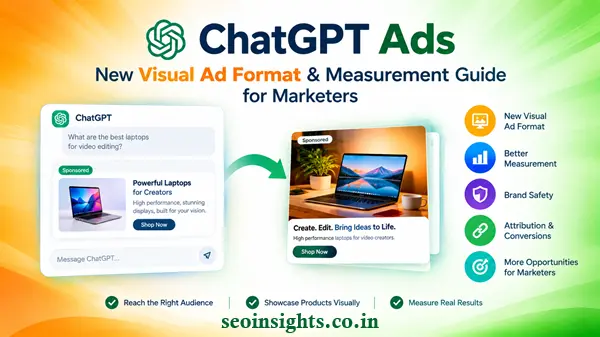
Instead of simply presenting an advertiser’s message, visual advertising can show a product, demonstrate how it might be used, or communicate an experience associated with a service.
OpenAI says the new format will initially be tested during image generation in ChatGPT.
The ads will be clearly labeled and kept separate from the image being created. OpenAI also says advertising does not influence ChatGPT’s answers.
The initial test is scheduled to begin later in October 2026 in the United States with a group of advertisers. That means marketers should not assume that the new visual format is already universally available worldwide.
How Is the New ChatGPT Visual Ad Format Different?
The simplest way to understand the change is to think about context versus presentation.
A traditional text ad might communicate:
“Buy our running shoes. Free shipping.”
A visual ad can potentially show the product being used, demonstrate a lifestyle around the product, or visually explain what makes the offering different.
OpenAI says the new format is intended to help people imagine how products and services could fit into their lives.
This is especially relevant for categories where visual information matters.
Examples include:
- Fashion
- Travel
- Home products
- Consumer electronics
- Food and lifestyle brands
- Fitness products
- Beauty
- Automotive
- Furniture
- Experiences and services
The important point for marketers is that creative quality becomes even more important when advertising moves into a visual, conversational environment.
Where Will the New Visual Ads Appear?
The initial visual format is being tested during image generation in ChatGPT.
OpenAI says the advertisements will be clearly identified and will remain separate from the image that ChatGPT generates.
This should not be confused with the broader ChatGPT Ads experience already documented by OpenAI.
Current ChatGPT Ads documentation describes ad units appearing below ChatGPT responses, with components such as the advertiser name, logo/favicon, title, description, landing page and image creative.
Therefore, marketers should think of the visual format as an expansion of ChatGPT’s advertising capabilities, rather than assuming every existing ad placement is being replaced by image-based advertising.
Why ChatGPT Ads Could Matter for Digital Marketing
Search advertising has traditionally been built around the idea that someone enters a query and advertisers compete for visibility against that query.
Conversational AI changes the journey.
A user might begin with a broad question:
“I need a good camera for travel.”
Then the conversation could develop into:
“I want something lightweight.”
Then:
“I also shoot video.”
Then:
“What are the best options under my budget?”
The user’s intent becomes richer as the conversation develops.
This creates an advertising environment where marketers need to think about the problem being solved, not simply the keyword being searched.
OpenAI’s current advertising guidance says its system considers multiple relevance signals, including conversational intent, current conversation context, landing-page information, ad copy, and advertiser-provided context hints.
For SEO and PPC professionals, this is one of the most important strategic differences to understand.
ChatGPT Ads Are Not Simply Another Search Ads Platform
It would be a mistake to treat ChatGPT Ads as a direct copy of Google Search Ads or another keyword-based advertising system.
OpenAI’s own creative guidance explicitly says ChatGPT advertising requires a different approach from keyword-based platforms.
Instead of asking only:
“Which keyword should trigger my advertisement?”
marketers should increasingly ask:
“During which conversations would my product genuinely help?”
That changes how campaigns should be planned.
Think About Problems, Not Just Keywords
Suppose you sell accounting software.
A traditional keyword strategy might focus on:
- accounting software
- accounting software for small business
- best accounting software
- online accounting software
For ChatGPT Ads, you can also think about situations such as:
- A new business choosing accounting software
- A freelancer looking for invoicing tools
- A company comparing accounting platforms
- A business owner preparing for tax reporting
- A growing company replacing spreadsheets
The second approach is closer to the conversational nature of the platform.
How ChatGPT Ads Measurement Is Expanding
Advertising becomes much more useful to businesses when they can connect ad exposure with actual business outcomes.
OpenAI says it is expanding its measurement tools and partner ecosystem to help advertisers understand how ChatGPT Ads contribute to business results.
The current measurement ecosystem includes several layers.
-
Conversion Measurement
Advertisers can measure actions that happen after ad engagement.
Depending on the implementation, these can include:
- Purchases
- Leads
- Sign-ups
- Registrations
- App installs
- Other configured conversion events
OpenAI’s current documentation supports conversion measurement through its Measurement Pixel, Conversions API, or both.
This is important because impressions and clicks do not necessarily tell the entire story.
A marketer ultimately wants to know:
Did advertising help produce a valuable business outcome?
-
Pixel and Conversions API
The measurement pixel can send conversion events from a website.
The Conversions API provides a server-side route for sending conversion information.
For businesses with more sophisticated analytics systems, using reliable conversion signals can improve both reporting and campaign optimization.
OpenAI says integrations with Hightouch, Tealium and LiveRamp can help advertisers send conversion data from existing systems into ChatGPT Ads.
-
Attribution
Attribution attempts to answer another important question:
Which advertising interaction should receive credit for the conversion?
OpenAI says its ChatGPT Ads ecosystem supports attribution and reporting partners across web and app environments, including companies such as AppsFlyer, Triple Whale, Adjust, Northbeam, Branch, Singular, Kochava, Airbridge and Tenjin.
This gives marketers more options for comparing ChatGPT advertising with their existing measurement systems.
-
Incrementality
Attribution alone does not necessarily prove that an advertisement caused an additional sale.
That is where incrementality becomes important.
The basic question is:
“Would this conversion have happened anyway?”
Incrementality experiments attempt to estimate the additional business impact caused by advertising.
OpenAI says its work in this area is still at an early stage and that it is partnering with Haus, Measured and WorkMagic to explore geo-based experiments.
For experienced marketers, this is an important development because it moves measurement beyond simple last-click reporting.
Early Measurement Results: What Should Marketers Know?
OpenAI’s announcement includes several early findings from measurement partners.
For example, DV Rockerbox reported that WeightWatchers’ attributed cost per acquisition on ChatGPT Ads was 15.3% lower than its blended paid-search benchmark.
WorkMagic reported statistically significant lift for wellness brand Dose, while Triple Whale reported that 93% of Portland Leather’s visitors from ChatGPT Ads were new.
These figures should be treated as partner-reported early findings, not universal benchmarks for every advertiser.
A marketer should not conclude that running ChatGPT Ads will automatically produce the same CPA or percentage of new visitors.
Performance can vary according to:
- Industry
- Offer
- Creative
- Audience
- Campaign objective
- Landing page
- Conversion tracking
- Budget
- Geography
- Buying cycle
- Campaign optimization
The correct lesson is that measurement infrastructure is developing and early advertisers are beginning to evaluate ChatGPT as a measurable advertising channel.
Why View-Through Conversions Matter
One interesting development is that advertising impact does not always happen through a click.
A customer might see an advertisement, continue researching, and later visit the advertiser independently.
OpenAI’s Ads measurement documentation says its systems can measure eligible conversions following an ad impression even when there is no qualifying click. Its current measurement approach includes click-through and, where available, view-through attribution.
This matters for marketers because click-only reporting can underestimate the influence of an advertisement.
However, view-through measurement should be interpreted carefully.
A conversion after an impression is not automatically proof that the ad caused the purchase.
That is why attribution and incrementality should be considered together when evaluating campaign performance.
ChatGPT Ads and Brand Safety
Advertising inside conversations creates a new brand-safety challenge.
On a traditional webpage, marketers can evaluate the surrounding content.
In ChatGPT, the context is generated through an ongoing conversation.
OpenAI says its advertising guardrails evaluate whether a conversation is appropriate for advertising and are designed to keep ads away from emotionally vulnerable, sensitive, or otherwise unsuitable contexts.
OpenAI also says automated review, human oversight and ongoing monitoring are used to identify policy violations and improve safeguards.
For qualifying advertisers, Negative Phrases can provide additional placement controls for narrow brand-specific requirements.
Independent Brand-Suitability Measurement
OpenAI is also developing brand-suitability evaluation pilots with DoubleVerify and Integral Ad Science (IAS).
The goal is to provide advertisers with more independent insight into the advertising environment while protecting private conversations.
This is strategically important.
As AI advertising grows, advertisers will want answers to questions such as:
- Where can my advertisements appear?
- What type of conversations surround my ads?
- Are placements consistent with my brand policies?
- Can independent measurement verify the environment?
- How is sensitive content handled?
The development of third-party measurement suggests these questions are becoming part of the AI advertising ecosystem rather than being limited to traditional media.
How Should Marketers Prepare for ChatGPT Ads?
If you are an SEO professional, PPC specialist, ecommerce owner or digital marketer, you do not need to completely replace your existing advertising strategy.
Instead, start preparing for a different kind of customer journey.
-
Build Around User Problems
Review your products and list the problems they solve.
For example:
Product: Project-management software
Problems:
- Teams losing track of tasks
- Businesses managing projects in spreadsheets
- Remote teams needing better collaboration
- Managers needing visibility into deadlines
Those problems can become the foundation for conversational advertising strategies.
-
Write Benefit-Focused Ads
OpenAI‘s current creative guidance recommends clear, specific and benefit-focused advertising rather than vague promotional language.
Instead of:
“The World’s Best Software!”
Try:
“Plan projects, assign tasks and keep deadlines visible in one workspace.”
The second message immediately tells the reader what the product does.
-
Create Multiple Creative Variations
One advertisement rarely communicates every useful angle.
Create variations around:
- Price
- Convenience
- Performance
- Ease of use
- Specific customer problems
- Product features
- Differentiators
- Use cases
OpenAI‘s guidance recommends broader creative coverage with multiple distinct variations rather than repetitive versions of the same message.
-
Improve Your Landing Pages
An advertisement can generate interest, but the landing page has to continue the story.
If an ad promotes a particular product, send the user to the most relevant product or content page rather than automatically sending everyone to the homepage.
OpenAI‘s current advertising guidance specifically recommends relevant landing destinations and clear connections between the advertisement and landing page.
-
Install Reliable Conversion Tracking
Before spending heavily, make sure you can measure meaningful outcomes.
At minimum, define the business action that matters.
Examples include:
- Purchase
- Lead submission
- Demo request
- Registration
- Subscription
- App installation
Then configure the appropriate measurement method.
Poor conversion data can make a sophisticated advertising platform much less useful.
What Does ChatGPT Ads Mean for SEO?
ChatGPT Ads do not replace SEO.
They represent another potential discovery channel.
SEO professionals should therefore think about two different journeys.
Traditional Search Journey
Search → Search results → Website → Conversion
Conversational Discovery Journey
Conversation → Recommendation/Discovery → Ad or organic result → Website → Conversion
The second journey is particularly interesting because users may explain their requirements in much greater detail than they would in a short search query.
This creates an opportunity for marketers to develop content around:
- Questions
- Comparisons
- Use cases
- Product categories
- Problems
- Decision criteria
- Buyer concerns
That strategy can support both traditional search visibility and AI-assisted discovery.
ChatGPT Ads vs Traditional Search Advertising
| Area | Traditional Search Advertising | ChatGPT Ads |
| Core environment | Search results | Conversational interface |
| Main context | Search query | Conversation and intent |
| Creative | Often text, images or shopping formats | Text and emerging visual formats |
| User journey | Query-driven | Conversation-driven |
| Measurement | Clicks, conversions, attribution | Clicks, conversions, attribution and emerging incrementality approaches |
| Targeting signals | Keywords, audiences and other campaign signals | Conversational context plus other relevance signals |
| Brand safety | Page/query environment | Conversation context |
| Creative strategy | Match search intent | Be useful within conversational intent |
This is not a claim that one channel is universally better.
They serve different user experiences.
For many businesses, the more sensible approach will be to test ChatGPT Ads alongside existing Google, Microsoft, social and other acquisition channels.
What Businesses Should Test First
A small controlled campaign can teach more than a large campaign launched without measurement.
Start with:
- One clearly defined business goal.
- A small number of strong ad variations.
- A well-defined conversion event.
- A relevant landing page.
- Reliable tracking.
- A reasonable testing period.
- A comparison against existing acquisition channels.
Then evaluate:
- Impressions
- Click-through rate
- Cost per click
- Conversion rate
- Cost per acquisition
- New-customer rate
- Revenue
- Return on ad spend
- Assisted conversions
- Incremental impact where measurable
Current ChatGPT Ads reporting includes metrics such as impressions, clicks, spend, CTR, average CPC, average CPM and conversions.
Is ChatGPT Advertising Worth Testing?
For businesses whose customers already use conversational research to evaluate products or services, ChatGPT Ads could be worth testing.
The strongest potential fit is not simply:
“Everyone should advertise on ChatGPT.”
It is:
“Businesses should test whether conversational discovery creates incremental value for their customers.”
That distinction matters.
A B2B software company, ecommerce retailer, travel brand and local service business may all experience the platform differently.
The right approach is to measure actual business outcomes rather than assuming that the novelty of AI advertising automatically produces better performance.
What Beginners Should Remember
If you are new to digital advertising, do not get distracted by every technical term.
Start with five questions:
Who is the customer?
Who are you trying to reach?
What problem are they solving?
What need brings them into a conversation?
What makes your product useful?
Why should they consider your offering?
What action matters?
Do you want a sale, lead, signup, app install or another outcome?
Can you measure it?
If you cannot measure the desired result reliably, optimization becomes much harder.
This simple framework is more useful than immediately worrying about advanced attribution models.
The Bigger Picture: Advertising Is Becoming Conversational
The most important part of OpenAI‘s announcement may not be the image format itself.
It is the broader shift in how advertising can fit into the customer journey.
People increasingly use AI systems to:
- Research products
- Compare alternatives
- Understand complicated subjects
- Plan purchases
- Explore ideas
- Make decisions
Advertising inside that environment requires a different mindset.
A successful advertisement cannot simply interrupt a conversation.
It needs to make sense within the user’s context.
That is why relevance, useful creative, strong landing pages, accurate conversion signals and brand suitability are becoming increasingly important.
Key Takeaways
- ChatGPT Ads are evolving beyond basic advertising placements, with OpenAI introducing a new visual format.
- The initial visual-ad test is planned for image generation in ChatGPT in the U.S. with an initial group of advertisers.
- Ads are designed to remain clearly labeled and separate from ChatGPT’s answers and generated images.
- OpenAI is expanding measurement through the Measurement Pixel, Conversions API, attribution partners and incrementality research.
- Marketers should not treat early partner results as universal performance benchmarks.
- Conversational intent means advertisers should focus on customer problems and useful benefits rather than relying only on traditional keyword thinking.
- Reliable conversion tracking and relevant landing pages will be essential for evaluating ChatGPT advertising properly.
FAQ
-
What are ChatGPT Ads?
ChatGPT Ads are advertising placements designed to help businesses reach people as they explore ideas, compare options and make decisions within ChatGPT. OpenAI is expanding the platform with new formats, including a visual advertising format.
-
What is the new ChatGPT visual ad format?
The new visual ad format allows advertisers to use imagery to help people understand products, services or experiences. OpenAI says the initial test will take place during image generation in ChatGPT, with ads clearly labeled and kept separate from the generated image.
-
Does advertising influence ChatGPT’s answers?
OpenAI says advertising does not influence the answers ChatGPT provides. It also states that ads remain separate from ChatGPT’s responses and emphasizes conversation privacy and user control.
-
How can advertisers measure ChatGPT Ads?
Advertisers can use reporting and conversion measurement tools, including the Measurement Pixel and Conversions API. OpenAI also supports attribution partners and is exploring incrementality measurement to better understand business impact.
-
How should businesses prepare for ChatGPT advertising?
Businesses should focus on clear customer problems, benefit-oriented creative, relevant landing pages, multiple ad variations and reliable conversion tracking. They should then test ChatGPT Ads against measurable business goals instead of assuming that performance will match another advertising channel.
Conclusion
The latest ChatGPT Ads update signals an important change in digital advertising.
Advertising is moving into an environment where customers do not simply type a keyword and choose a link. They can explain what they need, ask follow-up questions, compare alternatives and work through a decision conversationally.
OpenAI‘s new visual ad format is one step toward making advertising fit that environment more naturally. At the same time, the expansion of conversion measurement, attribution partnerships, incrementality research and brand-suitability initiatives shows that the company is building more than an ad placement—it is developing a broader advertising ecosystem.
For marketers, the opportunity is not to abandon SEO, Google Ads, social advertising or other established channels.
It is to learn how AI-native advertising fits alongside them.
The businesses most likely to learn quickly will be the ones that start with useful creative, clear customer intent, strong measurement and realistic testing.
ChatGPT Ads are still an evolving platform, so marketers should monitor OpenAI’s advertising documentation as formats, availability, measurement options and campaign capabilities continue to develop.
The article’s current facts are based primarily on OpenAI’s announcement and its current Ads Help Center/developer documentation. OpenAI