
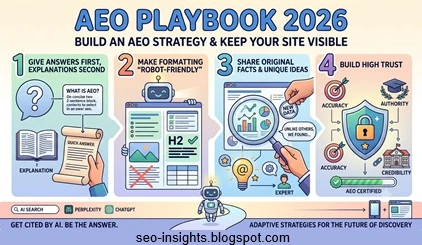
“AEO Playbook 2026: Build an AEO Strategy and Keep Your Site Visible”
Search is changing. People no longer just type a keyword and scroll through ten blue links. They ask a question, and an AI engine answers it directly — sometimes without sending them to any website at all.
This shift has a name: Answer Engine Optimization (AEO). It’s not a replacement for SEO. It’s the next layer on top of it. And in 2026, it decides whether your business gets mentioned by AI tools like ChatGPT, Google AI Overviews, Perplexity, and voice assistants — or gets skipped entirely.
Most articles on this topic give you a “Top 10 AEO Tips” list. That’s not a strategy, it’s a checklist. Checklists get copied by everyone, which means they stop working. What actually protects your visibility long-term is a system — one that’s harder to copy because it’s built on your own expertise, not borrowed tactics.
Here’s a simple, non-technical framework to build that system.
The 4-Layer Visibility Stack
Think of AEO like a building. Skip a layer, and the whole thing wobbles.
Layer 1: Foundation — Answer Real Questions, Not Just Keywords
AI engines aren’t looking for pages stuffed with keywords. They’re looking for the clearest, most complete answer to a specific question.
Instead of asking “what keyword should I target?”, ask: “What question is my ideal customer actually confused about?”
Write content that answers that question in the first two sentences — plainly, like you’re explaining it to a smart friend. Save the depth and nuance for after.
Layer 2: Structure — Make Your Content Easy to Lift
AI engines “read” your page by pulling out clear, self-contained chunks of information. If your answer is buried inside a long, winding paragraph, it’s harder to extract — so it gets skipped in favor of a competitor who made it easy.
Simple structural habits that help:
- Put the direct answer right under the heading, before the explanation
- Use short paragraphs (2–3 sentences)
- Break processes into numbered steps
- Use one heading per question
This isn’t about tricking an algorithm. It’s about respecting the reader’s time — which happens to be exactly what AI systems are trying to reward.
Layer 3: Trust — Prove You Actually Know This
This is the layer most people skip, and it’s the one that builds your moat.
Anyone can write generic advice. Few people can back it up with:
- Original data or examples (“we tested this with 40 client sites”)
- A clearly named framework (like the one you’re reading right now)
- A point of view that disagrees with common advice, and explains why
When your content contains something only you could have written, it becomes harder for AI engines — and competitors — to treat it as replaceable. That’s the real definition of a content moat: not “more content,” but content that can’t be regenerated by a machine scraping ten other articles.
Layer 4: Distribution — Show Up in More Than One Place
AI answer engines often cross-check multiple sources before forming a response. If your expertise only lives on your website, that’s one signal. If it also lives in forums, Reddit threads, YouTube transcripts, LinkedIn posts, and third-party reviews — consistently saying the same core things — that’s a pattern AI systems recognize as credible.
You don’t need to be everywhere. You need to be consistently accurate in the few places your audience already trusts.
How This Plays Out for a Global Audience
If your audience spans countries, keep language simple and avoid idioms that don’t translate well — both for human readers and for AI systems processing your content in multiple languages. Use universal examples, plain currency and date formats, and clear, literal phrasing. Clarity travels; cleverness often doesn’t.
Key Takeaways
- AEO is about being the answer, not just a search result — AI engines pull direct, well-structured content first.
- Generic listicle advice is easy to copy, which makes it weak. A real strategy is built on a repeatable system, like the 4-Layer Visibility Stack.
- Answer real questions plainly, structure content for easy extraction, add proof only you can provide, and stay consistent across multiple platforms.
- Your strongest long-term advantage isn’t more content — it’s original insight that can’t be scraped from someone else’s page.
- For global readers, simple and literal language outperforms clever or idiom-heavy writing.
FAQ
What is AEO in simple terms? AEO means shaping your content so AI tools can find it, understand it, and use it to directly answer someone’s question — not just rank it in a list of links.
Is AEO replacing SEO? No. SEO gets your page discovered. AEO determines whether your content is trustworthy and clear enough to be used as the answer. You need both.
Do I need technical skills to start with AEO? No. The biggest wins come from writing clearer answers and organizing your page better — both are non-technical skills.
How long does it take to see results? It varies, but consistency matters more than speed. Sites that keep publishing clear, original answers tend to build visibility steadily over months, not overnight.
What’s the single best first step? Pick one common question your customers ask you directly (in emails, calls, or comments) and write the clearest possible answer to it. That’s AEO in action.