

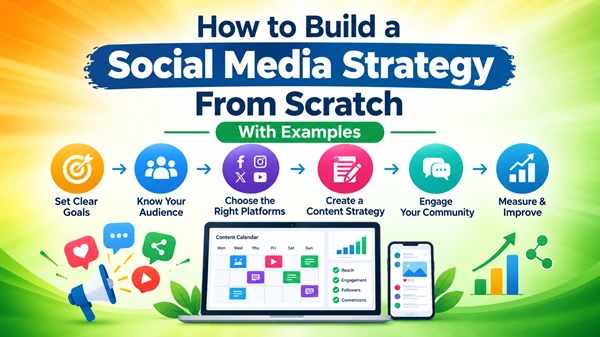
Learn how to build a social media strategy from scratch with simple steps, real examples, content ideas, platform tips, KPIs, and a practical plan.
How to Build a Social Media Strategy From Scratch (With Examples)
Imagine that you have just launched a small business.
You create accounts on Instagram, Facebook, LinkedIn, YouTube and X. Then you start posting whenever you have an idea.
One day you publish a product photo. The next day you share a motivational quote. A few days later, you post a promotional offer.
After several weeks, you look at your accounts and ask an important question:
“Is any of this actually helping my business?”
This is where a social media strategy makes a difference.
A strategy gives every post a purpose. Instead of publishing content simply because you feel you should, you decide who you want to reach, what you want to achieve, what content you will create, where you will publish it and how you will measure the results.
A documented social media strategy can connect social activity with broader business objectives and provide a framework for measuring performance.
The good news is that you do not need a large marketing team to create one.
You can start with a notebook, spreadsheet or simple document.
Let’s build one step by step.
What Is a Social Media Strategy?
A social media strategy is a plan that explains how a person, business or organization will use social platforms to achieve specific goals.
It normally covers:
- Business and marketing goals
- Target audience
- Selected social media platforms
- Content themes and formats
- Publishing schedule
- Community engagement
- Paid promotion, when appropriate
- Performance metrics
- Review and optimization process
Think of it as a roadmap.
Your social media accounts are the vehicles, your content is the fuel, and your business objectives determine where you are going.
Without a destination, simply driving faster does not help.
Why Do You Need a Social Media Strategy?
Opening a social media account is easy.
Building a useful presence is harder.
Without a strategy, businesses often make several mistakes:
- Posting without a clear objective
- Trying to maintain too many platforms
- Creating content for themselves rather than their audience
- Focusing only on follower numbers
- Repeating the same post everywhere
- Ignoring comments and customer questions
- Spending money on advertising without a clear goal
- Failing to analyze what worked
A strategy helps bring these activities together.
It also makes it easier to decide what not to do.
For example, if your target customers rarely use a particular platform, you do not necessarily need to spend hours creating content for it.
How to Build a Social Media Strategy From Scratch
Let’s use a fictional business throughout this guide.
Example business: GreenLeaf Coffee, a small coffee company selling specialty coffee online.
Its owner wants to increase awareness, attract potential customers and generate more visits to the online store.
Here is how the strategy could be developed.
Step 1: Define Your Business Goal
Do not begin with:
“We need more followers.”
Start with the business problem.
Ask:
What should social media help us accomplish?
Possible objectives include:
- Increasing brand awareness
- Generating website traffic
- Getting leads
- Supporting sales
- Promoting a product
- Building a community
- Providing customer service
- Educating potential customers
- Increasing event registrations
A social media strategy becomes much easier to build when the objective is clear.
Example
GreenLeaf Coffee decides:
“We want social media to introduce our coffee brand to new customers and encourage interested people to visit our online store.”
That is much more useful than simply saying:
“We want to grow Instagram.”
Step 2: Turn the Goal Into a Measurable Objective
Once you have a broad goal, decide how you will evaluate progress.
For example:
Goal: Increase website traffic from social media.
Possible measurements include:
- Social link clicks
- Sessions originating from social platforms
- Landing-page visits
- Leads generated
- Purchases attributed to social activity
The exact metrics should depend on your objective.
For awareness, reach and impressions may be useful.
For engagement, you might examine comments, shares, saves and other meaningful interactions.
For traffic, link clicks and website sessions become more relevant.
For sales, conversions and revenue-related measures are more important.
Current social strategy guidance similarly recommends connecting KPIs to objectives such as awareness, engagement, traffic, customer care and revenue.
A simple rule
Goal → KPI → Content → Action
For example:
Website traffic → Link clicks → Educational post → Visit website
This keeps your strategy connected from beginning to end.
Step 3: Understand Your Target Audience
One of the biggest social media mistakes is trying to speak to everyone.
Instead, describe the people you actually want to reach.
Consider:
- Age range
- Location
- Language
- Occupation
- Interests
- Problems
- Buying behavior
- Knowledge level
- Preferred content formats
- Questions they frequently ask
But do not stop at demographics.
Ask:
What problem are these people trying to solve?
That question can produce much better content ideas.
Example
GreenLeaf Coffee’s audience might include people who:
- Enjoy specialty coffee
- Want to improve their home-brewing skills
- Are interested in different coffee origins
- Need help choosing coffee beans
- Like discovering independent coffee brands
Now the content direction becomes clearer.
Instead of posting only:
“Buy our coffee!”
GreenLeaf could publish:
“How to choose coffee beans for a French press”
That post helps the audience before asking them to buy.
Step 4: Research Your Audience’s Questions
Your customers are already telling you what content to create.
Look at:
- Customer emails
- Comments
- Direct messages
- Product reviews
- Website search queries
- Sales conversations
- Frequently asked questions
- Competitor discussions
- Social comments
- Search suggestions
Create a list of recurring questions.
For example:
Coffee audience questions:
- Which coffee is best for beginners?
- How should coffee beans be stored?
- What grind size should I use?
- What is the difference between light and dark roast?
- How do I make better coffee at home?
Each question can become one or more social posts.
This is one of the simplest ways to build a sustainable content strategy.
Step 5: Choose the Right Social Media Platforms
You do not need to be everywhere.
Choose platforms based on:
Audience + business objective + content capability + available resources.
Different platforms have different audiences, formats and cultures, so platform selection should be intentional rather than automatic.
For example:
Useful when visual content, short-form video, products or community interaction are important.
Can be useful for communities, local businesses, broader consumer audiences and customer communication.
Often appropriate for B2B companies, professional services, recruitment and thought leadership.
Useful when demonstrations, tutorials, reviews or educational videos are central to the strategy.
Can make sense for visually searchable topics such as home, fashion, recipes, design and planning.
Can be useful for real-time conversations, commentary, industry discussions and news-oriented communication.
The important point is not to select a platform simply because it is popular.
Select it because your audience and your content strategy have a reason to be there.
Step 6: Decide on Your Content Pillars
Content pillars are the main themes you repeatedly use in your social media content.
They prevent your content calendar from becoming a random collection of posts.
A small business might use four or five pillars.
Example: GreenLeaf Coffee
Pillar 1: Education
- Coffee brewing tips
- Bean storage advice
- Brewing mistakes
Pillar 2: Product
- New coffee varieties
- Product demonstrations
- Product comparisons
Pillar 3: Behind the Scenes
- How coffee is prepared
- Packaging
- Team stories
Pillar 4: Community
- Customer photos
- Customer questions
- Polls
- User-generated content
Pillar 5: Brand Story
- Company history
- Values
- Sustainability initiatives
- Founder stories
Now GreenLeaf does not have to ask every morning:
“What should we post today?”
It has a framework.
Step 7: Create Content for Different Stages of the Customer Journey
Not everyone who sees your content is ready to buy.
Some people have never heard of you.
Others are researching.
Some already know your brand.
And some are ready to purchase.
Your content should reflect these different stages.
Awareness Content
Purpose: Introduce the problem, topic or brand.
Examples:
- Beginner guides
- Short educational videos
- Industry tips
- Interesting questions
- Problem-focused content
Consideration Content
Purpose: Help people evaluate options.
Examples:
- Comparisons
- Tutorials
- Case studies
- Demonstrations
- Product explanations
Conversion Content
Purpose: Encourage an appropriate business action.
Examples:
- Product pages
- Offers
- Free consultations
- Trials
- Demonstrations
- Registration links
Loyalty Content
Purpose: Keep existing customers engaged.
Examples:
- Customer stories
- Tips for existing products
- Exclusive information
- Community content
- Customer support
This approach prevents your social accounts from becoming nothing more than a continuous stream of advertisements.
Step 8: Choose the Right Content Formats
Your strategy should specify not only what you talk about but also how you present it.
Possible formats include:
- Short-form videos
- Long-form videos
- Images
- Carousels
- Text posts
- Stories
- Polls
- Live sessions
- Tutorials
- Customer testimonials
- Infographics
- Product demonstrations
The best format depends on the platform, topic, audience and resources available.
For example, a complicated tutorial might work better as a video or carousel than as a single image.
A quick industry observation might work well as a short text post.
Do not create a video simply because video is popular.
Create the format that communicates the idea effectively.
Step 9: Create a Social Media Content Calendar
A content calendar turns your strategy into an execution plan.
You can use a spreadsheet with columns such as:
| Date | Platform | Content Pillar | Topic | Format | CTA | Status |
| Monday | Education | Coffee storage tips | Carousel | Save this post | Planned | |
| Tuesday | Brand Story | Our business journey | Text/Image | Read more | Planned | |
| Wednesday | YouTube | Education | French press tutorial | Video | Watch tutorial | Planned |
| Friday | Product | New coffee blend | Reel | Visit store | Planned |
You do not have to publish every day.
Consistency is more important than creating an unrealistic schedule you cannot maintain.
A manageable publishing routine is better than an ambitious calendar that collapses after two weeks.
Step 10: Give Every Post a Purpose
Before publishing, ask:
Why does this post exist?
Possible purposes include:
- Educate
- Entertain
- Inspire
- Start a conversation
- Build trust
- Demonstrate expertise
- Generate traffic
- Generate leads
- Encourage a purchase
- Support existing customers
A simple post-planning formula is:
Hook → Value → Proof/Example → Call to Action
Example
Hook:
“Your coffee may taste bitter because of one simple brewing mistake.”
Value:
Explain the mistake and how to fix it.
Example:
Show the difference between two brewing methods.
CTA:
“Save this guide for your next coffee.”
The CTA does not always need to be “Buy now.”
Step 11: Develop a Consistent Brand Voice
People should gradually recognize your brand from the way it communicates.
Your brand voice might be:
- Friendly
- Professional
- Educational
- Humorous
- Bold
- Helpful
- Inspirational
- Technical
Choose a style appropriate for your audience.
For example, a cybersecurity company may need a different tone from a children’s clothing brand.
Consistency does not mean every post must sound identical.
It means your communication should feel like it comes from the same organization.
Step 12: Build Community, Not Just an Audience
Social media is called “social” for a reason.
Publishing is only one part of the job.
Pay attention to:
- Comments
- Questions
- Mentions
- Direct messages
- Customer complaints
- Positive feedback
- Industry conversations
Respond where appropriate.
A customer asking a question publicly gives you an opportunity to help that person and potentially demonstrate your expertise to everyone else reading the conversation.
Social strategy therefore includes community management and customer care, not just content publishing.
Step 13: Use Hashtags and Keywords Naturally
Social platforms increasingly function as discovery environments.
Use words that naturally describe:
- Your product
- Your service
- Your industry
- Your audience’s problem
- Your content topic
Avoid filling captions with unrelated keywords or hashtags.
For example, a coffee post could naturally mention:
French press coffee, coffee brewing, coffee beans and home brewing.
The objective is clarity, not repetition.
Write for humans first.
Step 14: Use AI as an Assistant, Not as Your Strategy
AI tools can help with tasks such as:
- Brainstorming content ideas
- Creating variations of headlines
- Summarizing long material
- Organizing content calendars
- Drafting first versions
- Analyzing patterns in data
But your strategy still needs human judgment.
You should verify facts, adapt the content to your brand voice and make sure the final message actually helps your audience.
Current social media management practices increasingly use AI for areas such as content workflows, analytics and audience insights, while strategic decisions still require a clear understanding of the brand and audience.
Step 15: Measure the Right Social Media Metrics
Do not judge your entire strategy by follower count.
A large audience is not automatically a valuable audience.
Instead, connect metrics to your objectives.
Awareness
Consider:
- Reach
- Impressions
- Brand mentions
- Share of voice
Engagement
Consider:
- Comments
- Shares
- Saves
- Meaningful interactions
Traffic
Consider:
- Link clicks
- Website sessions
- Landing-page visits
Leads
Consider:
- Form submissions
- Sign-ups
- Consultation requests
- Qualified leads
Sales
Consider:
- Purchases
- Conversion rate
- Revenue attributed to social activity
Customer service
Consider:
- Response time
- Resolution rate
- Customer feedback
The important question is:
Which metrics help answer whether the strategy is achieving its purpose?
Step 16: Review Your Results and Improve
A social media strategy should not be permanent.
It should evolve.
Set a regular review period and ask:
- Which posts performed well?
- Which topics generated meaningful responses?
- Which formats worked?
- Which platforms contributed to our goals?
- Which posts attracted the right audience?
- Which content should we stop creating?
- What questions are customers asking now?
- What should we test next?
For example, suppose GreenLeaf discovers that educational brewing content consistently produces more saves and website visits than generic promotional posts.
The company can create more educational content.
That is strategy in action:
Publish → Measure → Learn → Improve → Repeat
A Complete Social Media Strategy Example
Let’s put everything together for GreenLeaf Coffee.
Business
Online specialty coffee retailer.
Primary objective
Increase awareness and qualified visits to the online store.
Target audience
People interested in better-quality coffee and home brewing.
Primary platforms
Instagram and YouTube.
Content pillars
- Coffee education
- Brewing tutorials
- Product information
- Behind-the-scenes content
- Customer stories
Example weekly schedule
Monday:
Instagram carousel — “5 common coffee brewing mistakes”
Tuesday:
YouTube Short — “How fine should your coffee grind be?”
Wednesday:
Instagram Story — Customer poll
Thursday:
YouTube tutorial — “French Press Coffee for Beginners”
Friday:
Instagram Reel — Product demonstration
Saturday:
Customer-generated content
Sunday:
Review performance and prepare next week’s content
Notice something important.
The calendar is not simply:
“Post something every day.”
Each item has a purpose.
A Simple Social Media Strategy Template
If you are starting from zero, copy this framework into a document:
-
Business objective
What business result should social media support?
-
Target audience
Who are we trying to reach?
-
Audience problems
What questions, needs or frustrations do they have?
-
Platforms
Which platforms provide the strongest strategic fit?
-
Content pillars
What 3–5 subjects will we consistently discuss?
-
Content formats
Which formats can we realistically produce?
-
Publishing schedule
How frequently can we publish consistently?
-
Community management
How will we respond to comments, messages and customer questions?
-
KPIs
Which metrics will show progress?
-
Review process
When will we analyze results and change the strategy?
This is enough to create a useful first version of a social media marketing plan.
You can make it more sophisticated as your business grows.
Common Social Media Strategy Mistakes to Avoid
Trying to Use Every Platform
More platforms mean more work.
Start with the channels where your audience and business objectives overlap.
Posting Without a Goal
A beautiful post can still be strategically useless.
Know what you want each content piece to accomplish.
Making Every Post Promotional
People do not follow a brand simply to see advertisements.
Teach, help, entertain and communicate.
Copying Competitors
Competitor research can reveal opportunities, but copying their content makes your brand less distinctive.
Study the market.
Then develop your own point of view.
Obsessing Over Vanity Metrics
Followers and likes can provide useful context, but they should not replace business-focused measurements.
Ignoring Negative Feedback
Complaints can reveal problems with products, communication or customer experience.
Respond thoughtfully and use recurring complaints as learning opportunities.
Changing Strategy Too Quickly
One post rarely tells the whole story.
Look for patterns over a meaningful period rather than changing direction after every disappointing result.
How Long Does It Take to Build a Social Media Strategy?
You can create a basic strategy relatively quickly.
The more important part is not the document itself.
It is the research behind it.
A practical process is:
Research → Plan → Create → Publish → Engage → Measure → Improve
Your first strategy does not need to be perfect.
Start with a clear version, collect real-world feedback and improve it as you learn more about your audience.
Should Small Businesses Have a Social Media Strategy?
Yes, but the strategy should match the business’s resources.
A small business does not need a complicated marketing department.
For example, a local bakery might begin with:
- One or two social platforms
- Three content pillars
- A simple weekly calendar
- Regular customer interaction
- A small set of relevant KPIs
The objective is to create a system that the business can actually maintain.
A simple strategy executed consistently can be more useful than a sophisticated strategy that never gets implemented.
Key Takeaways
- Start with a business objective, not a follower target.
- Define your audience and their problems before creating content.
- Choose social platforms strategically instead of trying to use every network.
- Build content pillars so your publishing has direction.
- Use a content calendar to maintain consistency.
- Give each post a purpose and use appropriate calls to action.
- Measure results against your goals and continually improve the strategy.
FAQ
-
What is a social media strategy?
A social media strategy is a documented plan explaining how a business will use social platforms to reach a target audience, achieve specific objectives, publish content, engage with people and measure results.
-
How do I create a social media strategy from scratch?
Start by defining your business goal, identifying your target audience, researching their needs, selecting appropriate platforms, establishing content pillars, creating a publishing calendar and choosing KPIs. Then publish, measure and improve the strategy.
-
How many social media platforms should a beginner use?
There is no universal number. Beginners should generally prioritize platforms where their target audience is active and where they can consistently create useful content. It is better to manage a small number of platforms well than many platforms poorly.
-
What should I post on social media?
Create a mixture of educational, useful, entertaining, community-focused, product-related and brand content. Your content should be based on your audience’s interests and problems rather than consisting entirely of promotional messages.
-
How do I measure whether my social media strategy is working?
Match metrics to your objective. For awareness, examine measures such as reach and impressions. For engagement, examine meaningful interactions such as comments, shares and saves. For traffic, track clicks and website visits. For business outcomes, track leads, conversions or sales where appropriate.
Conclusion
Building a social media strategy from scratch does not mean creating hundreds of posts or joining every social network.
It starts with a much simpler question:
“What do we want social media to accomplish for our business?”
From there, identify the people you want to reach, understand what they need, choose the right platforms, develop useful content pillars and create a manageable publishing system.
Then measure what happens.
Your first strategy will not be perfect—and it does not need to be.
The strongest approach is to treat social media as an ongoing learning process. Plan, publish, listen, measure and improve.
When every part of your social presence has a clear reason for existing, social media stops being a collection of random posts and becomes a genuine part of your digital marketing strategy.