What Are the 7 Types of Digital Marketing? Explained with Examples
Digital marketing gives businesses a way to connect with customers online, promote products and services, and build long-term relationships. However, beginners often face a common challenge: there are so many marketing channels that choosing where to start can feel confusing.
Should you focus on Google Search, social media, paid advertisements, email newsletters, or partnerships with creators?
Understanding the seven types of digital marketing makes this decision easier. Each method has a different role, and the best choice depends on your audience, budget, business goals, and available resources.
This guide explains how each type works, its benefits and limitations, and how you can start using it with practical examples.
What Is Digital Marketing?
Digital marketing is the promotion of products, services, brands, or ideas through digital channels such as websites, search engines, social media platforms, email, and online advertising networks.
Unlike traditional marketing methods such as printed brochures, billboards, and television commercials, digital marketing can provide detailed information about how people interact with campaigns.
For example, a small online clothing store can use search engine optimization to attract people looking for fashion advice, social media to display new collections, and email to announce special offers to subscribers.
The store can then measure which channels attract visitors, encourage purchases, and help retain customers.
Why Is Digital Marketing Important?
Digital marketing helps businesses:
- Reach relevant audiences: Connect with people who are already interested in particular products, services, or topics.
- Build brand awareness: Introduce a business to potential customers across different online platforms.
- Generate leads: Encourage visitors to request information, book consultations, or subscribe to newsletters.
- Support sales: Guide potential customers from discovering a product to completing a purchase.
- Measure performance: Use analytics to understand which campaigns contribute to business objectives.
- Build relationships: Keep customers informed and engaged after their first interaction.
Digital marketing does not guarantee sales or high search rankings. Its effectiveness depends on factors such as the quality of the offer, customer demand, competition, execution, and budget.
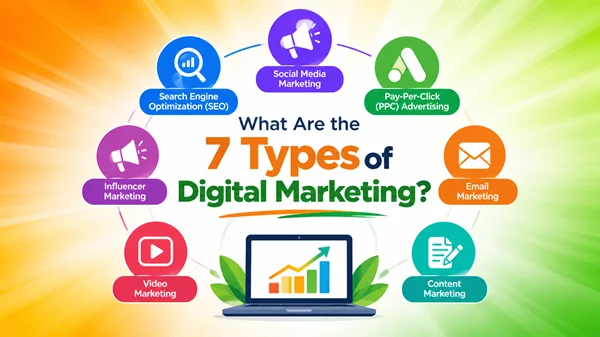
What Are the 7 Types of Digital Marketing?
The seven types discussed in this guide are:
-
Search Engine Optimization (SEO)
Improve organic visibility in search engines and attract relevant website visitors without paying for each organic click.
-
Search Engine Marketing (SEM)
Use paid search advertising to reach people searching for relevant products, services, or solutions.
-
Social Media Marketing
Build awareness, engage communities, and promote content through social platforms.
-
Content Marketing
Publish useful articles, videos, guides, and other resources to educate and attract an audience.
-
Email Marketing
Communicate with subscribers through newsletters, product updates, and relevant offers.
-
Affiliate Marketing
Work with partners who promote your products in exchange for an agreed commission or other compensation
-
Influencer Marketing
Collaborate with creators who can introduce a brand to an established audience.
There is no single universally accepted classification of digital marketing. Some frameworks list mobile marketing, video marketing, display advertising, or marketing automation as separate categories. The seven above provide a practical starting point for beginners.
-
Search Engine Optimization (SEO)
Search engine optimization, commonly called SEO, is the process of improving a website so that search engines can discover, understand, and present its pages for relevant searches.
SEO primarily aims to attract organic search traffic, meaning visits from unpaid search results.
For example, imagine that you run a website about digital marketing. Someone searches for “how to improve website SEO.” If your site has a useful, relevant article that appears in the results, that person may click through to read it.
Google’s official SEO Starter Guide explains how website owners can improve the accessibility and search-friendliness of their content.
How Does SEO Work?
SEO involves several connected activities.
On-page SEO
Improve individual pages through descriptive titles, clear headings, useful content, relevant internal links, and descriptive image alt text where appropriate.
Technical SEO
Help search engines access and understand your website. This can involve crawlability, indexability, a logical URL structure, mobile usability, and suitable performance.
Content SEO
Create pages that answer genuine user questions with accurate, helpful, and sufficiently detailed information.
Off-page SEO
Build awareness and credibility through legitimate mentions, relevant links, digital PR, and relationships within your industry.
Practical SEO Example
Suppose you own a bakery and want more local customers.
You could publish a page about custom birthday cakes, explain available designs and ordering options, provide useful photographs, and maintain accurate business information online.
Someone searching for a relevant bakery or cake service might discover your page.
Benefits of SEO
- Can attract relevant visitors over an extended period.
- Helps users discover information when they are actively searching.
- Supports brand credibility and content discovery.
- Can complement paid advertising and social media campaigns.
Limitations of SEO
SEO takes time, competition can be strong, and rankings are not guaranteed. Search engines change their systems, competitors publish new content, and even technically sound pages may not receive substantial traffic.
Useful SEO Tools
- Google Search Console — monitor search performance and identify indexing issues.
- Google Analytics — understand website traffic and visitor behaviour.
- Google Trends — explore how interest in search topics changes over time.
- PageSpeed Insights — evaluate website performance and user experience.
Best for: Bloggers, publishers, service providers, online stores, and businesses seeking sustainable organic visibility.
-
Search Engine Marketing (SEM)
Search engine marketing is commonly used to describe paid advertising on search engines, although some sources use SEM as an umbrella term that includes SEO and paid search.
In this article, SEM refers specifically to paid search advertising.
Advertisers create campaigns that can display ads when people search for selected terms or meet the platform’s targeting criteria. Depending on the campaign and advertising platform, charges may be based on clicks, impressions, conversions, or another bidding model.
How Does Paid Search Marketing Work?
A typical campaign involves these steps:
- Select a business goal, such as sales, enquiries, or appointment bookings.
- Identify relevant search terms and audience needs.
- Write clear advertisements that accurately describe the offer.
- Send visitors to a relevant landing page.
- Set a budget and appropriate bidding strategy.
- Measure conversions and improve campaign performance.
For example, a plumbing company might run search ads targeting people looking for emergency plumbing services in its service area.
If someone clicks an ad, the company may be charged according to its campaign’s pricing model. Whether that visitor becomes a customer depends on the service, price, urgency, and landing-page experience.
SEO vs. SEM: What Is the Difference?
| Feature | SEO | Paid search advertising |
| Traffic source | Organic search results | Sponsored search placements |
| Payment | No charge for each organic click, though SEO has operating costs | Advertising spend applies |
| Speed | Often takes time to build visibility | Campaigns can begin serving quickly after approval |
| Longevity | Useful visibility can continue, but rankings fluctuate | Paid placements generally stop when campaigns stop serving |
| Main work | Content, website quality, technical improvements | Bidding, targeting, ad copy, budget and conversion optimisation |
Benefits of Paid Search
- Can reach people with strong purchase or enquiry intent.
- Offers control over campaign budgets and targeting settings.
- Provides measurable campaign data.
- Can be useful for testing offers and landing pages.
Limitations of Paid Search
Advertising can become expensive in competitive industries. Poor targeting, weak landing pages, irrelevant keywords, and low conversion rates can waste budget.
Best for: Businesses that need faster exposure, have a clear offer, and can measure whether advertising generates valuable results.
-
Social Media Marketing
Social media marketing uses social platforms to promote a brand, distribute content, communicate with customers, and develop an engaged audience.
Depending on the business and target market, platforms may include Instagram, Facebook, LinkedIn, TikTok, YouTube, Pinterest, and other relevant networks.
Social media marketing includes both organic activities and paid social advertising.
How Does Social Media Marketing Work?
A successful strategy starts with understanding where the intended audience spends time and what content they find useful.
Common activities include:
- Publishing educational posts and short videos.
- Sharing product demonstrations and customer stories.
- Responding to questions and comments.
- Participating in relevant discussions.
- Running paid campaigns to reach selected audiences.
- Reviewing engagement, website visits, leads, and sales.
Practical Social Media Example
A small fitness studio wants to attract new members.
It publishes short workout demonstrations, explains beginner-friendly exercises, shares class schedules, and answers common questions. It may also run local ads promoting a trial session.
The studio can measure enquiries and trial bookings instead of judging success only by likes or follower counts.
Benefits of Social Media Marketing
- Provides opportunities for direct audience interaction.
- Helps businesses build brand awareness and community.
- Supports visual storytelling and product demonstrations.
- Can distribute blog posts, videos, and other marketing materials.
- Offers paid targeting options on supported platforms.
Limitations of Social Media Marketing
Organic reach is not guaranteed, platform rules and algorithms can change, and maintaining several accounts requires time. A large audience does not necessarily translate into sales.
Best for: Consumer brands, creators, local businesses, visual products, and companies whose customers actively use social platforms.
-
Content Marketing
Content marketing involves creating and distributing useful, relevant material to attract an audience and encourage valuable customer actions.
Rather than relying entirely on direct sales messages, content marketing helps people understand a topic, solve a problem, compare options, or make a better decision.
Common content formats include:
- Blog articles and tutorials.
- Videos and webinars.
- E-books and downloadable guides.
- Infographics and checklists.
- Case studies and original research.
- Podcasts and newsletters.
Content marketing is closely connected to SEO, social media marketing, and email marketing. A single useful article, for instance, can attract search visitors, be shared on social media, and be included in an email newsletter.
How Does Content Marketing Work?
A practical content marketing process follows five steps.
- Understand the audience: Identify the questions, problems, and decisions that matter to potential customers.
- Choose a suitable format: Decide whether an article, video, guide, or another format best answers the question.
- Create useful content: Provide clear explanations, accurate information, practical examples, and next steps.
- Distribute the content: Use relevant search, social, email, and other channels to help people discover it.
- Measure results: Track meaningful indicators such as qualified traffic, engagement, leads, and conversions.
Practical Content Marketing Example
A company that sells website hosting could publish beginner guides on choosing a domain, setting up WordPress, improving website speed, and securing a website.
These resources help readers solve problems while introducing the company’s services where relevant.
A useful article should answer the reader’s question first. It should not be merely a sales pitch disguised as educational content.
Benefits of Content Marketing
- Builds trust by demonstrating subject knowledge.
- Helps attract potential customers at different stages of the buying journey.
- Supports organic search visibility.
- Creates resources that can be reused across marketing channels.
- Can help answer customer questions before a sales conversation.
Limitations of Content Marketing
Quality content requires research, planning, production, and maintenance. Some topics are highly competitive, and publishing more articles does not automatically produce more traffic or sales.
Best for: Bloggers, educators, B2B companies, service providers, publishers, and businesses with questions to answer or expertise to share.
-
Email Marketing
Email marketing involves sending relevant messages to people who have provided their email addresses or otherwise can lawfully receive your communications.
Businesses use email to share newsletters, product updates, educational content, offers, reminders, and customer onboarding messages.
Unlike social media posts, email is delivered directly to a recipient’s mailbox, although inbox placement and whether a person opens the message are not guaranteed.
How Does Email Marketing Work?
A basic email marketing strategy includes:
- Building a permission-based subscriber list.
- Explaining what subscribers can expect.
- Sending content relevant to their interests.
- Using segmentation where it improves relevance.
- Creating automated messages for suitable customer journeys.
- Monitoring delivery, clicks, conversions, unsubscribes, and complaints.
For example, an online bookstore might send subscribers a monthly newsletter featuring new releases in their preferred genres.
Practical Email Marketing Example
Imagine that you run a blog about digital marketing.
You offer readers a free SEO checklist in exchange for subscribing. You then send useful tips, links to new tutorials, and occasional relevant product recommendations.
This approach gives interested readers a way to hear from you again without relying solely on search rankings or social media reach.
Benefits of Email Marketing
- Supports ongoing communication with subscribers.
- Can help bring existing visitors back to a website.
- Enables audience segmentation and personalised messaging.
- Supports customer retention and repeat purchases.
- Makes it possible to measure clicks and downstream conversions.
Limitations of Email Marketing
Messages may land in spam folders, subscribers may lose interest, and poorly targeted campaigns can damage trust. Collecting email addresses also creates responsibilities around privacy, consent, data protection, and unsubscribe handling.
Follow applicable email marketing laws in the countries where you operate and where your recipients live.
Best for: Online stores, bloggers, subscription businesses, service providers, and organisations that want to build lasting customer relationships.
6.Affiliate Marketing
Affiliate marketing is a performance-based arrangement in which a business rewards partners for generating agreed actions, such as qualifying sales or leads.
The partners are called affiliates. They may promote products through websites, blogs, comparison pages, videos, newsletters, or other permitted channels.
Compensation depends on the agreement. Some programmes pay for a sale, while others pay for a qualified lead or another defined result.
How Does Affiliate Marketing Work?
The typical process is:
- A business establishes an affiliate programme directly or through a network.
- An affiliate joins and receives tracking links or another attribution method.
- The affiliate creates relevant promotional content.
- A potential customer clicks a link and completes a qualifying action.
- The programme records the action and pays the affiliate according to its terms.
Practical Affiliate Marketing Example
A blogger publishes an article comparing website hosting services.
The article explains differences in performance, features, pricing, support, and limitations. If the blogger participates in an affiliate programme, links to eligible services may generate a commission when readers make qualifying purchases.
The article should remain useful even to readers who do not buy through those links.
Benefits of Affiliate Marketing
- Businesses may pay based on agreed results rather than every promotional exposure.
- Affiliates can monetise relevant audiences and useful content.
- Partnerships can expand a brand’s reach.
- Performance can often be tracked through links and programme reporting.
Limitations of Affiliate Marketing
Results depend on audience trust, product quality, competition, commission terms, and attribution rules. Businesses must monitor fraud and unsuitable promotional practices, while affiliates should avoid misleading claims and recommendations.
Important: Clearly disclose affiliate relationships where required by applicable law and platform rules. Readers should understand when a recommendation may earn the publisher a commission.
Best for: Bloggers, niche publishers, comparison websites, creators, and businesses with products suitable for partner promotion.
-
Influencer Marketing
Influencer marketing involves working with content creators or other influential individuals to introduce a product, service, or brand to their audiences.
Influencers may be recognised for their expertise, entertainment, professional experience, lifestyle content, or participation in a specific community.
Follower count is only one consideration. Audience relevance, credibility, content quality, engagement, and alignment with the brand’s values can be more useful when choosing a partner.
How Does Influencer Marketing Work?
A campaign may involve:
- Identifying creators whose audiences match the target market.
- Agreeing on deliverables, deadlines, usage rights, and payment.
- Providing accurate product information.
- Allowing appropriate creative freedom.
- Requiring clear sponsorship disclosures where applicable.
- Measuring results against campaign goals.
Compensation can include a fixed fee, free products, affiliate commissions, or another agreed arrangement.
Practical Influencer Marketing Example
A skincare brand wants to introduce a new moisturiser.
It partners with a skincare creator who produces a demonstration explaining how the product fits into a routine. The creator clearly discloses the commercial relationship and avoids unsupported claims about the product.
The brand measures relevant outcomes, such as qualified website visits, sales attributed to the campaign, and audience response.
Benefits of Influencer Marketing
- Introduces products to established communities.
- Provides opportunities for demonstrations and storytelling.
- Can help brands reach specialised audiences.
- May support awareness, consideration, and sales.
Limitations of Influencer Marketing
Creator fees can be substantial, campaign results vary, and inflated follower counts or low-quality engagement can distort performance. A creator’s reputation can also affect the brand.
Advertising and endorsement disclosure requirements differ by jurisdiction. For example, the US Federal Trade Commission provides guidance on disclosing material connections between influencers and brands.
Best for: Brands whose customers follow relevant creators, especially in consumer products, lifestyle, beauty, fashion, technology, education, and specialist interest communities.
How Do the Seven Types of Digital Marketing Work Together?
These methods are most useful when they support the same customer journey rather than operating as disconnected activities.
Consider a business selling online digital marketing courses.
Step 1: Attract visitors
SEO and paid search help people discover the course when they look for relevant training.
Step 2: Educate the audience
Blog posts, tutorials, and videos explain useful marketing concepts and demonstrate expertise.
Step 3: Build relationships
Social media conversations, creator partnerships, and a permission-based email list help the business stay connected with interested people.
Step 4: Convert and measure
Landing pages, course details, relevant offers, and conversion tracking help the business evaluate registrations and sales.
Affiliate and influencer partnerships may also introduce new audiences to the course. Paid advertising can promote successful offers, while email can help interested prospects understand the course before deciding to purchase.
Not every business needs all seven types. A local service provider may prioritise local SEO and search ads, while a creator might focus on useful content, social media, and email.
The objective is to select channels that complement one another and contribute to measurable business goals.
Which Type of Digital Marketing Is Best for Beginners?
The best starting point depends on what you want to achieve, how much you can spend, and how quickly you need results.
| Your goal | Useful starting point | Why it may fit |
| Grow a blog | SEO and content marketing | Helpful articles can attract readers through search and other discovery channels |
| Promote a local service | Local SEO and paid search | Reach people looking for relevant services in a defined area |
| Build a personal brand | Content and social media marketing | Share expertise and develop an audience around your work |
| Sell online products | SEO, paid ads, email marketing | Support discovery, purchase decisions, and repeat business |
| Earn through referrals | Content and affiliate marketing | Recommend relevant products to an audience that trusts your content |
| Launch a new consumer brand | Social media and influencer marketing | Introduce products to relevant communities |
| Retain existing customers | Email marketing | Communicate updates, helpful information, and relevant offers |
A Simple Starting Strategy
If you are a beginner with a limited budget, try the following approach:
- Define one specific goal, such as generating enquiries or growing relevant website traffic.
- Identify your target audience and the problems they want to solve.
- Choose one primary marketing channel and one complementary channel.
- Create a small set of useful, high-quality assets, such as a landing page and a helpful article.
- Measure results and improve your approach before expanding to more channels.
For example, a new blogger might focus on publishing useful articles and improving SEO, then distribute those articles through one relevant social platform.
A small business with urgent demand might test paid search while improving its website and customer reviews.
Common Digital Marketing Mistakes to Avoid
Even a well-designed marketing plan can fail when the fundamentals are overlooked.
-
Trying Every Channel at Once
Managing SEO, multiple social platforms, paid ads, email, and partnerships simultaneously can overwhelm a beginner.
Better approach: Choose a small number of channels based on audience fit and available resources. Expand only when you can maintain quality.
-
Focusing on Traffic Instead of Outcomes
A campaign can attract many visitors without generating qualified leads or sales.
Better approach: Connect traffic metrics to business results. A service company may care more about qualified enquiries than total page views.
-
Ignoring the Target Audience
Content and advertisements that attempt to appeal to everyone often lack relevance.
Better approach: Define the audience’s needs, questions, location where relevant, and stage in the buying process.
-
Expecting Immediate SEO Results
Organic search visibility generally takes ongoing work and may be affected by competition and search engine changes.
Better approach: Publish useful content, maintain a technically accessible website, and review performance over time rather than expecting instant rankings.
-
Spending on Ads Without Conversion Tracking
Without suitable measurement, you may know how many clicks you purchased but not whether those clicks generated useful business outcomes.
Better approach: Configure relevant conversion tracking, check its accuracy, and compare advertising costs with the value of the resulting leads or sales.
-
Buying Followers or Using Misleading Promotions
Artificial engagement can damage trust and produce misleading performance signals.
Better approach: Focus on relevant audiences, genuine engagement, accurate product claims, and transparent partnerships.
-
Neglecting the Website Experience
A slow, confusing, inaccessible, or untrustworthy landing page can discourage visitors from taking action.
Better approach: Make important information easy to find, explain the offer clearly, ensure forms work, and test the experience on mobile devices.
Best Practices for a Successful Digital Marketing Strategy
Use these principles to make your activities more focused and measurable.
- Set specific goals: Choose a meaningful outcome, such as qualified leads, purchases, newsletter subscriptions, or relevant organic visits.
- Understand customer intent: Match the message and format to what people need at each stage of their journey.
- Create genuinely useful content: Answer questions clearly, demonstrate expertise, and avoid exaggerated claims.
- Use appropriate calls to action: Tell visitors what they can do next, whether that means reading a guide, requesting a quote, or making a purchase.
- Measure consistently: Use reliable analytics and define success before launching campaigns.
- Respect privacy: Collect only the information you need, protect customer data, and follow applicable consent and marketing rules.
- Test carefully: Change one meaningful element at a time when practical, and use sufficient data before drawing conclusions.
- Improve continuously: Review what works, address weak points, and adapt to changes in customer needs.
Digital Marketing Tools for Beginners
You do not need a large collection of paid tools to get started. Select tools that answer specific questions or help you complete necessary tasks.
| Tool | Main use |
| Google Search Console | Monitor organic search performance and indexing |
| Google Analytics | Analyse website activity and configured conversions |
| Google Trends | Explore topic interest and compare search trends |
| Google Ads | Create and manage paid advertising campaigns |
| Meta Ads Manager | Manage advertising across supported Meta placements |
| Mailchimp | Manage email campaigns and marketing automation |
| Canva | Create graphics and social media assets |
| Google PageSpeed Insights | Evaluate page performance and user experience |
Features, eligibility, pricing, and availability vary by tool and location. Check the provider’s current documentation before selecting a paid plan.
What Should You Measure?
Your metrics should reflect your goal rather than the number of reports a tool can produce.
| Marketing type | Example metrics |
| SEO | Organic clicks, impressions, relevant landing-page traffic, conversions |
| Paid search | Spend, click-through rate, cost per conversion, conversion value |
| Social media | Relevant reach, engagement, referral visits, leads |
| Content marketing | Qualified traffic, engagement, assisted conversions |
| Email marketing | Delivery, clicks, unsubscribes, conversions |
| Affiliate marketing | Qualified referrals, attributed sales, commission cost |
| Influencer marketing | Relevant reach, tracked visits, conversions, campaign cost |
Metrics require context. For example, email open rates can be affected by privacy features and automated activity, while last-click attribution may overlook other channels that contributed to a purchase.
Use more than one relevant indicator when evaluating campaign performance.
What Are the Future Opportunities in Digital Marketing?
Digital marketing continues to evolve as customer behaviour, platforms, and measurement systems change. Beginners do not need to chase every new trend, but several developments are worth understanding.
Artificial Intelligence in Marketing
AI tools can help marketers brainstorm ideas, analyse information, draft material, and automate selected tasks. However, outputs still need human review for accuracy, originality, usefulness, and brand suitability.
Personalisation and Automation
Businesses can use suitable customer data to tailor messages, recommend relevant products, and automate communications. These activities should respect consent, privacy, and user expectations.
Video and Creator-Led Content
Video and creator partnerships offer ways to demonstrate products, explain difficult concepts, and connect with specific communities. Their value depends on audience relevance and content quality rather than format alone.
First-Party Relationships
Email subscriptions, customer accounts, and direct customer interactions can help businesses maintain relationships with audiences. Responsible data collection and transparent practices are essential.
Better Measurement
Privacy restrictions, changing attribution systems, and cross-device behaviour can make campaign measurement less straightforward. Businesses should use trustworthy data, understand its limitations, and avoid treating any single metric as a complete picture.
The most reliable long-term principle is to solve real customer problems and use digital channels to make those solutions easier to discover.
Authoritative Resources for Further Learning
The following resources can help beginners develop their knowledge:
- Google Search Central SEO Starter Guide — understand SEO fundamentals and how to make website content search-friendly.
- Google Search Central documentation — explore crawling, indexing, search appearance, and other SEO topics.
- Mailchimp Email Marketing Resources — learn about email campaigns, subscriber engagement, and campaign measurement.
- FTC guidance on endorsements and influencers — understand US guidance on influencer endorsements and disclosures.
These resources are useful starting points, but always check applicable laws and platform requirements for your own market.
Key Takeaways
- SEO helps people discover your website through unpaid search results.
- Search engine marketing can bring faster visibility through paid search advertisements.
- Social media marketing helps businesses build awareness, communicate with audiences, and distribute content.
- Content marketing attracts and educates potential customers through useful resources.
- Email marketing supports ongoing communication, customer retention, and repeat purchases.
- Affiliate marketing and influencer marketing help businesses reach new audiences through partnerships.
- The best strategy depends on your goals. Start with a manageable number of channels, measure meaningful results, and expand based on evidence.
FAQ
-
What are the seven types of digital marketing?
The seven types covered in this guide are search engine optimization (SEO), search engine marketing (SEM), social media marketing, content marketing, email marketing, affiliate marketing, and influencer marketing. Other classifications may include mobile marketing, display advertising, and video marketing as separate categories.
-
Which type of digital marketing is best for beginners?
SEO and content marketing are useful starting points for people building a blog or website, while social media marketing may suit businesses that already have an engaged audience on relevant platforms. Paid search can be useful when a business has a budget and a clear conversion goal. The right choice depends on your audience, resources, and objectives.
-
What is the difference between SEO and SEM?
SEO focuses on improving visibility in organic search results, whereas SEM is often used to describe paid search advertising. Some marketers use SEM more broadly to include both organic and paid search activities. SEO typically requires ongoing work to build visibility, while paid search can provide exposure when campaigns are eligible to serve.
-
Can I start digital marketing with no money?
Yes, you can begin with free learning resources, a basic website or social profile, and useful content. Organic SEO, content creation, and organic social media activities can be started without paying for advertising, although they still require time and effort. Some activities may also involve hosting, software, or other operating costs.
-
How long does digital marketing take to produce results?
There is no universal timeline. Paid campaigns can generate visits soon after launch, while SEO and content marketing often need sustained effort before they build meaningful organic visibility. Results also depend on competition, audience demand, campaign quality, budget, and the offer being promoted.
-
Is digital marketing useful for small businesses?
Yes. Small businesses can use digital marketing to reach relevant customers, explain their services, generate enquiries, and maintain relationships with existing customers. A local business might start with a well-maintained website, local SEO, and a focused paid campaign rather than investing in every available channel.
-
What skills are needed to learn digital marketing?
Useful skills include writing, audience research, basic SEO, content planning, social media communication, data analysis, and an understanding of customer behaviour. Depending on the chosen specialisation, paid advertising, email automation, conversion optimisation, or design skills may also be valuable. Beginners can develop these skills gradually through practice.
-
How can I measure the success of a digital marketing campaign?
Start by defining the campaign’s objective. Measure relevant indicators such as qualified website visits, enquiries, purchases, conversion rate, cost per lead, or revenue attributed to the campaign. Use analytics tools and campaign reports to understand performance, while remembering that attribution methods may not capture every influence on a customer’s decision.
Conclusion
Understanding the seven types of digital marketing helps you make better decisions about how to promote a business, blog, product, or personal brand online.
SEO and content marketing can help people discover useful information. Paid search can reach people with immediate needs. Social media and influencer partnerships can build awareness, while email and affiliate marketing can support customer relationships and product discovery.
You do not need to master every channel at once. Start by defining your audience and one measurable goal, select one or two suitable marketing methods, and evaluate the results before expanding your strategy.
Your next step: Choose the digital marketing channel most closely aligned with your goal and create a simple 30-day plan to test it.
For more articles on Digital Marketing: