

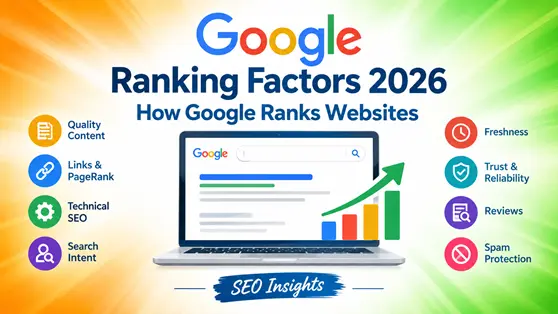
Google Ranking Factors 2026: How Google Ranks Websites
If you have ever wondered why one website appears on the first page of Google while another similar page sits much lower, you are asking one of the most important questions in SEO.
The simple answer is that Google does not use one single “ranking factor.”
Instead, Google Search uses many automated ranking systems, signals and processes to understand a search query, evaluate web pages and return results that it considers relevant and useful. Google says its systems examine many factors and signals across hundreds of billions of web pages and other content in its Search index.
That distinction matters.
SEO is not about finding one secret setting and changing it. It is about making a page easier for search engines to understand while making the page genuinely useful for the person who lands on it.
So, what are the Google ranking factors in 2026, and how does Google actually rank websites?
Let’s break it down in simple language.
What Are Google Ranking Factors?

The term Google ranking factors is commonly used by SEO professionals to describe the signals and characteristics that can influence where a webpage appears in Google Search.
However, Google generally describes its technology in terms of ranking systems and signals, rather than publishing a fixed checklist of ranking factors.
Google explains that its ranking systems work primarily at the page level. Site-wide signals and classifiers can also contribute to Google’s understanding of individual pages. Having strong signals across a website does not automatically mean every page will rank highly.
This is an important lesson for beginners.
Imagine you run a technology website with 500 articles. Twenty of those articles may be excellent and highly relevant to particular searches. That does not mean every other article on the website automatically receives the same ranking advantage.
Google evaluates the relevance and usefulness of individual pages.
How Does Google Rank Websites?
Think of Google Search as a huge matching system.
A person types a question such as:
“How do I improve my website speed?”
Google has to determine what that person means, find potentially relevant pages, understand those pages and then organize the results.
Several systems can contribute to that process.
Google says its ranking systems are designed to understand the meaning of queries and pages, assess relevance and usefulness, and continually improve through testing and evaluation.
For website owners, this means SEO has several connected parts:
- Understanding search intent
- Creating useful and original content
- Making pages technically accessible
- Demonstrating expertise and reliability where appropriate
- Building useful links and relationships between pages
- Keeping information current when freshness matters
- Avoiding spam and manipulative practices
- Making content easy for users to read and navigate
There is no single switch called “rank higher.”
-
Helpful, Original and Relevant Content
Content remains at the centre of successful SEO.
But simply publishing a long article is not enough.
Google has systems designed to help surface original content, including original reporting, ahead of pages that merely repeat or cite the original material.
This creates an important opportunity for smaller websites.
Suppose ten websites publish articles about the same Google update. Nine repeat the announcement and rearrange the same information.
The tenth website explains what changed, demonstrates the change with examples, explains who is affected and adds genuinely useful observations.
That tenth article gives readers a reason to visit.
What should you do?
Before publishing an article, ask:
- Does this answer the reader’s actual question?
- Does it provide information beyond the obvious?
- Are examples clear and useful?
- Are important claims supported by reliable sources?
- Is the information accurate?
- Have I removed unnecessary filler?
- Would a reader feel that the page solved their problem?
That is a much better starting point than asking how many times a keyword should appear.
-
Search Intent Matters
One of the most important Google SEO principles is understanding what the searcher wants.
Consider these searches:
“What is Google Search Console?”
This is primarily informational.
“Google Search Console login”
This has a navigational intent.
“Best SEO tools for small business”
This suggests investigation and comparison.
A page can contain the correct keywords and still fail to satisfy the search intent.
For example, someone searching “how to submit a sitemap to Google” probably wants instructions, not a 2,000-word history of XML sitemaps.
A simple search-intent test
Before writing, search your target keyword and examine the results.
Look for the common format:
- Guides
- Tutorials
- Product pages
- News
- Definitions
- Comparisons
- Videos
- Official documentation
Then create something that satisfies the same underlying need while providing your own useful value.
-
Google Understands Meaning, Not Just Exact Keywords
Modern Google Search does not depend only on exact keyword matching.
Google’s documentation describes systems such as BERT, neural matching and RankBrain, which help Google understand language, concepts and relationships between words.
For example, a page about “improving website loading speed” can be relevant to a search such as “make my website faster” even if the exact phrase does not appear repeatedly throughout the article.
This is why natural writing is important.
Instead of writing:
Website speed is an important website speed ranking factor because website speed affects website ranking.
Write naturally:
A fast website gives visitors a smoother experience and can also help your pages perform better in Search when page experience and other signals are considered.
The second version is written for humans rather than a keyword counter.
-
Page Experience and Technical SEO
A great article cannot perform properly if Google or users cannot access it reliably.
Technical SEO helps search engines crawl, understand and process your website.
Important areas include:
- Crawlability
- Indexability
- Mobile usability
- HTTPS
- Page performance
- Correct canonical URLs
- Internal linking
- Structured data where appropriate
- Clear page titles
- Descriptive URLs
- Proper handling of redirects
- Avoiding accidental noindex directives
Technical SEO does not mean adding hundreds of complicated settings.
For a beginner, the goal is simple:
Make your important pages accessible to search engines and usable for people.
Google provides Search Console specifically to help website owners monitor Search performance and understand indexing issues.
-
Links and PageRank Still Matter
There is a common misconception that PageRank is an outdated Google algorithm that no longer matters.
Google’s current documentation says otherwise.
Google describes link analysis systems and PageRank as part of its ranking technology and says PageRank continues to be part of its core ranking systems, although it has evolved substantially since Google’s early days.
Links can help Google understand how pages relate to each other.
For example, suppose an established technology publication links to a detailed technical guide. That link can provide useful context about the relationship between the two pages.
But this does not mean that buying thousands of links is a good SEO strategy.
Google also operates spam detection systems, including SpamBrain, to address spammy behaviour that violates its spam policies.
Focus on useful links
Good link-building starts with something worth linking to.
That could be:
- Original research
- An industry study
- A useful tutorial
- A unique data analysis
- An original tool
- A detailed resource
- Expert commentary
- An exceptionally useful reference guide
Think “Why would someone naturally want to reference this page?” rather than “How many backlinks can I get?”
-
Freshness Can Matter
Not every search requires the newest information.
If someone searches for a historical definition, an older authoritative page may still be perfectly useful.
But some searches clearly demand current information.
Google describes freshness systems that are designed to show newer content when a query deserves fresh information. For example, searches involving recent events can require information that reflects what happened recently.
This matters particularly for SEO and digital marketing websites.
An article about:
- Google’s current Search features
- SEO tools
- AI search
- advertising platforms
- software
- security
- algorithm changes
can become outdated much faster than an article explaining a stable concept.
A practical freshness strategy
Do not change an article simply to put a new date on it.
Instead:
- Check whether the information is still correct.
- Replace outdated instructions.
- Remove discontinued features.
- Add genuinely useful new information.
- Verify links.
- Update examples where necessary.
- Clearly indicate the current information when appropriate.
The goal is fresh information, not cosmetic freshness.
-
Originality Is More Than Rewriting
Changing the wording of another article does not automatically make a page valuable.
Imagine three articles covering the same Google announcement.
Article A repeats the announcement.
Article B rewrites the announcement in different words.
Article C explains the announcement, adds screenshots, gives practical examples and explains how website owners can respond.
Article C provides a stronger reason for a reader to visit.
Google’s ranking systems include mechanisms intended to surface original content prominently, including original reporting.
For bloggers, originality can come from:
- Your own examples
- Your own testing
- Original screenshots
- First-hand experience
- Unique explanations
- Comparative analysis
- Original research
- Clear interpretation of complicated documentation
You do not need to invent facts to be original.
You can make an article original by explaining verified information better.
-
Google Uses Passage Ranking
Sometimes the most useful part of a long article is only one section.
Google’s passage ranking system helps identify individual passages or sections of a webpage that may be particularly relevant to a search.
This is another reason to structure articles clearly.
Instead of writing one enormous block of text, use descriptive headings.
For example:
What Is PageRank?
Does PageRank Still Matter?
How Can Beginners Build Useful Links?
A well-structured article makes it easier for both readers and search systems to understand individual sections.
-
Reliable Information Matters
Google maintains multiple systems designed to help surface reliable information and reduce the visibility of lower-quality information.
This is especially important for topics where inaccurate information can cause real harm.
For SEO bloggers, the lesson is straightforward:
Do not publish a claim simply because another website says it.
Check the original source whenever possible.
For Google Search topics, Google’s own documentation and announcements should generally be among the first places to verify technical claims.
For example, Google’s ranking-systems documentation distinguishes between current systems and retired systems. The Helpful Content system is now listed as retired because it became part of Google’s core ranking systems in March 2024.
That is much more accurate than continuing to describe “Helpful Content” as a completely separate current ranking system.
-
Reviews Have Their Own Ranking System
If your website publishes product or service reviews, simply describing a product is not necessarily enough to create a useful review.
Google says its reviews system is designed to reward high-quality reviews containing insightful analysis and original research, particularly from people who demonstrate relevant knowledge or expertise.
A useful review might therefore include:
- What was tested
- How it was tested
- Real advantages and disadvantages
- Specific examples
- Comparisons
- Original observations
- Evidence supporting important conclusions
This approach is more useful to readers than rewriting a manufacturer’s product description.
-
Spam Signals Can Work Against Manipulative SEO
SEO becomes counterproductive when the primary objective changes from helping users to manipulating search results.
Google says it uses multiple spam detection systems, including SpamBrain, to identify content and behaviour that violate its spam policies. These systems are continually updated as spam techniques evolve.
Common mistakes include:
- Keyword stuffing
- Manipulative links
- Automatically generated pages created mainly for Search traffic
- Cloaking
- Misleading redirects
- Scaled low-value content
- Other tactics designed primarily to manipulate rankings
The safest long-term approach is to understand Google’s Search Essentials and create content that provides genuine value.
-
Site Reputation and Third-Party Content
Website owners should also pay attention to where content comes from.
Google introduced its site reputation policy to address situations where third-party content is published on an established website primarily to exploit the site’s existing reputation and ranking signals. Google updated the policy in August 2026 and clarified how enforcement applies in the European Economic Area.
For publishers, this reinforces an important principle:
Do not treat your website’s existing authority as a shortcut for unrelated, low-value content.
If you allow guest posts or third-party material, maintain editorial standards and make sure the content genuinely belongs on your site.
-
Don’t Obsess Over a Fixed List of Ranking Factors
One of the biggest SEO mistakes is searching for a definitive list such as:
“These are Google’s 200 ranking factors.”
Google does not publish such a simple master checklist.
Its own ranking-systems guide explains that multiple systems use many signals, and that the systems are regularly improved.
That means SEO should be approached as a process rather than a checklist.
Instead of asking:
“What single ranking factor am I missing?”
Ask:
“Does my page provide the best useful answer for this search, and can Google access and understand it?”
That question leads to much better SEO decisions.
-
What About AI-Generated Content?
AI can help with research, brainstorming, editing and many other parts of content creation.
But using AI does not remove the need for accuracy, originality and usefulness.
Google’s ranking documentation says its former Helpful Content system was designed to favour original, helpful content created for people rather than content created primarily to attract Search traffic. That system later became part of Google’s core ranking systems.
So the important question is not simply:
“Was AI used?”
A better question is:
“Is the finished content useful, accurate, original and created to serve the reader?”
If AI is used as part of your workflow, human review remains important, especially for facts, technical instructions, dates and claims about Google products.
-
A Simple Google SEO Checklist for Beginners
Before publishing a page, work through this checklist.
Content
- Does the page satisfy the search intent?
- Does it answer the main question early?
- Is the information accurate?
- Does it provide something genuinely useful?
- Have unnecessary sections been removed?
- Does it offer original examples or insights where appropriate?
On-page SEO
- Is the title clear and descriptive?
- Does the H1 accurately describe the page?
- Is the primary keyword used naturally?
- Are related terms included where they make sense?
- Are headings descriptive?
- Is the URL short and meaningful?
- Is the meta description useful and compelling?
Technical SEO
- Can Google crawl the page?
- Can the page be indexed?
- Is the canonical URL correct?
- Does the page work well on mobile?
- Are important internal links present?
- Are images appropriately optimized?
- Is HTTPS working correctly?
Trust and quality
- Are important claims supported?
- Are sources reliable?
- Is the author or publisher information appropriate for the topic?
- Have outdated claims been removed?
- Is the content free from obvious manipulation?
After publication
Do not immediately judge a page by its ranking position.
Use Google Search Console to monitor impressions, clicks, queries and other Search performance data. Search performance can change over time as Google’s systems, competitors, user behaviour and the web itself change. Google also continues to make improvements to its ranking systems.
Key Takeaways
- Google ranking factors are not a fixed checklist. Google uses multiple ranking systems and many signals to evaluate pages.
- Relevance and usefulness are fundamental. A page should satisfy the searcher’s actual intent rather than simply contain keywords.
- Original content matters. Add information, examples, research or experience that gives readers a reason to choose your page.
- Links and PageRank still matter. Google says PageRank remains part of its core ranking systems, although it has evolved considerably.
- Freshness matters for some searches. Current topics require current information, while evergreen topics may remain useful for years.
- Technical SEO supports discoverability. Crawling, indexing, mobile usability, performance and correct page signals all matter.
- Avoid manipulative SEO. Google operates spam detection systems designed to address behaviour that violates its spam policies.
Frequently Asked Questions
-
What are Google’s most important ranking factors in 2026?
There is no official fixed list of the “most important” Google ranking factors. Google uses multiple ranking systems and signals to determine which pages are relevant and useful for particular searches. Content relevance, quality, links, freshness when appropriate, language understanding and spam detection are among the areas covered in Google’s documentation.
-
Does Google use PageRank in 2026?
Yes. Google’s current ranking-systems documentation says PageRank continues to be part of its core ranking systems, although the technology has evolved significantly since its original implementation.
-
Is the Helpful Content system still a separate Google ranking system?
No. Google lists the Helpful Content system as retired because it evolved and became part of Google’s core ranking systems in March 2024.
-
Does using keywords improve Google rankings?
Using words that accurately describe the subject of a page can help search engines and users understand the content. However, repeating keywords excessively is not a sound SEO strategy. Google’s systems are designed to understand concepts, meaning and relevance rather than rely solely on exact keyword matching.
-
How can beginners improve their Google rankings?
Start with the basics: understand search intent, create accurate and useful content, make pages accessible to search engines, improve internal linking, earn useful links naturally, maintain important information and monitor performance in Google Search Console. Avoid tactics designed primarily to manipulate rankings.
Conclusion
Understanding Google ranking factors becomes much easier when you stop looking for a secret formula.
Google Search is built from multiple systems that work together. Some help understand language and search intent. Others analyse links, freshness, originality, passages, reviews, reliability and spam. Google says these systems are continually improved through testing and evaluation.
For an SEO beginner, the practical lesson is simple.
Start with the person searching.
Understand what they want. Create a page that answers the question clearly. Add original value. Make the page technically accessible. Support important claims with reliable information. Keep content current when freshness matters. Build useful relationships between your pages and earn links because your content deserves to be referenced.
There is no guaranteed ranking formula.
But a website built around useful content, sound technical SEO, relevance, originality and a good user experience is much better positioned to compete in modern Google Search than one built around keyword stuffing or shortcuts.
And that is the most useful way to think about Google ranking factors in 2026: not as a list of tricks to manipulate Search, but as a framework for creating pages that genuinely deserve to be found.
Nice, useful and exclusive article on Google Ranking Factors.